
Country exposure · NP

Nepal
South Asia · Kathmandu · federal parliamentary republic
What Nepal means for your money, the prices you pay, the tariffs in motion, and where U.S. policy could change both.
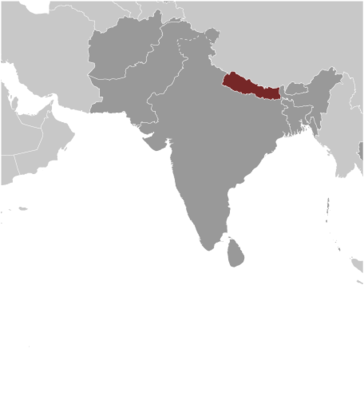
$124M
U.S. imports, 2025
+2.8%
change in one year
$112M
U.S. exports, 2025
31M
Population
$42.9B
GDP
In your house
What you buy that Nepal makes
America bought $124M in goods from Nepal in 2025. Of every $100 of it, here's where the money went.
Rugs
rugs
Feedstuff and foodgrains
Apparel, household goods - wool
wool sweaters and coats
Apparel, textiles, nonwool or cotton
synthetic and performance apparel
Apparel, household goods - cotton
cotton clothing and linens
Cell phones and other household goods, n.e.c.
cell phones and home electronics
Minimum value shipments
Artwork, antiques, stamps, etc.
Finished textile supplies
Tobacco, waxes, etc.
2026 so far (through July): $75M in imports. Source: U.S. Census Bureau, International Trade in Goods (customs basis).
The other direction
What America sells to Nepal
$112M in 2025, a trade rupture cuts both ways, for American producers as well as American prices.
Soybeans
$50Mmeat at the counter
Minimum value shipments
$10MCivilian aircraft, engines, equipment, and parts
$7MComputers
$7Mlaptops, desktops, monitors
Chemicals-other
$7MAnimal feeds, n.e.c.
$4MMedicinal equipment
$3Mmedical devices and equipment
Manmade cloth
$3MToiletries and cosmetics
$2Mtoiletries and cosmetics
Where you stand
U.S. tariff posture toward Nepal
No U.S. tariff action singles this country out. Its goods face the universal 10% temporary import surcharge under Section 122 of the Trade Act (which replaced the IEEPA reciprocal baseline in February 2026) plus the sectoral Section 232 duties — steel and aluminum at 50% — that apply to all countries. The Section 122 surcharge is statutorily temporary — scheduled to lapse on or about July 23, 2026 (a 150-day cap) unless extended or replaced.
Reciprocal tariff (universal baseline)
10%
The universal 10% floor, a Section 122 import surcharge since February 2026, previously the EO 14257 reciprocal baseline, applies to nearly all U.S. imports. This country has no higher assigned rate of its own.
Policy in motion
Tariff status: a moving target
No U.S. tariff action names Nepal. These are the universal measures, applied to every country without a country-specific arrangement, that set its treatment.
2026-04-06
Section 232 metals coverage expanded
In effectThe April 2026 proclamation strengthening Section 232 actions on aluminum, steel, and copper expanded derivative-product coverage for all countries, keeping the general metals rate at 50%.
91 FR 18201 →2026-02-24
IEEPA reciprocal tariffs terminated — replaced by 10% Section 122 surcharge
In effectExecutive Order 14389 (Ending Certain Tariff Actions) terminated the IEEPA tariff duties — including the EO 14257 reciprocal baseline — effective February 24, 2026. A flat 10% Section 122 temporary import surcharge (Proclamation 11012 of February 20, 2026) replaced them, leaving the universal rate unchanged at 10% on a different statutory basis. Section 122 caps such surcharges at 150 days, so this 10% surcharge is scheduled to lapse on or about July 23, 2026 absent further action (the administration has signaled it could raise the rate toward the 15% statutory maximum).
91 FR 9437 →2025-11-13
Agricultural products exempted from reciprocal tariffs
In effectExecutive Order 14360 of November 14, 2025 removed reciprocal duties from certain agricultural products listed in its annexes (coffee, cocoa, bananas, and other goods the U.S. does not produce in sufficient quantity), retroactive to November 13, 2025 — for all countries subject to the reciprocal tariff.
90 FR 54091 →2025-06-04
Section 232 steel and aluminum duties doubled to 50%
In effectThe June 3, 2025 proclamation raised Section 232 duties on steel and aluminum articles and derivatives from 25% to 50% for all countries, effective June 4, 2025.
90 FR 24199 →2025-04-05
Universal 10% reciprocal baseline takes effect
In effectExecutive Order 14257 (signed April 2, 2025) imposed a 10% ad valorem reciprocal duty on imports from all trading partners, effective April 5, 2025. Countries without a higher Annex I rate remain at this baseline.
Federal Register · 2025-06063 →2025-03-12
Section 232 steel and aluminum duties set at 25% for all countries
In effectProclamations of February 10, 2025 terminated all country exemptions and quota arrangements and applied 25% Section 232 duties to steel and aluminum imports from every country, effective March 12, 2025.
90 FR 9817 →
Made for America
What Nepal makes for America
Nepal is a direct U.S. source of 3 essential goods Americans rely on, the items themselves, shipped finished off the line.
Reference
The country itself
South Asia · Geography, people, economy, and government, public-domain data from the CIA World Factbook.
During the late 18th and early 19th centuries, the principality of Gorkha united many of the other principalities and states of the sub-Himalayan region into a Nepali Kingdom. Nepal retained its independence after the Anglo-Nepalese War of 1814-16, and the subsequent peace treaty laid the foundations for two centuries of amicable relations between Britain and Nepal. In 1951, the Nepali monarch ended the century-old system of hereditary rule and instituted a cabinet system that brought political parties into the government. That arrangement lasted until 1960, when political parties were again banned, but it was reinstated in 1990 with the establishment of a multiparty democracy within the framework of a constitutional monarchy. A Maoist-led insurgency broke out in 1996. During the ensuing 10-year civil war between Maoist and government forces, the monarchy dissolved the cabinet and parliament. In 2001, Crown Prince DIPENDRA first massacred the royal family and then shot himself. His uncle GYANENDRA became king, and the monarchy reassumed absolute power the next year. A peace accord in 2006 led to the promulgation of an interim constitution in 2007. After a nationwide Constituent Assembly (CA) election in 2008, the newly formed CA declared Nepal a federal democratic republic, abolished the monarchy, and elected the country's first president. When the CA failed to draft a Supreme Court-mandated constitution, then-Prime Minister Baburam BHATTARAI dissolved the CA. An interim government held elections in 2013, in which the Nepali Congress (NC) won the largest share of seats. In 2014, NC formed a coalition government with the second-place Communist Party of Nepal-Unified Marxist-Leninist (UML). Nepal's new constitution came into effect in 2015, at which point the CA became the Parliament and Khagda Prasad Sharma OLI the first post-constitution prime minister (2015-16). He resigned ahead of a no-confidence motion, and Parliament elected Communist Party of Nepal-Maoist (CPN-M) leader Pushpa Kamal DAHAL as prime minister. The parties headed by OLI and DAHAL ran in coalition and swept the parliamentary elections in 2017, and OLI was sworn in as prime minister in 2018. OLI's efforts to dissolve parliament and hold elections were declared unconstitutional in 2021, and the opposition-supported NC leader Sher Bahadur DEUBA was named prime minister. The NC won a majority of seats in the parliamentary elections in 2022, but DAHAL then broke with the ruling coalition and partnered with OLI and the CPN-UML to become prime minister. DAHAL's first cabinet lasted about two months, until OLI withdrew his support over disagreements about ministerial assignments. In early 2023, DAHAL survived a vote of confidence and formed a coalition with the NC to remain prime minister.
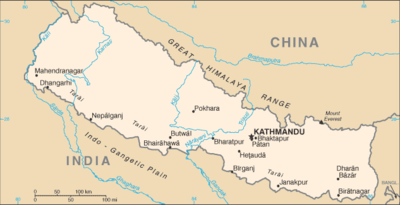
Geography
- Location
- Southern Asia, between China and India
- Area
- 147,181 sq km
- Climate
- varies from cool summers and severe winters in north to subtropical summers and mild winters in south
- Terrain
- Tarai or flat river plain of the Ganges in south; central hill region with rugged Himalayas in north
- Natural resources
- quartz, water, timber, hydropower, scenic beauty, small deposits of lignite, copper, cobalt, iron ore
- Coastline
- 0 km (landlocked)
- Natural hazards
- severe thunderstorms; flooding; landslides; drought and famine depending on the timing, intensity, and duration of the summer monsoons
People & society
- Population
- 31,334,402 (2025 est.)
- Nationality
- Nepali (singular and plural)
- Ethnic groups
- Chhettri 16.5%, Brahman-Hill 11.3%, Magar 6.9%, Tharu 6.2%, Tamang 5.6%, Bishwokarma 5%, Musalman 4.9%, Newar 4.6%, Yadav 4.2%, Rai 2.2%, Pariyar 1.9%, Gurung 1.9%, Thakuri 1.7%, Mijar 1.6%, Teli 1.5%, Yakthung/Limbu 1.4%, Chamar/Harijan/Ram 1.4%, Koiri/Kushwaha 1.2%, other 20% (2021 est.)
- Languages
- Nepali (official) 44.9%, Maithali 11.1%, Bhojpuri 6.2%, Tharu 5.9%, Tamang 4.9%, Bajjika 3.9%, Avadhi 3%, Nepalbhasha (Newari) 3%, Magar Dhut 2.8%, Doteli 1.7%, Urdu 1.4%, Yakthung/Limbu 1.2%, Gurung 1.1%, other 8.9% (2021 est.)
- Religions
- Hindu 81.2%, Buddhist 8.2%, Muslim 5.1%, Kirat 3.2%, Christian 1.8%; less than 1%: Prakriti, Bon, Jains, Sikh (2021 est.)
- Median age
- 28.1 years (2025 est.)
- Life expectancy at birth
- 73 years (2024 est.)
- Literacy
- 68.7% (2019 est.)
Economy
- Economic overview
- low-income South Asian economy; post-conflict fiscal federalism increasing stability; COVID-19 hurt trade and tourism; widening current account deficits; environmentally fragile economy from earthquakes; growing Chinese relations and investments
- Industries
- tourism, carpets, textiles, small rice, jute, sugar, oilseed mills, cigarettes, cement and brick production
- Agricultural products
- rice, vegetables, potatoes, sugarcane, maize, wheat, bison milk, milk, mangoes/guavas, bananas (2023)
- Exports - partners
- India 67%, USA 12%, Germany 3%, China 2%, UK 2% (2023)
- Imports - partners
- India 71%, China 17%, UAE 3%, Singapore 2%, Germany 1% (2023)
Government
- Government type
- federal parliamentary republic
- Capital
- Kathmandu
- Independence
- 1768 (unified by Prithvi Narayan SHAH)
- Constitution
- several previous; latest approved by the Second Constituent Assembly 16 September 2015, signed by the president and effective 20 September 2015
- Executive branch
- President Ram Chandra POUDEL (since 13 March 2023)
- Legislative branch
- Federal Parliament (Sanghiya Sansad)
Full reference data
Every field, by section, CIA World Factbook. Open a topic to expand it.
Introduction
Travel Facts
Please visit the following links to find further information about your desired destination.
CDC - To learn what vaccines and health precautions to take while visiting your destination.
US State Dept Travel Information - Overall information about foreign travel for US citizens.
To obtain an international driving permit (IDP). Only two organizations in the US issue IDPs: American Automobile Association (AAA) and American Automobile Touring Alliance (AATA)
How to get help in an emergency? Contact the nearest US embassy or consulate, or call one of these numbers: from the US or Canada - 1-888-407-4747 or from Overseas - +1 202-501-4444
Page last updated: Thursday, December 19, 2024