
Country exposure · SZ
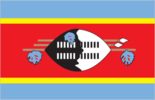
Eswatini
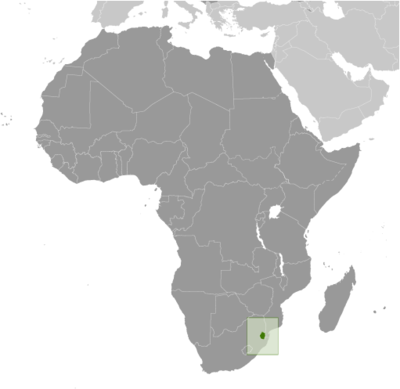
Africa · Mbabane (administrative capital); Lobamba (royal and legislative capital) · absolute monarchy
What Eswatini means for your money, the prices you pay, the tariffs in motion, and where U.S. policy could change both.
$25M
U.S. imports, 2025
+11.8%
change in one year
$44M
U.S. exports, 2025
1M
Population
$4.9B
GDP
In your house
What you buy that Eswatini makes
America bought $25M in goods from Eswatini in 2025. Of every $100 of it, here's where the money went.
Cane and beet sugar
cane and beet sugar
Fruits, frozen juices
fruit and frozen juices
Apparel, textiles, nonwool or cotton
synthetic and performance apparel
Apparel, household goods - cotton
cotton clothing and linens
Bakery products
Cell phones and other household goods, n.e.c.
cell phones and home electronics
Measuring, testing, control instruments
Metalworking machine tools
Industrial machines, other
Minimum value shipments
2026 so far (through May): $7M in imports. Source: U.S. Census Bureau, International Trade in Goods (customs basis).
The other direction
What America sells to Eswatini
$44M in 2025, a trade rupture cuts both ways, for American producers as well as American prices.
Agriculture-manufactured, other
$10MNewsprint
$6MCivilian aircraft, engines, equipment, and parts
$4MElectric apparatus
$4MArtwork, antiques, stamps, etc.
$3MIndustrial engines
$3MNuts
$3MChemicals-organic
$3MOther foods
$2MWhere you stand
U.S. tariff posture toward Eswatini
No U.S. tariff action singles this country out. Its goods face the universal 10% temporary import surcharge under Section 122 of the Trade Act (which replaced the IEEPA reciprocal baseline in February 2026) plus the sectoral Section 232 duties — steel and aluminum at 50% — that apply to all countries. The Section 122 surcharge is statutorily temporary — scheduled to lapse on or about July 23, 2026 (a 150-day cap) unless extended or replaced.
Reciprocal tariff (universal baseline)
10%
The universal 10% floor, a Section 122 import surcharge since February 2026, previously the EO 14257 reciprocal baseline, applies to nearly all U.S. imports. This country has no higher assigned rate of its own.
Policy in motion
Tariff status: a moving target
No U.S. tariff action names Eswatini. These are the universal measures, applied to every country without a country-specific arrangement, that set its treatment.
2026-04-06
Section 232 metals coverage expanded
In effectThe April 2026 proclamation strengthening Section 232 actions on aluminum, steel, and copper expanded derivative-product coverage for all countries, keeping the general metals rate at 50%.
91 FR 18201 →2026-02-24
IEEPA reciprocal tariffs terminated — replaced by 10% Section 122 surcharge
In effectExecutive Order 14389 (Ending Certain Tariff Actions) terminated the IEEPA tariff duties — including the EO 14257 reciprocal baseline — effective February 24, 2026. A flat 10% Section 122 temporary import surcharge (Proclamation 11012 of February 20, 2026) replaced them, leaving the universal rate unchanged at 10% on a different statutory basis. Section 122 caps such surcharges at 150 days, so this 10% surcharge is scheduled to lapse on or about July 23, 2026 absent further action (the administration has signaled it could raise the rate toward the 15% statutory maximum).
91 FR 9437 →2025-11-13
Agricultural products exempted from reciprocal tariffs
In effectExecutive Order 14360 of November 14, 2025 removed reciprocal duties from certain agricultural products listed in its annexes (coffee, cocoa, bananas, and other goods the U.S. does not produce in sufficient quantity), retroactive to November 13, 2025 — for all countries subject to the reciprocal tariff.
90 FR 54091 →2025-06-04
Section 232 steel and aluminum duties doubled to 50%
In effectThe June 3, 2025 proclamation raised Section 232 duties on steel and aluminum articles and derivatives from 25% to 50% for all countries, effective June 4, 2025.
90 FR 24199 →2025-04-05
Universal 10% reciprocal baseline takes effect
In effectExecutive Order 14257 (signed April 2, 2025) imposed a 10% ad valorem reciprocal duty on imports from all trading partners, effective April 5, 2025. Countries without a higher Annex I rate remain at this baseline.
Federal Register · 2025-06063 →2025-03-12
Section 232 steel and aluminum duties set at 25% for all countries
In effectProclamations of February 10, 2025 terminated all country exemptions and quota arrangements and applied 25% Section 232 duties to steel and aluminum imports from every country, effective March 12, 2025.
90 FR 9817 →
Made for America
What Eswatini makes for America
Eswatini is a direct U.S. source of 1 essential good Americans rely on, the items themselves, shipped finished off the line.
Reference
The country itself
Africa · Geography, people, economy, and government, public-domain data from the CIA World Factbook.
A Swazi kingdom was founded in the mid-18th century and ruled by a series of kings, including MSWATI II, a 19th century ruler whose name was adopted for the country and its predominant ethnic group. European countries defined the kingdom’s modern borders during the late-19th century, and Swaziland (as it became known) was administered as a UK high commission territory from 1903 until its independence in 1968. A new constitution that came into effect in 2005 included provisions for a more independent parliament and judiciary, but the legal status of political parties remains unclear, and the kingdom is still considered an absolute monarchy. King MSWATI III renamed the country from Swaziland to Eswatini in 2018 to reflect the name most commonly used by its citizens. In 2021, MSWATI III used security forces to suppress prodemocracy protests. A national dialogue and reconciliation process agreed to in the wake of violence has not materialized. In November 2023, King MSWATI III appointed a new prime minister following peaceful national elections. Despite its classification as a lower-middle income country, Eswatini suffers from severe poverty, corruption, and high unemployment. Eswatini has the world's highest HIV/AIDS prevalence rate, although recent years have shown marked declines in new infections. Eswatini is the only country in Africa that recognizes Taiwan.
Geography
- Location
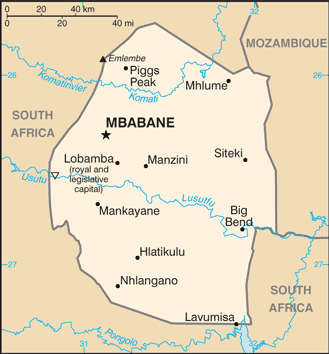
- Southern Africa, between Mozambique and South Africa
- Area
- 17,364 sq km
- Climate
- varies from tropical to near temperate
- Terrain
- mostly mountains and hills; some moderately sloping plains
- Natural resources
- asbestos, coal, clay, cassiterite, hydropower, forests, small gold and diamond deposits, quarry stone, and talc
- Coastline
- 0 km (landlocked)
- Natural hazards
- drought
People & society
- Population
- 1,137,268 (2025 est.)
- Nationality
- liSwati (singular), emaSwati (plural); note - former term, Swazi(s), still used among English speakers
- Ethnic groups
- predominantly Swazi; smaller populations of other African ethnic groups, including the Zulu, as well as people of European ancestry
- Languages
- English (official, used for government business), siSwati (official)
- Religions
- Christian 90% (Zionist - a blend of Christianity and traditional African religions - 40%, Roman Catholic 20%, other Christian 30% - includes Anglican, Methodist, Church of Jesus Christ, Jehovah's Witness), Muslim 2%, other 8% (includes Baha'i, Buddhist, Hindu, indigenous, Jewish) (2015 est.)
- Median age
- 24.8 years (2025 est.)
- Life expectancy at birth
- 60.7 years (2024 est.)
- Literacy
- 90.8% (2022 est.)
Economy
- Economic overview
- landlocked southern African economy; South African trade dependent and currency pegging; CMA and SACU member state; COVID-19 economic slowdown; growing utilities inflation; persistent poverty and unemployment; HIV/AIDS labor force disruptions
- Industries
- soft drink concentrates, coal, forestry, sugar processing, textiles, and apparel
- Agricultural products
- sugarcane, maize, root vegetables, grapefruits, oranges, milk, pineapples, bananas, beef, sweet potatoes (2023)
- Exports - partners
- South Africa 61%, Ireland 4%, Mozambique 4%, Kenya 4%, Nigeria 3% (2023)
- Imports - partners
- South Africa 71%, China 8%, India 4%, USA 2%, Mozambique 1% (2023)
Government
- Government type
- absolute monarchy
- Capital
- Mbabane (administrative capital); Lobamba (royal and legislative capital)
- Independence
- 6 September 1968 (from the UK)
- Constitution
- previous 1968, 1978; latest signed by the king 26 July 2005, effective 8 February 2006
- Executive branch
- King MSWATI III (since 25 April 1986)
- Legislative branch
- Parliament (Libandla)
Full reference data
Every field, by section, CIA World Factbook. Open a topic to expand it.
Introduction
Travel Facts
Please visit the following links to find further information about your desired destination.
World Health Organization (WHO) - To learn what vaccines and health precautions to take while visiting your destination.
US State Dept Travel Information - Overall information about foreign travel for US citizens.
To obtain an international driving permit (IDP). Only two organizations in the US issue IDPs: American Automobile Association (AAA) and American Automobile Touring Alliance (AATA)
How to get help in an emergency? Contact the nearest US embassy or consulate, or call one of these numbers: from the US or Canada - 1-888-407-4747 or from Overseas - +1 202-501-4444
Page last updated: Wednesday, July 20, 2022