
The home market · US
United States
North America · Washington, D.C. · constitutional federal republic
The home market. Every country profile on PolicyRisk measures its trade, tariffs, and supply chains against the United States, the prices American households actually pay. This is the country itself.
338M
Population
$29.2T
GDP (2024)
10M km²
Area
Made at home
What America makes
The supply map links the United States to 24 essential American goods through 12 domestic inputs, what the country produces, refines, or grows on its own soil.
energy
100%Water for Injection (WFI)
manufactured
100%Emergency Alert System ENDEC hardware
chemical
100%Phosphogypsum Disposal / Stacking
energy
100%Interstate natural gas transmission pipelines
manufactured
100%Strategic National Stockpile PPE reserves
pharmaceutical
100%Repository Corticotropin Injection (Acthar Gel / Porcine ACTH)
Reference
The country itself
North America · Geography, people, economy, and government, public-domain data from the CIA World Factbook.
Thirteen of Britain's American colonies broke with the mother country in 1776 and were recognized as the new nation of the United States of America following the Treaty of Paris in 1783. During the 19th and 20th centuries, 37 new states were added as the nation expanded across the North American continent and acquired a number of overseas possessions. Two of the most traumatic experiences in the nation's history were the Civil War (1861-65), in which a northern Union of states defeated a secessionist Confederacy of 11 southern slave states, and the Great Depression of the 1930s, an economic downturn during which about a quarter of the labor force lost its jobs. Buoyed by victories in World Wars I and II and the end of the Cold War in 1991, the US remains the world's most powerful nation state. Since the end of World War II, the economy has achieved relatively steady growth, low unemployment, and rapid advances in technology.
Geography
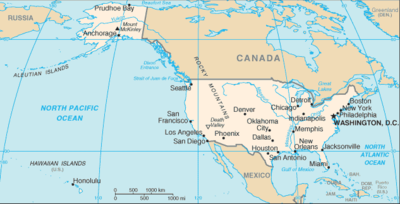
- Location
- North America, bordering both the North Atlantic Ocean and the North Pacific Ocean, between Canada and Mexico
- Area
- 9,833,517 sq km
- Climate
- mostly temperate, but tropical in Hawaii and Florida, arctic in Alaska, semiarid in the great plains west of the Mississippi River, and arid in the Great Basin of the southwest; low winter temperatures in the northwest are ameliorated occasionally in January and February by warm chinook winds from the eastern slopes of the Rocky Mountains
- Terrain
- vast central plain, mountains in west, hills and low mountains in east; rugged mountains and broad river valleys in Alaska; rugged, volcanic topography in Hawaii
- Natural resources
- coal, copper, lead, molybdenum, phosphates, rare earth elements, uranium, bauxite, gold, iron, mercury, nickel, potash, silver, tungsten, zinc, petroleum, natural gas, timber, arable land
- Coastline
- 19,924 km
- Natural hazards
- tsunamis; volcanoes; earthquake activity around Pacific Basin; hurricanes along the Atlantic and Gulf of America coasts; tornadoes in the Midwest and Southeast; mud slides in California; forest fires in the west; flooding; permafrost in northern Alaska is a major impediment to development volcanism: volcanic activity in the Hawaiian Islands, Western Alaska, the Pacific Northwest, and in the Northern Mariana Islands; Mauna Loa (4,170 m) in Hawaii and Mount Rainier (4,392 m) in Washington have been deemed Decade Volcanoes by the International Association of Volcanology and Chemistry of the Earth's Interior, worthy of study due to their explosive history and close proximity to human populations; Pavlof (2,519 m) is the most active volcano in Alaska's Aleutian Arc and poses a significant threat to intercontinental air travel; St. Helens (2,549 m), famous for the devastating 1980 eruption, remains active today; other historically active volcanoes are mostly concentrated in the Aleutian arc and Hawaii, including (in Alaska) Aniakchak, Augustine, Chiginagak, Fourpeaked, Iliamna, Katmai, Kupreanof, Martin, Novarupta, Redoubt, Spurr, Wrangell, Trident, Ugashik-Peulik, Ukinrek Maars, Veniaminof, (in Hawaii) Haleakala, Kilauea, Loihi, (in the Northern Mariana Islands) Anatahan, (in the Pacific Northwest) Mount Baker, and Mount Hood; see note 2 under "Geography - note"
People & society
- Population
- 338,016,259 (2025 est.)
- Nationality
- American(s)
- Ethnic groups
- White 61.6%, Black or African American 12.4%, Asian 6%, Indigenous and Alaska native 1.1%, Native Hawaiian and Other Pacific Islander 0.2%, other 8.4%, two or more races 10.2% (2020 est.)
- Languages
- English only (official) 78.2%, Spanish 13.4%, Chinese 1.1%, other 7.3% (2017 est.)
- Religions
- Protestant 46.5%, Roman Catholic 20.8%, Jewish 1.9%, Church of Jesus Christ 1.6%, other Christian 0.9%, Muslim 0.9%, Jehovah's Witness 0.8%, Buddhist 0.7%, Hindu 0.7%, other 1.8%, unaffiliated 22.8%, don't know/refused 0.6% (2014 est.)
- Median age
- 39.5 years (2025 est.)
- Life expectancy at birth
- 80.9 years (2024 est.)
Economy
- Economic overview
- world’s largest economy by nominal GDP; largest importer and second-largest exporter; home to leading financial exchanges and global reserve currency; high and growing public debt; inflation moderating but remains above pre-pandemic levels
- Industries
- highly diversified, world leading, high-technology innovator, second-largest industrial output in the world; petroleum, steel, motor vehicles, aerospace, telecommunications, chemicals, electronics, food processing, consumer goods, lumber, mining
- Agricultural products
- maize, soybeans, milk, wheat, sugar beets, sugarcane, potatoes, chicken, pork, tomatoes (2023)
- Exports - partners
- Canada 14%, Mexico 13%, China 8%, Germany 5%, Japan 4% (2023)
- Imports - partners
- Mexico 15%, China 15%, Canada 14%, Germany 5%, Japan 5% (2023)
Government
- Government type
- constitutional federal republic
- Capital
- Washington, D.C.
- Independence
- 4 July 1776 (declared independence from Great Britain); 3 September 1783 (recognized by Great Britain)
- Constitution
- previous 1781 (Articles of Confederation and Perpetual Union); latest drafted July - September 1787, submitted to the Congress of the Confederation 20 September 1787, submitted for states' ratification 28 September 1787, ratification completed by nine of the 13 states 21 June 1788, effective 4 March 1789
- Executive branch
- President Donald J. TRUMP (since 20 January 2025)
- Legislative branch
- Congress
Full reference data
Every field, by section, CIA World Factbook. Open a topic to expand it.
Introduction
Travel Facts
Please visit the following links to find further information about your desired destination.
CDC - To learn what vaccines and health precautions to take while visiting your destination.
US State Dept Travel Information - Overall information about foreign travel for US citizens.
To obtain an international driving permit (IDP). Only two organizations in the US issue IDPs: American Automobile Association (AAA) and American Automobile Touring Alliance (AATA)
How to get help in an emergency? Contact the nearest US embassy or consulate, or call one of these numbers: from the US or Canada - 1-888-407-4747 or from Overseas - +1 202-501-4444
Page last updated: Wednesday, June 26, 2024