
Country exposure · UY
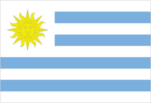
Uruguay
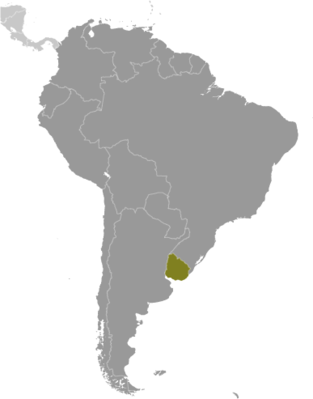
South America · Montevideo · presidential republic
What Uruguay means for your money, the prices you pay, the tariffs in motion, and where U.S. policy could change both.
$1.6B
U.S. imports, 2025
+28.7%
change in one year
$2.0B
U.S. exports, 2025
3M
Population
$81.0B
GDP
In your house
What you buy that Uruguay makes
America bought $1.6B in goods from Uruguay in 2025, up 28.7% in a single year. Of every $100 of it, here's where the money went.
Meat products
meat at the counter
Pulpwood and woodpulp
Other foods
Tobacco, waxes, etc.
Lumber
lumber for homebuilding
U.s. goods returned, and reimports
Cell phones and other household goods, n.e.c.
cell phones and home electronics
Fruits, frozen juices
fruit and frozen juices
Plywood and veneers
Fish and shellfish
fish, shrimp, shellfish
2026 so far (through July): $977M in imports. Source: U.S. Census Bureau, International Trade in Goods (customs basis).
The other direction
What America sells to Uruguay
$2.0B in 2025, a trade rupture cuts both ways, for American producers as well as American prices.
Crude oil
$435MPharmaceutical preparations
$203Mmedicines and pharmacy items
Cell phones and other household goods, n.e.c.
$136Mcell phones and home electronics
Toiletries and cosmetics
$119Mtoiletries and cosmetics
Minimum value shipments
$76MChemicals-inorganic
$67MComputers
$62Mlaptops, desktops, monitors
Chemicals-fertilizers
$61MPlastic materials
$55Mplastics for packaging and goods
Where you stand
U.S. tariff posture toward Uruguay
No U.S. tariff action singles this country out. Its goods face the universal 10% temporary import surcharge under Section 122 of the Trade Act (which replaced the IEEPA reciprocal baseline in February 2026) plus the sectoral Section 232 duties — steel and aluminum at 50% — that apply to all countries. The Section 122 surcharge is statutorily temporary — scheduled to lapse on or about July 23, 2026 (a 150-day cap) unless extended or replaced.
Reciprocal tariff (universal baseline)
10%
The universal 10% floor, a Section 122 import surcharge since February 2026, previously the EO 14257 reciprocal baseline, applies to nearly all U.S. imports. This country has no higher assigned rate of its own.
Policy in motion
Tariff status: a moving target
No U.S. tariff action names Uruguay. These are the universal measures, applied to every country without a country-specific arrangement, that set its treatment.
2026-04-06
Section 232 metals coverage expanded
In effectThe April 2026 proclamation strengthening Section 232 actions on aluminum, steel, and copper expanded derivative-product coverage for all countries, keeping the general metals rate at 50%.
91 FR 18201 →2026-02-24
IEEPA reciprocal tariffs terminated — replaced by 10% Section 122 surcharge
In effectExecutive Order 14389 (Ending Certain Tariff Actions) terminated the IEEPA tariff duties — including the EO 14257 reciprocal baseline — effective February 24, 2026. A flat 10% Section 122 temporary import surcharge (Proclamation 11012 of February 20, 2026) replaced them, leaving the universal rate unchanged at 10% on a different statutory basis. Section 122 caps such surcharges at 150 days, so this 10% surcharge is scheduled to lapse on or about July 23, 2026 absent further action (the administration has signaled it could raise the rate toward the 15% statutory maximum).
91 FR 9437 →2025-11-13
Agricultural products exempted from reciprocal tariffs
In effectExecutive Order 14360 of November 14, 2025 removed reciprocal duties from certain agricultural products listed in its annexes (coffee, cocoa, bananas, and other goods the U.S. does not produce in sufficient quantity), retroactive to November 13, 2025 — for all countries subject to the reciprocal tariff.
90 FR 54091 →2025-06-04
Section 232 steel and aluminum duties doubled to 50%
In effectThe June 3, 2025 proclamation raised Section 232 duties on steel and aluminum articles and derivatives from 25% to 50% for all countries, effective June 4, 2025.
90 FR 24199 →2025-04-05
Universal 10% reciprocal baseline takes effect
In effectExecutive Order 14257 (signed April 2, 2025) imposed a 10% ad valorem reciprocal duty on imports from all trading partners, effective April 5, 2025. Countries without a higher Annex I rate remain at this baseline.
Federal Register · 2025-06063 →2025-03-12
Section 232 steel and aluminum duties set at 25% for all countries
In effectProclamations of February 10, 2025 terminated all country exemptions and quota arrangements and applied 25% Section 232 duties to steel and aluminum imports from every country, effective March 12, 2025.
90 FR 9817 →
Made for America
What Uruguay makes for America
Uruguay is a direct U.S. source of 7 essential goods Americans rely on, the items themselves, shipped finished off the line.
food
6% of U.S.Beef and ground beef
$800M to the U.S.
materials
1% of U.S.Lumber and wood products
$94M to the U.S.
food
5% of U.S.Processed meats and deli
$70M to the U.S.
grocery
Fresh produce staples
$30M to the U.S.
food
1% of U.S.Condiments, sauces & dressings
$21M to the U.S.
food
Seafood and fish
$15M to the U.S.
food
Soft drinks & juices
$9M to the U.S.
Go deeper
The supply chain view
Uruguay sits upstream of 4 essential American goods through 3 tracked inputs.
chemical
2%Beverage Flavor Concentrate & Syrup
agricultural
2%Rapeseed / canola seed
agricultural
1%SPF softwood logs (Spruce-Pine-Fir)
Reference
The country itself
South America · Geography, people, economy, and government, public-domain data from the CIA World Factbook.
The Spanish founded the city of Montevideo in modern-day Uruguay in 1726 as a military stronghold, and it soon became an important commercial center due to its natural harbor. Argentina initially claimed Uruguay, but Brazil annexed the country in 1821. Uruguay declared its independence in 1825 and secured its freedom in 1828 after a three-year struggle. The administrations of President Jose BATLLE in the early 20th century launched widespread political, social, and economic reforms that established a statist tradition. A violent Marxist urban guerrilla movement named the Tupamaros (or Movimiento de Liberación Nacional-Tupamaros) launched in the late 1960s and pushed Uruguay's president to cede control of the government to the military in 1973. By year-end, the rebels had been crushed, but the military continued to expand its hold over the government. Civilian rule was restored in 1985. In 2004, the left-of-center Frente Amplio (FA) Coalition won national elections that effectively ended 170 years of political control by the Colorado and National (Blanco) parties. The left-of-center coalition retained the presidency and control of both chambers of congress until 2019. Uruguay's political and labor conditions are among the freest on the South American continent.
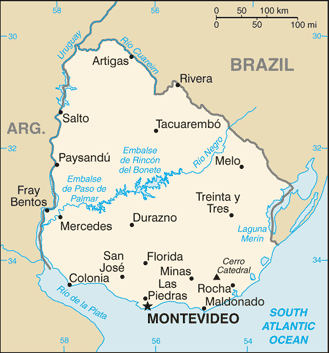
Geography
- Location
- Southern South America, bordering the South Atlantic Ocean, between Argentina and Brazil
- Area
- 176,215 sq km
- Climate
- warm temperate; freezing temperatures almost unknown
- Terrain
- mostly rolling plains and low hills; fertile coastal lowland
- Natural resources
- arable land, hydropower, minor minerals, fish
- Coastline
- 660 km
- Natural hazards
- seasonally high winds (the pampero is a chilly and occasional violent wind that blows north from the Argentine pampas), droughts, floods; because of the absence of mountains, which act as weather barriers, all locations are particularly vulnerable to rapid changes from weather fronts
People & society
- Population
- 3,449,444 (2025 est.)
- Nationality
- Uruguayan(s)
- Ethnic groups
- White 87.7%, Black 4.6%, Indigenous 2.4%, other 0.3%, none or unspecified 5% (2011 est.)
- Languages
- Spanish (official, Rioplatense is the most widely spoken dialect)
- Religions
- Roman Catholic 36.5%, Protestant 5% (Evangelical (non-specific) 4.6%, Adventist 0.2%, Protestant (non-specific) 0.3%), African American Cults/Umbanda 2.8%, Jehovah's Witness 0.6%, Church of Jesus Christ 0.2%, other 1%, Believer (not belonging to the church) 1.8%, agnostic 0.3%, atheist 1.3%, none 47.3%, unspecified 3.4% Roman Catholic 42%, Protestant 15%, other 6%, agnostic 3%, atheist 10%, unspecified 24% (2023 est.)
- Median age
- 37.4 years (2025 est.)
- Life expectancy at birth
- 78.9 years (2024 est.)
- Literacy
- 98.9% (2024 est.)
Economy
- Economic overview
- high-income, export-oriented South American economy; South America’s largest middle class; low socioeconomic inequality; growing homicide rates; growing Chinese and EU relations; 2019 Argentine recession hurt; key milk, beef, rice, and wool exporter
- Industries
- food processing, electrical machinery, transportation equipment, petroleum products, textiles, chemicals, beverages
- Agricultural products
- milk, rice, wheat, barley, soybeans, beef, rapeseed, sugarcane, maize, beef offal (2023)
- Exports - partners
- China 21%, Brazil 17%, USA 8%, Argentina 5%, Netherlands 5% (2023)
- Imports - partners
- Brazil 22%, China 18%, Argentina 11%, USA 9%, Nigeria 4% (2023)
Government
- Government type
- presidential republic
- Capital
- Montevideo
- Independence
- 25 August 1825 (from Brazil)
- Constitution
- several previous; latest approved by plebiscite 27 November 1966, effective 15 February 1967, reinstated in 1985 at the conclusion of military rule
- Executive branch
- President Yamandú ORSI Martínez (since 1 March 2025)
- Legislative branch
- General Assembly (Asamblea General)
Full reference data
Every field, by section, CIA World Factbook. Open a topic to expand it.
Introduction
Travel Facts
Please visit the following links to find further information about your desired destination.
World Health Organization (WHO) - To learn what vaccines and health precautions to take while visiting your destination.
US State Dept Travel Information - Overall information about foreign travel for US citizens.
To obtain an international driving permit (IDP). Only two organizations in the US issue IDPs: American Automobile Association (AAA) and American Automobile Touring Alliance (AATA)
How to get help in an emergency? Contact the nearest US embassy or consulate, or call one of these numbers: from the US or Canada - 1-888-407-4747 or from Overseas - +1 202-501-4444
Page last updated: Wednesday, July 20, 2022