
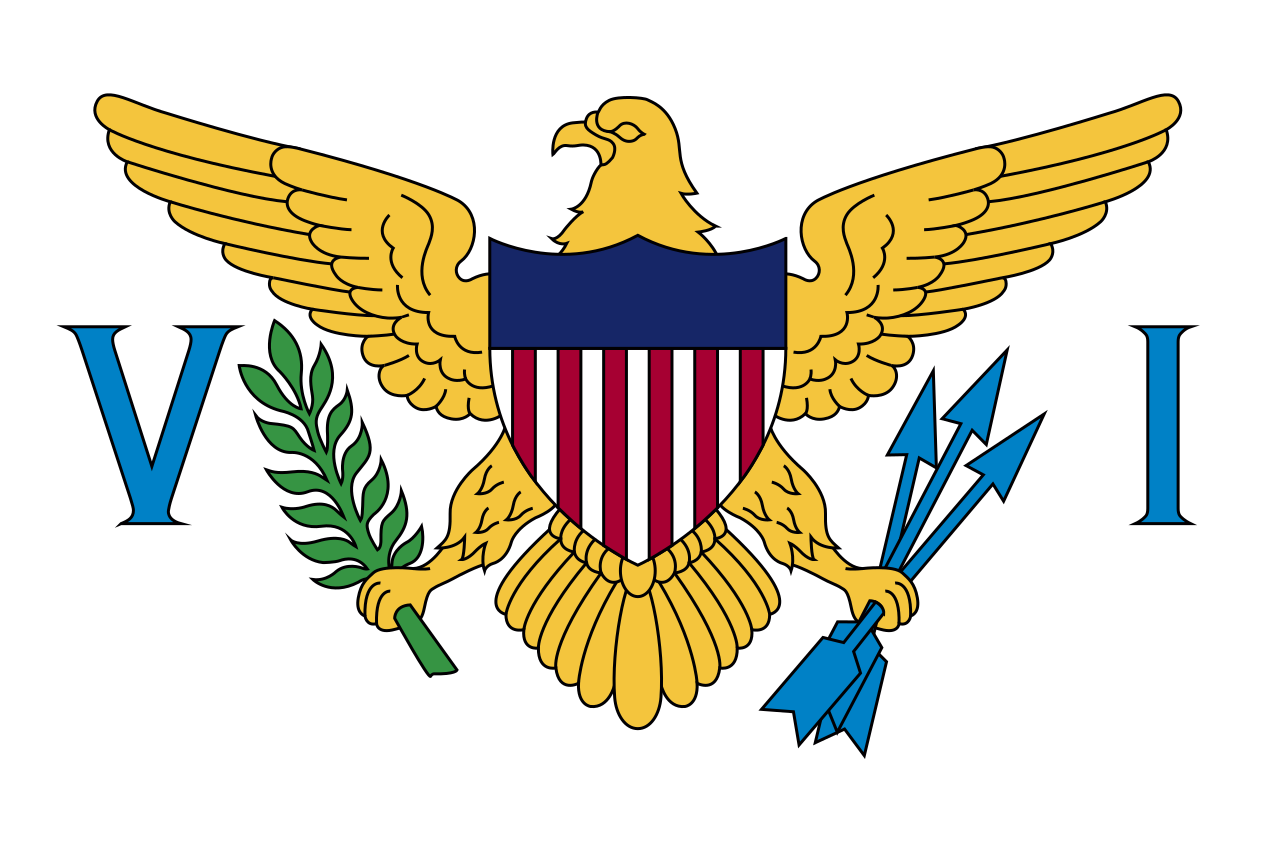
State of · VI
Virgin Islands
Albert Bryan
Governor
DemocratState Government 101
How Virgin Islands’s Government Works
The U.S. Virgin Islands is the territory governed without a constitution: five constitutional conventions have come and gone, so the islands still operate under a federal statute, the Revised Organic Act of 1954, that only Congress can amend. Within that charter sits a familiar three-branch government with two genuine rarities: a one-house, 15-member Legislature, and a tax system that "mirrors" the entire federal Internal Revenue Code as local law.
- Governor term
- 4 years
- Governor term limit
- 2 consecutive terms
- Legislature
- Legislature of the Virgin Islands
- Senate (one chamber)
- 15 seats · 2-yr terms
- Legislator term limit
- None
- Sessions
- Annual (convenes the second Monday in January)
- Session length
- No fixed limit (set by the Legislature)
- Legislature type
- Full-time / professional / unicameral
- Legislator pay
- Full-time salary set by local law
- Veto override
- Two-thirds of all 15 senators
- Line-item veto
- Yes (appropriations)
The Executive Branch, Who Runs the Territory
Executive power rests with a Governor, elected with a Lieutenant Governor on a single ticket to a four-year term. A candidate must win a majority of the vote, if no ticket clears 50%, the territory holds a runoff, which is rare among the states. Governors are limited to two full consecutive terms, though they may run again after sitting one out. Until 1970 the governor was appointed by the President; the Virgin Islands Elective Governor Act of 1968 made the office popularly elected.
The Governor and Lieutenant Governor are the only territory-wide elected executives. Everyone else, the Attorney General, the commissioners who head the departments (Education, Health, Finance, Licensing & Consumer Affairs, Planning & Natural Resources, Public Works, Police, and the rest of the cabinet), is appointed by the Governor with the advice and consent of the Legislature. That makes this a strongly single-executive government: unlike the 43 states that elect their attorney general, the VI Attorney General answers to the Governor, not directly to voters.
The Legislature, Who Writes the Laws
The Legislature of the Virgin Islands is unicameral, a single chamber of 15 members, all titled senators, making it one of only a handful of one-house legislatures under the U.S. flag (with Nebraska, Guam, and the District of Columbia's council). Seven senators are elected from the District of St. Croix, seven from the District of St. Thomas–St. John, and one at-large senator who must be a resident of St. John, a built-in guarantee that the smallest island always has a voice.
Senators serve two-year terms with no term limits, so the entire body stands for election at once every two years. It is a full-time, salaried legislature that convenes in regular session each year, by federal law on the second Monday in January unless the Legislature sets a different date, and sits in Charlotte Amalie, St. Thomas.
How a Bill Becomes Law
With one chamber, lawmaking is compact: a bill is introduced and numbered, referred to a committee for a public hearing, reported to the floor, and passed by a majority of senators present and voting. There is no second house, no conference committee, and no crossover deadline, the committee process and the Governor's veto are the main institutional brakes.
The Governor has 10 days (Sundays excepted) to sign or return a bill; an unreturned bill becomes law. If the Legislature's adjournment prevents a bill's return, the Governor gets 30 days to sign it or it dies, a pocket veto. The Legislature can override any veto, including line-item vetoes, with the votes of two-thirds of all 15 members (10 senators). These mechanics are not in a local constitution, they are spelled out in the Revised Organic Act, a federal statute.
What the Governor Can (and Can't) Do
The Governor appoints the entire cabinet and the Attorney General (with legislative consent), proposes the budget, may call the Legislature into special session limited to the subjects of the call, and holds a line-item veto over appropriations, the power to strike individual spending items while approving the rest, granted directly by 48 U.S.C. § 1575.
The deepest limit on the office is structural: the charter the Governor operates under is an act of Congress. Congress retains plenary authority over the territory under the Constitution's Territory Clause, so the ground rules of Virgin Islands government, the veto, the term limit, even the existence of the elected governorship, can be changed only in Washington, not in Charlotte Amalie.
The Courts
Local justice runs through two tiers: the Superior Court of the Virgin Islands, the trial court of general jurisdiction, and the Supreme Court of the Virgin Islands, the territory's highest court, which heard its first cases in 2007. Justices and judges are appointed by the Governor with legislative consent. Since 2012, decisions of the VI Supreme Court are reviewable directly by the U.S. Supreme Court, the same path a state supreme court's rulings take.
Alongside the local courts sits the District Court of the Virgin Islands, a federal territorial court created under Article IV rather than Article III, its judges serve 10-year terms instead of life tenure. Its appeals go to the U.S. Court of Appeals for the Third Circuit in Philadelphia.
What makes the Virgin Islands' government distinctive
- No constitution of its own: five constitutional conventions have failed, so the territory is governed by the federal Revised Organic Act of 1954, a charter only Congress can amend.
- A "mirror" tax code: the entire federal Internal Revenue Code applies as local law with "Virgin Islands" substituted for "United States," and residents file with the VI Bureau of Internal Revenue, not the IRS.
- A unicameral, 15-member Legislature in which one at-large senator must live on St. John, a permanent seat for the smallest island.
- The Attorney General is appointed by the Governor, not elected, and the governor's line-item veto is written into federal statute.
- It is a territory, not a state: residents are U.S. citizens (since 1927) but do not vote for President and elect a single non-voting Delegate to the U.S. House.
See how Virgin Islands is governed right now
Jump from the explainer into the live record for Virgin Islands.
Executive branch
Orders, rulemaking & official actions
Recent activity
View all →- Press Release·Oct 19, 2026Open ↗
Governor Bryan Grants Administrative Leave to Non-Essential Government Employees on Nov. 2 and Nov. 27
- Press Release·Oct 19, 2026Open ↗
Governor Bryan Announces $250 Million Bond Financing Proposal to Strengthen Hospitals, Utilities and Territory’s Financial Stability
- Press Release·Oct 19, 2026Open ↗
Governor Bryan Marks Opening of St. Croix Modular Morgue, Advancing Juan F. Luis Hospital Rebuilding
- Press Release·Oct 17, 2026Open ↗
Governor Bryan Advances Efforts to Recruit Nurses and Teachers from Ghana as Labor Delegation Meets with USVI Officials
- Press Release·Oct 14, 2026Open ↗
Governor Bryan Meets with Senators to Advance Horse Racing Agreement
- Press Release·Oct 8, 2026Open ↗
Governor Bryan Takes Action on Bills Passed During 36th Legislature’s Latest Session
- Press Release·Oct 3, 2026Open ↗
Governor Bryan Signs Fiscal Year 2027 Budget, Ensuring Continued Funding for Government Operations and Essential Services
- Press Release·Oct 2, 2026Open ↗
Governor Bryan Proclaims October Observances Honoring Service, Heritage, Safety and Community Awareness
Legislative branch
Constitution, statutes & bills
386 bills tracked · 36th Legislature of the Virgin Islands (2025-2026)
Foundational
Revised Organic Act of the Virgin Islands
7 articles · 37 sections · 0 paragraphs
Codified
Virgin Islands Statutes
37 titles · 11,323 sections
- Lease 36-0311enacted
An act approving a multi-year lease agreement between the Government of the Virgin Islands, acting through its Commissioner of the Department of Property
Milton E. Potter
Last action Oct 7, 2026
- Bill No. 36-0301enacted
An act amending title 14 Virgin Islands Code prohibiting incarcerated persons from possessing or using electronic communication or recording devices
Kenneth L. Gittens
Last action Oct 7, 2026
- Bill No. 36-0392enacted
An act amending title 33 Virgin Islands Code, chapter 111 creating the Virgin Islands Contractor Bonds Cost Revolving Loan Fund
Novelle E. Francis, Jr.
Last action Oct 7, 2026
- Bill No. 36-0393enacted
An act amending Act No. 9035 to reprogram funds within the 2026 fiscal year budget for Virgin Islands Department of Health to provide a $2,500,000 appropriation
Kurt A. Vialet
Last action Oct 7, 2026
- Bill No. 36-0331enacted
An act approving the lease agreement modification and extension between the Government of the Virgin Islands, acting through the Commissioner of the Department
Last action Oct 7, 2026
- Bill No. 36-0339enacted
An act approving the lease agreement between the Government of the Virgin Islands, acting through the Commissioner of the Department of Property and Procurement,
Milton E. Potter
Last action Oct 7, 2026
- Lease 36-0293enacted
An act approving the lease agreement between the Government of the Virgin Islands and The St. Thomas Cricket Association Inc. for Parcel No-2 of Tract
Milton E. Potter
Last action Oct 7, 2026
- Bill No. 36-0308enacted
An act appropriating the sum of $150,000 from the Virgin Islands Education Initiative Fund to the Virgin Islands Department of Education to conduct a biannual
Kurt A. Vialet
Last action Oct 7, 2026
Frequently asked questions
Does the U.S. Virgin Islands have a constitution?
No. Five constitutional conventions (most recently producing a 2009 draft) have failed to yield a ratified constitution. The territory operates under the Revised Organic Act of 1954, a federal statute codified at 48 U.S.C. chapter 12 that functions as its constitution and can be amended only by Congress.
Why does the Virgin Islands Legislature have only one chamber?
The Revised Organic Act of 1954 established a single 15-member chamber. Seven senators represent St. Croix, seven represent St. Thomas–St. John, and one at-large senator must reside on St. John. It is one of only a few unicameral legislatures under the U.S. flag.
Is the Virgin Islands Attorney General elected?
No. The Attorney General is appointed by the Governor with the advice and consent of the Legislature, and heads the Virgin Islands Department of Justice. Most states (43 of 50) elect their attorney general instead.
Do Virgin Islanders pay federal income tax to the IRS?
Generally no. Under the "mirror code" system in place since 1921, the federal Internal Revenue Code applies as the territory's own tax law, and bona fide VI residents file with the Virgin Islands Bureau of Internal Revenue rather than the IRS. The rates match federal rates, but the revenue stays in the territory.
Can residents of the U.S. Virgin Islands vote for President?
No. Virgin Islanders are U.S. citizens, but as a territory the USVI has no electoral votes. Residents elect a Delegate to the U.S. House of Representatives who can vote in committee but not on final passage of legislation.