
Country exposure · BN
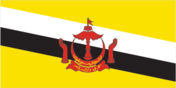
Brunei
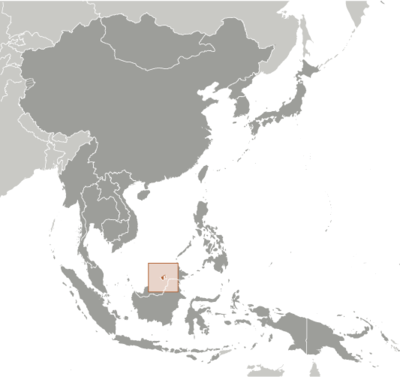
East N Southeast Asia · Bandar Seri Begawan · absolute monarchy or sultanate
What Brunei means for your money, the prices you pay, the tariffs in motion, and where U.S. policy could change both.
$105M
U.S. imports, 2025
-55.8%
change in one year
$100M
U.S. exports, 2025
492K
Population
$15.5B
GDP
In your house
What you buy that Brunei makes
America bought $105M in goods from Brunei in 2025, down 55.8% in a single year. Of every $100 of it, here's where the money went.
Petroleum products, other
gasoline and petroleum products
U.s. goods returned, and reimports
Drilling & oilfield equipment
Industrial machines, other
Apparel, household goods - cotton
cotton clothing and linens
Gem diamonds
Finished metal shapes
Apparel, textiles, nonwool or cotton
synthetic and performance apparel
Chemicals-organic
Cell phones and other household goods, n.e.c.
cell phones and home electronics
2026 so far (through July): $8M in imports. Source: U.S. Census Bureau, International Trade in Goods (customs basis).
The other direction
What America sells to Brunei
$100M in 2025, a trade rupture cuts both ways, for American producers as well as American prices.
Industrial engines
$17MCivilian aircraft, engines, equipment, and parts
$13MIndustrial machines, other
$8MMinimum value shipments
$7MElectric apparatus
$6MMeasuring, testing, control instruments
$6MParts for military-type goods
$6MTelecommunications equipment
$2Mphones, routers, networking gear
Medicinal equipment
$2Mmedical devices and equipment
Where you stand
U.S. tariff posture toward Brunei
Brunei was assigned 24% in April 2025 and, unusually, saw it nudged up to 25% in August despite negotiations — no bilateral deal was reached, unlike Southeast Asian neighbors Vietnam and Indonesia. Brunei's economy is dominated by oil and gas, which fall under the universal energy carve-out, limiting real exposure to the headline rate. Executive Order 14389 (Ending Certain Tariff Actions, Feb 20, 2026) terminated the IEEPA reciprocal duties, and Proclamation 11012 replaced it with a 10% Section 122 temporary import surcharge effective February 24, 2026; energy imports remain exempt. Brunei has no Section 232 steel/aluminum exposure.
Reciprocal tariff (assigned, terminated)
24%
The rate this country was assigned under the EO 14257 reciprocal Annex, no longer in force. The Supreme Court struck down the IEEPA tariffs and they were terminated February 24, 2026 (EO 14389), replaced by a universal ~10% Section 122 surcharge. See the timeline below for the current effective rate.
Policy in motion
Tariff status: a moving target
U.S. tariff policy toward Brunei has changed 4 times since 2025. This page tracks it.
2026-02-24
IEEPA reciprocal tariffs terminated — replaced by 10% Section 122
In effectExecutive Order 14389 (Ending Certain Tariff Actions) terminated the IEEPA tariff duties effective February 24, 2026, replacing Brunei's 25% reciprocal rate with a 10% Section 122 temporary import surcharge under Proclamation 11012 (capped at 150 days); energy imports remain exempt.
91 FR 9437 →2025-08-07
Rate set at 25% — no deal reached
In effectExecutive Order 14326 set the post-pause Annex I reciprocal rates; Brunei's rate was set at 25% effective August 7, 2025 — marginally above the 24% threatened in April — with no bilateral agreement, the energy carve-out leaving its oil and gas exports untouched.
90 FR 37963 →2025-04-10
Elevated reciprocal rates paused to 10% for 90 days
In effectExecutive Order 14266 suspended the higher country-specific reciprocal rates — including Brunei's 24% — back to the 10% baseline for 90 days to allow negotiations.
90 FR 15625 →2025-04-05
Reciprocal tariff regime begins — Brunei assigned 24%
In effectExecutive Order 14257 imposed a 10% universal reciprocal duty effective April 5 and a 24% country-specific rate for Brunei scheduled to take effect April 9 — though oil and gas, the bulk of Brunei's exports, fall under the energy carve-out.
90 FR 15041 →
Made for America
What Brunei makes for America
Brunei is a direct U.S. source of 2 essential goods Americans rely on, the items themselves, shipped finished off the line.
Reference
The country itself
East N Southeast Asia · Geography, people, economy, and government, public-domain data from the CIA World Factbook.
The Sultanate of Brunei's influence peaked between the 15th and 17th centuries, when its control extended over coastal areas of northwest Borneo and the southern Philippines. Internal strife over royal succession, colonial expansion of European powers, and piracy subsequently brought on a period of decline. In 1888, Brunei became a British protectorate; independence was achieved in 1984. The same family has ruled Brunei for over six centuries, and in 2017, the country celebrated the 50th anniversary of Sultan Hassanal BOLKIAH’s accession to the throne. Brunei has one of the highest per-capita GDPs in the world, thanks to extensive petroleum and natural gas fields.
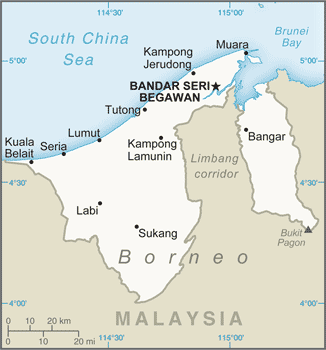
Geography
- Location
- Southeastern Asia, along the northern coast of the island of Borneo, bordering the South China Sea and Malaysia
- Area
- 5,765 sq km
- Climate
- tropical; hot, humid, rainy
- Terrain
- flat coastal plain rises to mountains in east; hilly lowland in west
- Natural resources
- petroleum, natural gas, timber
- Coastline
- 161 km
- Natural hazards
- typhoons, earthquakes, and severe flooding are rare
People & society
- Population
- 491,900 (2024 est.)
- Nationality
- Bruneian(s)
- Ethnic groups
- Malay 67.4%, Chinese 9.6%, other 23% (2021 est.)
- Languages
- Malay (Bahasa Melayu) (official), English, Chinese dialects
- Religions
- Muslim (official) 82.1%, Christian 6.7%, Buddhist 6.3%, other 4.9% (2021 est.)
- Median age
- 32.6 years (2025 est.)
- Life expectancy at birth
- 78.9 years (2024 est.)
Economy
- Economic overview
- almost exclusively an oil and gas economy; high income country; expansive and robust welfare system; the majority of the population works for the government; promulgating a nationalized halal brand; considering establishment of a bond market and stock exchange
- Industries
- petroleum, petroleum refining, liquefied natural gas, construction, agriculture, aquaculture, transportation
- Agricultural products
- chicken, eggs, fruits, vegetables, rice, bananas, beans, cucumbers/gherkins, pineapples, beef (2023)
- Exports - partners
- Australia 21%, Japan 17%, China 17%, Singapore 16%, Malaysia 6% (2023)
- Imports - partners
- Malaysia 23%, UAE 10%, China 10%, UK 10%, Australia 6% (2023)
Government
- Government type
- absolute monarchy or sultanate
- Capital
- Bandar Seri Begawan
- Independence
- 1 January 1984 (from the UK)
- Constitution
- drafted 1954 to 1959, signed 29 September 1959
- Executive branch
- Sultan and Prime Minister Sir HASSANAL Bolkiah (since 5 October 1967)
- Legislative branch
- Legislative Council (Majlis Mesyuarat Negara)
Full reference data
Every field, by section, CIA World Factbook. Open a topic to expand it.
Introduction
Travel Facts
Please visit the following links to find further information about your desired destination.
World Health Organization (WHO) - To learn what vaccines and health precautions to take while visiting your destination.
US State Dept Travel Information - Overall information about foreign travel for US citizens.
To obtain an international driving permit (IDP). Only two organizations in the US issue IDPs: American Automobile Association (AAA) and American Automobile Touring Alliance (AATA)
How to get help in an emergency? Contact the nearest US embassy or consulate, or call one of these numbers: from the US or Canada - 1-888-407-4747 or from Overseas - +1 202-501-4444
Page last updated: Wednesday, October 05, 2022