
Country exposure · CI
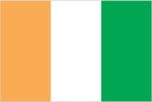
Cote d'Ivoire
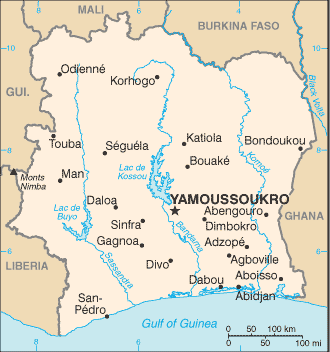
Africa · Yamoussoukro (legislative capital), Abidjan (administrative and economic capital); note - the US Embassy is in Abidjan · presidential republic
What Cote d'Ivoire means for your money, the prices you pay, the tariffs in motion, and where U.S. policy could change both.
$1.9B
U.S. imports, 2025
+90%
change in one year
$655M
U.S. exports, 2025
32M
Population
$86.5B
GDP
In your house
What you buy that Cote d'Ivoire makes
America bought $1.9B in goods from Cote d'Ivoire in 2025, up 90% in a single year. Of every $100 of it, here's where the money went.
Cocoa beans
cocoa for chocolate
Bakery products
Natural rubber
natural rubber for tires
Tobacco, waxes, etc.
Nuts
nuts
Crude oil
U.s. goods returned, and reimports
Nonferrous metals, other
Fruits, frozen juices
fruit and frozen juices
Plywood and veneers
2026 so far (through July): $1.6B in imports. Source: U.S. Census Bureau, International Trade in Goods (customs basis).
The other direction
What America sells to Cote d'Ivoire
$655M in 2025, a trade rupture cuts both ways, for American producers as well as American prices.
Natural gas liquids
$341MPlastic materials
$85Mplastics for packaging and goods
Fuel oil
$24MPassenger cars, new and used
$20Mnew and used cars
Drilling & oilfield equipment
$16MRice
$15Mcocoa for chocolate
Metalworking machine tools
$12MAnimal feeds, n.e.c.
$10MMinimum value shipments
$9MWhere you stand
U.S. tariff posture toward Cote d'Ivoire
No U.S. tariff action singles this country out. Its goods face the universal 10% temporary import surcharge under Section 122 of the Trade Act (which replaced the IEEPA reciprocal baseline in February 2026) plus the sectoral Section 232 duties — steel and aluminum at 50% — that apply to all countries. The Section 122 surcharge is statutorily temporary — scheduled to lapse on or about July 23, 2026 (a 150-day cap) unless extended or replaced.
Reciprocal tariff (universal baseline)
10%
The universal 10% floor, a Section 122 import surcharge since February 2026, previously the EO 14257 reciprocal baseline, applies to nearly all U.S. imports. This country has no higher assigned rate of its own.
Policy in motion
Tariff status: a moving target
No U.S. tariff action names Cote d'Ivoire. These are the universal measures, applied to every country without a country-specific arrangement, that set its treatment.
2026-04-06
Section 232 metals coverage expanded
In effectThe April 2026 proclamation strengthening Section 232 actions on aluminum, steel, and copper expanded derivative-product coverage for all countries, keeping the general metals rate at 50%.
91 FR 18201 →2026-02-24
IEEPA reciprocal tariffs terminated — replaced by 10% Section 122 surcharge
In effectExecutive Order 14389 (Ending Certain Tariff Actions) terminated the IEEPA tariff duties — including the EO 14257 reciprocal baseline — effective February 24, 2026. A flat 10% Section 122 temporary import surcharge (Proclamation 11012 of February 20, 2026) replaced them, leaving the universal rate unchanged at 10% on a different statutory basis. Section 122 caps such surcharges at 150 days, so this 10% surcharge is scheduled to lapse on or about July 23, 2026 absent further action (the administration has signaled it could raise the rate toward the 15% statutory maximum).
91 FR 9437 →2025-11-13
Agricultural products exempted from reciprocal tariffs
In effectExecutive Order 14360 of November 14, 2025 removed reciprocal duties from certain agricultural products listed in its annexes (coffee, cocoa, bananas, and other goods the U.S. does not produce in sufficient quantity), retroactive to November 13, 2025 — for all countries subject to the reciprocal tariff.
90 FR 54091 →2025-06-04
Section 232 steel and aluminum duties doubled to 50%
In effectThe June 3, 2025 proclamation raised Section 232 duties on steel and aluminum articles and derivatives from 25% to 50% for all countries, effective June 4, 2025.
90 FR 24199 →2025-04-05
Universal 10% reciprocal baseline takes effect
In effectExecutive Order 14257 (signed April 2, 2025) imposed a 10% ad valorem reciprocal duty on imports from all trading partners, effective April 5, 2025. Countries without a higher Annex I rate remain at this baseline.
Federal Register · 2025-06063 →2025-03-12
Section 232 steel and aluminum duties set at 25% for all countries
In effectProclamations of February 10, 2025 terminated all country exemptions and quota arrangements and applied 25% Section 232 duties to steel and aluminum imports from every country, effective March 12, 2025.
90 FR 9817 →
Made for America
What Cote d'Ivoire makes for America
Cote d'Ivoire is a direct U.S. source of 2 essential goods Americans rely on, the items themselves, shipped finished off the line.
Go deeper
The supply chain view
Cote d'Ivoire sits upstream of 11 essential American goods through 8 tracked inputs.
agricultural
44%Cocoa Beans (Theobroma cacao)
agricultural
38%Cocoa Beans
agricultural
10%Natural rubber (NR) — Hevea brasiliensis latex
agricultural
5%Cocoa Butter
agricultural
5%Green Coffee Beans — Robusta
agricultural
4%Natural Rubber (Compounded, Tire & Track Grade)
Reference
The country itself
Africa · Geography, people, economy, and government, public-domain data from the CIA World Factbook.
Various small kingdoms ruled the area of Cote d'Ivoire between the 15th and 19th centuries, when European explorers arrived and then began to expand their presence. In 1844, France established a protectorate. During this period, many of these kingdoms and tribes fought to maintain their cultural identities -- some well into the 20th century. For example, the Sanwi kingdom -- originally founded in the 17th century -- tried to break away from Cote d’Ivoire and establish an independent state in 1969. Cote d’Ivoire achieved independence from France in 1960 but has maintained close ties. Foreign investment and the export and production of cocoa drove economic growth that led Cote d’Ivoire to become one of the most prosperous states in West Africa. Then in 1999, a military coup overthrew the government, and a year later, junta leader Robert GUEI held rigged elections and declared himself the winner. Popular protests forced him to step aside, and Laurent GBAGBO was elected. Ivoirian dissidents and members of the military launched a failed coup in 2002 that developed into a civil war. In 2003, a cease-fire resulted in rebels holding the north, the government holding the south, and peacekeeping forces occupying a buffer zone in the middle. In 2007, President GBAGBO and former rebel leader Guillaume SORO signed an agreement in which SORO joined GBAGBO's government as prime minister. The two agreed to reunite the country by dismantling the buffer zone, integrating rebel forces into the national armed forces, and holding elections. In 2010, Alassane Dramane OUATTARA won the presidential election, but GBAGBO refused to hand over power, resulting in five months of violent conflict. Armed OUATTARA supporters and UN and French troops eventually forced GBAGBO to step down in 2011. OUATTARA won a second term in 2015 and a controversial third term in 2020 -- despite the two-term limit in the Ivoirian constitution -- in an election boycotted by the opposition. Through political compromise with OUATTARA, the opposition participated peacefully in 2021 legislative elections and won a substantial minority of seats. Also in 2021, the International Criminal Court in The Hague ruled on a final acquittal for GBAGBO, who was on trial for crimes against humanity, paving the way for GBAGBO’s return to Abidjan the same year. GBAGBO has publicly met with OUATTARA since his return as a demonstration of political reconciliation.
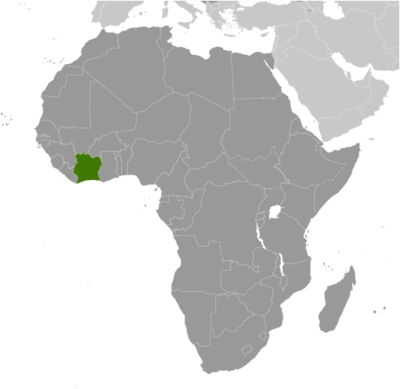
Geography
- Location
- Western Africa, bordering the North Atlantic Ocean, between Ghana and Liberia
- Area
- 322,463 sq km
- Climate
- tropical along coast, semiarid in far north; three seasons - warm and dry (November to March), hot and dry (March to May), hot and wet (June to October)
- Terrain
- mostly flat to undulating plains; mountains in northwest
- Natural resources
- petroleum, natural gas, diamonds, manganese, iron ore, cobalt, bauxite, copper, gold, nickel, tantalum, silica sand, clay, cocoa beans, coffee, palm oil, hydropower
- Coastline
- 515 km
- Natural hazards
- coast has heavy surf and no natural harbors; during the rainy season torrential flooding is possible
People & society
- Population
- 31,855,971 (2025 est.)
- Nationality
- Ivoirian(s)
- Ethnic groups
- Akan 38%, Voltaique or Gur 22%, Northern Mande 22%, Kru 9.1%, Southern Mande 8.6%, other 0.3% (2021 est.)
- Languages
- French (official), 60 native dialects of which Dioula is the most widely spoken
- Religions
- Muslim 42.9%, Catholic 17.2%, Evangelical 11.8%, Methodist 1.7%, other Christian 3.2%, animist 3.6%, other religion 0.5%, none 19.1% (2014 est.)
- Median age
- 20 years (2025 est.)
- Life expectancy at birth
- 63.2 years (2024 est.)
- Literacy
- 50% (2021 est.)
Economy
- Economic overview
- one of West Africa’s most influential, stable, and rapidly developing economies; poverty declines in urban but increases in rural areas; strong construction sector and increasingly diverse economic portfolio; increasing but manageable public debt; large labor force in agriculture
- Industries
- foodstuffs, beverages; wood products, oil refining, gold mining, truck and bus assembly, textiles, fertilizer, building materials, electricity
- Agricultural products
- yams, cassava, oil palm fruit, cocoa beans, sugarcane, plantains, rice, rubber, maize, cashews (2023)
- Exports - partners
- Switzerland 17%, Netherlands 9%, Mali 7%, USA 5%, Malaysia 4% (2023)
- Imports - partners
- China 16%, Nigeria 12%, France 6%, India 5%, USA 4% (2023)
Government
- Government type
- presidential republic
- Capital
- Yamoussoukro (legislative capital), Abidjan (administrative and economic capital); note - the US Embassy is in Abidjan
- Independence
- 7 August 1960 (from France)
- Constitution
- previous 1960, 2000; latest draft completed 24 September 2016, approved by the National Assembly 11 October 2016, approved by referendum 30 October 2016, promulgated 8 November 2016
- Executive branch
- President Alassane Dramane OUATTARA (since 25 October 2025)
- Legislative branch
- Parliament (Parlement)
Full reference data
Every field, by section, CIA World Factbook. Open a topic to expand it.
Introduction
Travel Facts
Please visit the following links to find further information about your desired destination.
World Health Organization (WHO) - To learn what vaccines and health precautions to take while visiting your destination.
US State Dept Travel Information - Overall information about foreign travel for US citizens.
To obtain an international driving permit (IDP). Only two organizations in the US issue IDPs: American Automobile Association (AAA) and American Automobile Touring Alliance (AATA)
How to get help in an emergency? Contact the nearest US embassy or consulate, or call one of these numbers: from the US or Canada - 1-888-407-4747 or from Overseas - +1 202-501-4444
Page last updated: Monday, September 18, 2023