
Country exposure · FJ
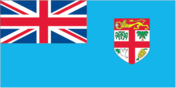
Fiji
Australia Oceania · Suva (on Viti Levu) · parliamentary republic
What Fiji means for your money, the prices you pay, the tariffs in motion, and where U.S. policy could change both.
$207M
U.S. imports, 2025
-19.9%
change in one year
$122M
U.S. exports, 2025
952K
Population
$5.8B
GDP
In your house
What you buy that Fiji makes
America bought $207M in goods from Fiji in 2025, down 19.9% in a single year. Of every $100 of it, here's where the money went.
Other foods
Fish and shellfish
fish, shrimp, shellfish
Tobacco, waxes, etc.
Tea, spices, etc.
tea and spices
Lumber
lumber for homebuilding
Cane and beet sugar
cane and beet sugar
Fruits, frozen juices
fruit and frozen juices
Vegetables
vegetables
Toiletries and cosmetics
toiletries and cosmetics
Minimum value shipments
2026 so far (through July): $108M in imports. Source: U.S. Census Bureau, International Trade in Goods (customs basis).
The other direction
What America sells to Fiji
$122M in 2025, a trade rupture cuts both ways, for American producers as well as American prices.
Civilian aircraft, engines, equipment, and parts
$44MTelecommunications equipment
$24Mphones, routers, networking gear
Minimum value shipments
$17MPhoto, service industry machinery
$4MElectric apparatus
$2MFruits, frozen juices
$2MToiletries and cosmetics
$2Mtoiletries and cosmetics
Furniture, household goods, etc.
$2Mfurniture, mattresses, lamps
Computers
$2Mlaptops, desktops, monitors
Where you stand
U.S. tariff posture toward Fiji
Fiji was assigned 32% in April 2025 — the highest U.S. tariff in the Pacific — hitting key exports like bottled mineral water (Fiji Water), kava, fish, and sugar confectionery; Fiji disputed the underlying claim that it levied a 63% tariff on U.S. goods. The rate was reduced to 15% in August 2025 without a formal deal. Executive Order 14389 (Ending Certain Tariff Actions, Feb 20, 2026) terminated the IEEPA reciprocal duties, and Proclamation 11012 replaced it with a 10% Section 122 temporary import surcharge effective February 24, 2026. Fiji has no Section 232 steel/aluminum exposure.
Reciprocal tariff (assigned, terminated)
32%
The rate this country was assigned under the EO 14257 reciprocal Annex, no longer in force. The Supreme Court struck down the IEEPA tariffs and they were terminated February 24, 2026 (EO 14389), replaced by a universal ~10% Section 122 surcharge. See the timeline below for the current effective rate.
Policy in motion
Tariff status: a moving target
U.S. tariff policy toward Fiji has changed 4 times since 2025. This page tracks it.
2026-02-24
IEEPA reciprocal tariffs terminated — replaced by 10% Section 122
In effectExecutive Order 14389 (Ending Certain Tariff Actions) terminated the IEEPA tariff duties effective February 24, 2026, replacing Fiji's 15% reciprocal rate with a 10% Section 122 temporary import surcharge under Proclamation 11012 (capped at 150 days).
91 FR 9437 →2025-08-07
Rate reduced to 15%
In effectExecutive Order 14326 set the post-pause Annex I reciprocal rates; Fiji's rate was lowered from 32% to 15% effective August 7, 2025, without a formal bilateral agreement.
90 FR 37963 →2025-04-10
Elevated reciprocal rates paused to 10% for 90 days
In effectExecutive Order 14266 suspended the higher country-specific reciprocal rates — including Fiji's 32% — back to the 10% baseline for 90 days.
90 FR 15625 →2025-04-05
Reciprocal tariff regime begins — Fiji assigned 32%
In effectExecutive Order 14257 imposed a 10% universal reciprocal duty effective April 5 and a 32% country-specific rate for Fiji scheduled to take effect April 9 — the highest in the Pacific — which Fiji's government challenged as based on an inaccurate trade-barrier estimate.
90 FR 15041 →
Made for America
What Fiji makes for America
Fiji is a direct U.S. source of 5 essential goods Americans rely on, the items themselves, shipped finished off the line.
Go deeper
The supply chain view
Fiji sits upstream of 1 essential American goods through 1 tracked inputs.
Full supply-map profile →Reference
The country itself
Australia Oceania · Geography, people, economy, and government, public-domain data from the CIA World Factbook.
Austronesians settled Fiji around 1000 B.C., followed by successive waves of Melanesians starting around the first century A.D. Fijians traded with Polynesian groups in Samoa and Tonga, and by about 900, much of Fiji was in the Tu’i Tongan Empire’s sphere of influence. The Tongan influence declined significantly by 1200, while Melanesian seafarers continued to periodically arrive in Fiji, further mixing Melanesian and Polynesian cultural traditions. The first European spotted Fiji in 1643 and by the 1800s, European merchants, missionaries, traders, and whalers frequented the islands. Rival kings and chiefs competed for power, at times aided by Europeans, and in 1865, Seru Epenisa CAKOBAU united many groups into the Confederacy of Independent Kingdoms of Viti. The arrangement proved weak, however, and in 1871 CAKOBAU formed the Kingdom of Fiji in an attempt to centralize power. Fearing a hostile takeover by a foreign power as the kingdom’s economy began to falter, CAKOBAU ceded Fiji to the UK in 1874. The first British governor set up a plantation-style economy and brought in more than 60,000 Indians as indentured laborers, most of whom chose to stay in Fiji rather than return to India when their contracts expired. In the early 1900s, society was divided along ethnic lines, with iTaukei (indigenous Fijians), Europeans, and Indo-Fijians living in separate areas and maintaining their own languages and traditions. ITaukei fears of an Indo-Fijian takeover of government delayed independence through the 1960s; Fiji achieved independence in 1970 with agreements to allocate parliamentary seats by ethnic groups. After two coups in 1987, a new constitution in 1990 cemented iTaukei control of politics, leading thousands of Indo-Fijians to leave. A reformed constitution in 1997 was more equitable and led to the election of an Indo-Fijian prime minister in 1999, who was ousted in a coup the following year. In 2005, the new prime minister put forward a bill that would grant pardons to the coup perpetrators, leading Josaia Voreqe "Frank" BAINIMARAMA to launch a coup in 2006. BAINIMARAMA appointed himself prime minister in 2007 and retained the position after elections in 2014 and 2018 that international observers deemed credible. BAINIMARAMA's party lost control of the prime minister position after elections in 2022 with former opposition leader Sitiveni Ligamamada RABUKA winning the office by a narrow margin.
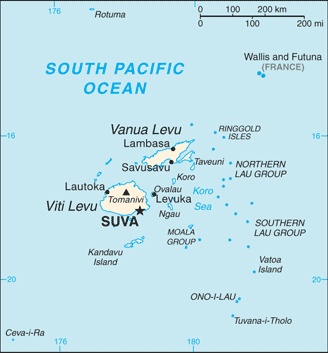
Geography
- Location
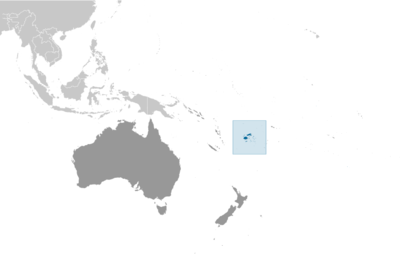
- Oceania, island group in the South Pacific Ocean, about two-thirds of the way from Hawaii to New Zealand
- Area
- 18,274 sq km
- Climate
- tropical marine; only slight seasonal temperature variation
- Terrain
- mostly mountains of volcanic origin
- Natural resources
- timber, fish, gold, copper, offshore oil potential, hydropower
- Coastline
- 1,129 km
- Natural hazards
- cyclonic storms can occur from November to January
People & society
- Population
- 951,611 (2024 est.)
- Nationality
- Fijian(s)
- Ethnic groups
- iTaukei 56.8% (predominantly Melanesian with a Polynesian admixture), Indo-Fijian 37.5%, Rotuman 1.2%, other 4.5% (European, part European, other Pacific Islanders, Chinese) (2007 est.)
- Languages
- English (official), iTaukei (official), Fiji Hindi (official)
- Religions
- Protestant 45% (Methodist 34.6%, Assembly of God 5.7%, Seventh Day Adventist 3.9%, and Anglican 0.8%), Hindu 27.9%, other Christian 10.4%, Roman Catholic 9.1%, Muslim 6.3%, Sikh 0.3%, other 0.3%, none 0.8% (2007 est.)
- Median age
- 32 years (2025 est.)
- Life expectancy at birth
- 74.8 years (2024 est.)
- Literacy
- 92.4% (2021 est.)
Economy
- Economic overview
- upper-middle income, tourism-based Pacific island economy; susceptible to ocean rises; key energy and infrastructure investments; post-pandemic tourism resurgence; improved debt standing; limited workforce
- Industries
- tourism, sugar processing, clothing, copra, gold, silver, lumber
- Agricultural products
- sugarcane, cassava, taro, vegetables, chicken, coconuts, eggs, ginger, milk, sweet potatoes (2023)
- Exports - partners
- USA 32%, Australia 12%, Tonga 6%, NZ 6%, Samoa 4% (2023)
- Imports - partners
- Singapore 25%, China 16%, Australia 15%, NZ 14%, USA 5% (2023)
Government
- Government type
- parliamentary republic
- Capital
- Suva (on Viti Levu)
- Independence
- 10 October 1970 (from the UK)
- Constitution
- several previous; latest signed into law 6 September 2013
- Executive branch
- President Ratu Naiqama LALABALAVU (since 12 November 2024)
- Legislative branch
- Parliament
Full reference data
Every field, by section, CIA World Factbook. Open a topic to expand it.
Introduction
Travel Facts
Please visit the following links to find further information about your desired destination.
World Health Organization (WHO) - To learn what vaccines and health precautions to take while visiting your destination.
US State Dept Travel Information - Overall information about foreign travel for US citizens.
To obtain an international driving permit (IDP). Only two organizations in the US issue IDPs: American Automobile Association (AAA) and American Automobile Touring Alliance (AATA)
How to get help in an emergency? Contact the nearest US embassy or consulate, or call one of these numbers: from the US or Canada - 1-888-407-4747 or from Overseas - +1 202-501-4444
Page last updated: Tuesday, September 20, 2022