
Country exposure · LA
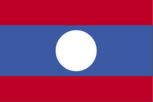
Laos (Lao People's Democratic Republic)
East N Southeast Asia · Vientiane (Viangchan) · communist party-led state
What Laos (Lao People's Democratic Republic) means for your money, the prices you pay, the tariffs in motion, and where U.S. policy could change both.
$2.1B
U.S. imports, 2025
+161.7%
change in one year
$20M
U.S. exports, 2025
8M
Population
$16.5B
GDP
In your house
What you buy that Laos (Lao People's Democratic Republic) makes
America bought $2.1B in goods from Laos (Lao People's Democratic Republic) in 2025, up 161.7% in a single year. Of every $100 of it, here's where the money went.
Semiconductors
semiconductors and chips
Cell phones and other household goods, n.e.c.
cell phones and home electronics
Furniture, household goods, etc.
furniture, mattresses, lamps
Telecommunications equipment
phones, routers, networking gear
Apparel, textiles, nonwool or cotton
synthetic and performance apparel
Sulfur, nonmetallic minerals
Footwear
shoes and sneakers
Industrial supplies, other
Apparel, household goods - cotton
cotton clothing and linens
Nonferrous metals, other
2026 so far (through July): $282M in imports. Source: U.S. Census Bureau, International Trade in Goods (customs basis).
The other direction
What America sells to Laos (Lao People's Democratic Republic)
$20M in 2025, a trade rupture cuts both ways, for American producers as well as American prices.
Pulpwood and woodpulp
$3MAgric. industry-unmanufactured
$3MAgriculture-manufactured, other
$1MIndustrial machines, other
$1MCivilian aircraft, engines, equipment, and parts
$1MRice
$997Kcocoa for chocolate
Jewelry, etc.
$940Kjewelry
Nonmonetary gold
$692KChemicals-other
$646KWhere you stand
U.S. tariff posture toward Laos (Lao People's Democratic Republic)
Laos was assigned 48% in April 2025 and, after only limited progress in trade talks, saw a modest reduction to 40% effective August 7 — one of the highest rates in the world (tied with Myanmar, behind only Syria) and far above its deal-making neighbors Cambodia, Thailand, and Vietnam. No formal trade deal was reached. Executive Order 14389 (Ending Certain Tariff Actions, Feb 20, 2026) terminated the IEEPA reciprocal duties, and Proclamation 11012 replaced it with a 10% Section 122 temporary import surcharge effective February 24, 2026 — a dramatic drop from 40% to 10%. Laos has no Section 232 steel/aluminum exposure.
Reciprocal tariff (assigned, terminated)
48%
The rate this country was assigned under the EO 14257 reciprocal Annex, no longer in force. The Supreme Court struck down the IEEPA tariffs and they were terminated February 24, 2026 (EO 14389), replaced by a universal ~10% Section 122 surcharge. See the timeline below for the current effective rate.
Policy in motion
Tariff status: a moving target
U.S. tariff policy toward Laos (Lao People's Democratic Republic) has changed 4 times since 2025. This page tracks it.
2026-02-24
IEEPA reciprocal tariffs terminated — replaced by 10% Section 122
In effectExecutive Order 14389 (Ending Certain Tariff Actions) terminated the IEEPA tariff duties effective February 24, 2026, replacing Laos's 40% reciprocal rate with a 10% Section 122 temporary import surcharge under Proclamation 11012 (capped at 150 days) — a sharp reduction.
91 FR 9437 →2025-08-07
Rate reduced to 40% — no deal reached
In effectExecutive Order 14326 set the post-pause Annex I reciprocal rates; Laos secured only a modest reduction to 40% from 48% after limited progress in talks, leaving it among the highest-tariffed countries in the world with no formal agreement.
90 FR 37963 →2025-04-10
Elevated reciprocal rates paused to 10% for 90 days
In effectExecutive Order 14266 suspended the higher country-specific reciprocal rates — including Laos's 48% — back to the 10% baseline for 90 days to allow negotiations.
90 FR 15625 →2025-04-05
Reciprocal tariff regime begins — Laos assigned 48%
In effectExecutive Order 14257 imposed a 10% universal reciprocal duty effective April 5 and a 48% country-specific rate for Laos scheduled to take effect April 9 — among the steepest rates assigned to any partner.
90 FR 15041 →
Made for America
What Laos (Lao People's Democratic Republic) makes for America
Laos (Lao People's Democratic Republic) is a direct U.S. source of 7 essential goods Americans rely on, the items themselves, shipped finished off the line.
health
7% of U.S.Eyeglasses & contact lenses
$208M to the U.S.
home
2% of U.S.Mattresses & bedding
$62M to the U.S.
materials
Clothing and apparel
$52M to the U.S.
digital
Fiber optic cables and networking
$34M to the U.S.
materials
Footwear
$31M to the U.S.
logistics
Emergency communications equipment
$7M to the U.S.
digital
Cameras & photo equipment
$6M to the U.S.
Go deeper
The supply chain view
Laos (Lao People's Democratic Republic) sits upstream of 3 essential American goods through 3 tracked inputs.
manufactured
10%Sunglass Lens Blank (CR-39/PC/Nylon)
chemical
6%Viscoelastic Memory Foam
mineral
5%Potassium Chloride (Pharmaceutical Grade, KCl)
Reference
The country itself
East N Southeast Asia · Geography, people, economy, and government, public-domain data from the CIA World Factbook.
Modern-day Laos has its roots in the ancient Lao kingdom of Lan Xang, established in the 14th century under King FA NGUM. For 300 years, Lan Xang had influence reaching into present-day Cambodia and Thailand, as well as over all of what is now Laos. After centuries of gradual decline, Laos came under the domination of Siam (Thailand) from the late 18th century until the late 19th century, when it became part of French Indochina. The Franco-Siamese Treaty of 1907 defined the current Lao border with Thailand. Following more than 15 years of civil war, the communist Pathet Lao took control of the government in 1975, ending a six-century-old monarchy and instituting a one party--the Lao People's Revolutionary Party--communist state. A gradual, limited return to private enterprise and the liberalization of foreign investment laws began in the late 1980s. Laos became a member of ASEAN in 1997 and the WTO in 2013. In the 2010s, the country benefited from direct foreign investment, particularly in the natural resource and industry sectors. Construction of a number of large hydropower dams and expanding mining activities have also boosted the economy. Laos has retained its official commitment to communism and maintains close ties with its two communist neighbors, Vietnam and China, both of which continue to exert substantial political and economic influence on the country. China, for example, provided 70% of the funding for a $5.9 billion, 400-km railway line between the Chinese border and the capital Vientiane, which opened for operations in 2021. Laos financed the remaining 30% with loans from China. At the same time, Laos has expanded its economic reliance on the West and other Asian countries, such as Japan, Malaysia, Singapore, Taiwan, and Thailand. Nevertheless, despite steady economic growth for more than a decade, it remains one of Asia's poorest countries.
Geography
- Location
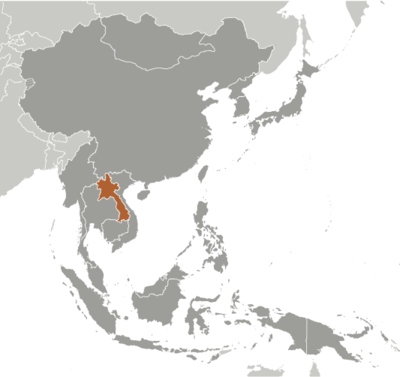
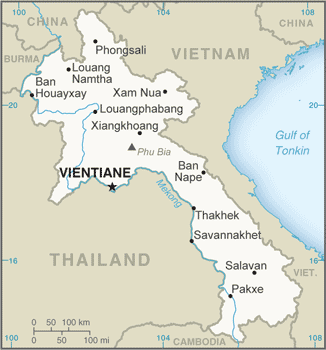
- Southeastern Asia, northeast of Thailand, west of Vietnam
- Area
- 236,800 sq km
- Climate
- tropical monsoon; rainy season (May to November); dry season (December to April)
- Terrain
- mostly rugged mountains; some plains and plateaus
- Natural resources
- timber, hydropower, gypsum, tin, gold, gemstones
- Coastline
- 0 km (landlocked)
- Natural hazards
- floods, droughts
People & society
- Population
- 7,953,556 (2024 est.)
- Nationality
- Lao(s) or Laotian(s)
- Ethnic groups
- Lao 53.2%, Khmou 11%, Hmong 9.2%, Phouthay 3.4%, Tai 3.1%, Makong 2.5%, Katong 2.2%, Lue 2%, Akha 1.8%, other 11.6% (2015 est.)
- Languages
- Lao (official), French, English, various ethnic languages
- Religions
- Buddhist 64.7%, Christian 1.7%, none 31.4%, other/not stated 2.1% (2015 est.)
- Median age
- 25.8 years (2025 est.)
- Life expectancy at birth
- 69 years (2024 est.)
- Literacy
- 75.6% (2023 est.)
Economy
- Economic overview
- lower middle-income, industrial Southeast Asian economy; high inflation due to 2022 currency depreciation brought on by persistently high debt; new Laos-China railway and dry port; rising inequities; ongoing labor shortages
- Industries
- mining (copper, tin, gold, gypsum); timber, electric power, agricultural processing, rubber, construction, garments, cement, tourism
- Agricultural products
- cassava, root vegetables, rice, sugarcane, vegetables, bananas, maize, rubber, coffee, watermelons (2023)
- Exports - partners
- China 39%, Thailand 34%, Australia 4%, USA 4%, Cambodia 2% (2023)
- Imports - partners
- Thailand 58%, China 36%, Japan 1%, Singapore 1%, Germany 1% (2023)
Government
- Government type
- communist party-led state
- Capital
- Vientiane (Viangchan)
- Independence
- 19 July 1949 (from France); 22 October 1953 (Franco-Lao Treaty recognizes full independence)
- Constitution
- previous 1947 (pre-independence); latest promulgated 13-15 August 1991
- Executive branch
- President THONGLOUN Sisoulith (since 22 March 2021)
- Legislative branch
- National Assembly (Sapha Heng Xat)
Full reference data
Every field, by section, CIA World Factbook. Open a topic to expand it.
Introduction
Travel Facts
Please visit the following links to find further information about your desired destination.
World Health Organization (WHO) - To learn what vaccines and health precautions to take while visiting your destination.
US State Dept Travel Information - Overall information about foreign travel for US citizens.
To obtain an international driving permit (IDP). Only two organizations in the US issue IDPs: American Automobile Association (AAA) and American Automobile Touring Alliance (AATA)
How to get help in an emergency? Contact the nearest US embassy or consulate, or call one of these numbers: from the US or Canada - 1-888-407-4747 or from Overseas - +1 202-501-4444
Page last updated: Monday, July 25, 2022