
Country exposure · VN
Vietnam
East N Southeast Asia · Hanoi (Ha Noi) · communist party-led state
What Vietnam means for your money, the prices you pay, the tariffs in motion, and where U.S. policy could change both.
$193.9B
U.S. imports, 2025
+42.2%
change in one year
$15.6B
U.S. exports, 2025
107M
Population
$476.4B
GDP
In your house
What you buy that Vietnam makes
America bought $193.9B in goods from Vietnam in 2025, up 42.2% in a single year. Of every $100 of it, here's where the money went.
Computers
laptops, desktops, monitors
Telecommunications equipment
phones, routers, networking gear
Computer accessories
keyboards, drives, computer parts
Furniture, household goods, etc.
furniture, mattresses, lamps
Apparel, textiles, nonwool or cotton
synthetic and performance apparel
Cell phones and other household goods, n.e.c.
cell phones and home electronics
Toys, games, and sporting goods
toys, games, sporting goods
Apparel, household goods - cotton
cotton clothing and linens
Camping apparel and gear
camping gear and outdoor apparel
Stereo equipment, etc
speakers and audio equipment
2026 so far (through July): $149.6B in imports. Source: U.S. Census Bureau, International Trade in Goods (customs basis).
The other direction
What America sells to Vietnam
$15.6B in 2025, a trade rupture cuts both ways, for American producers as well as American prices.
Semiconductors
$1.9Bsemiconductors and chips
Cotton, raw
$1.3BPlastic materials
$963Mplastics for packaging and goods
Logs and lumber
$742MNuts
$736MSoybeans
$672Mmeat at the counter
Cell phones and other household goods, n.e.c.
$565Mcell phones and home electronics
Civilian aircraft, engines, equipment, and parts
$518MNatural gas liquids
$465MWhere you stand
U.S. tariff posture toward Vietnam
Vietnam negotiated its reciprocal tariff down from 46% to 20% under the October 26, 2025 U.S.-Vietnam framework agreement (effective August 7, 2025), with a defined product list eligible for 0%. Because the reciprocal element was IEEPA-based, Executive Order 14389 (Ending Certain Tariff Actions) terminated it effective February 24, 2026, replacing it with a 10% Section 122 temporary import surcharge under Proclamation 11012 (capped at 150 days). Vietnam has no Section 232 steel/aluminum exposure.
Reciprocal tariff (assigned, terminated)
46%
The rate this country was assigned under the EO 14257 reciprocal Annex, no longer in force. The Supreme Court struck down the IEEPA tariffs and they were terminated February 24, 2026 (EO 14389), replaced by a universal ~10% Section 122 surcharge. See the timeline below for the current effective rate.
Policy in motion
Tariff status: a moving target
U.S. tariff policy toward Vietnam has changed 6 times since 2025. This page tracks it.
2026-02-24
IEEPA reciprocal tariffs terminated — replaced by 10% Section 122
In effectExecutive Order 14389 (Ending Certain Tariff Actions) terminated the IEEPA tariff duties effective February 24, 2026, replacing Vietnam's 20% reciprocal rate with a 10% Section 122 temporary import surcharge under Proclamation 11012 (capped at 150 days) pending a finalized agreement.
91 FR 9437 →2025-10-26
U.S.–Vietnam trade framework agreement
AgreementJoint statement on a framework for a reciprocal, fair, and balanced trade agreement, holding Vietnam's reciprocal rate at 20% with a path to 0% on a defined product list.
USTR fact sheet, October 2025 ↗2025-08-07
Vietnam's reciprocal rate set at 20%
In effectFollowing a July framework announcement, Vietnam's reciprocal tariff was set at 20% (down from 46%), effective August 7, 2025.
90 FR 37963 →2025-04-15
Reciprocal rates paused to a 10% baseline
In effectA modification lowered most countries' reciprocal rates to a 10% baseline for a 90-day negotiating window.
90 FR 15625 →2025-04-07
46% reciprocal tariff imposed on Vietnam
In effectAnnex I of EO 14257 assigned Vietnam a 46% additional ad valorem reciprocal tariff — one of the highest country rates in the program.
90 FR 15041 (EO 14257) →2025-02-19
U.S. announces reciprocal tariff policy
In effectExecutive order directing a reciprocal-tariff approach to address large and persistent U.S. goods trade deficits, the framework Vietnam's rate would later fall under.
90 FR 9837 →
Made for America
What Vietnam makes for America
Vietnam is a direct U.S. source of 12 essential goods Americans rely on, the items themselves, shipped finished off the line.
digital
57% of U.S.Computers and laptops
$30.0B to the U.S.
digital
27% of U.S.Fiber optic cables and networking
$24.2B to the U.S.
materials
21% of U.S.Clothing and apparel
$17.2B to the U.S.
materials
35% of U.S.Furniture
$11.0B to the U.S.
materials
37% of U.S.Footwear
$9.4B to the U.S.
digital
11% of U.S.Smartphones and tablets
$5.9B to the U.S.
digital
49% of U.S.Headphones, speakers & home audio
$5.5B to the U.S.
digital
56% of U.S.Video game consoles & games
$3.7B to the U.S.
digital
22% of U.S.Printers & peripherals
$2.4B to the U.S.
digital
1% of U.S.Servers and cloud hardware
$2.1B to the U.S.
digital
24% of U.S.Cameras & photo equipment
$2.1B to the U.S.
materials
21% of U.S.Power & hand tools
$2.0B to the U.S.
Go deeper
The supply chain view
Vietnam sits upstream of 24 essential American goods through 12 tracked inputs.
manufactured
53%Connected-Fitness Electronics (Touchscreen/SoC)
agricultural
40%Green Coffee Beans — Robusta
agricultural
38%Black Pepper
manufactured
35%Stationery / Notebook Paper
mineral
30%Tungsten Metal
manufactured
28%Bluetooth Audio SoC (with ANC DSP)
Reference
The country itself
East N Southeast Asia · Geography, people, economy, and government, public-domain data from the CIA World Factbook.
Vietnam's early history included periods of occupation by outside forces and eventual power consolidation under Vietnamese dynastic families. A succession of Han Chinese emperors ruled the area, which was centered on the Red River Valley, until approximately the 10th century. The Ly Dynasty (11th-13th century) created the first independent Vietnamese state, which was known as Dai Viet, and established their capital at Thang Long (Hanoi). Under the Tran Dynasty (13th-15th century), TRAN Hung Dao, one of Vietnam’s national heroes, led Dai Viet forces to fight off Mongol invaders in 1279. After a brief Chinese occupation in the early 1400s, Vietnamese resistance leader LE Thai To made himself emperor and established the Le Dynasty, which lasted until the late 18th century despite decades of political turmoil, civil war, and division. During this period, Dai Viet expanded southward to the Central Highlands and Mekong Delta, reaching the approximate boundaries of modern-day Vietnam by the 1750s. Dai Viet suffered additional civil war and division in the latter half of the 18th century, but it was reunited and renamed Vietnam under Emperor NGUYEN Phuc Anh (aka Gia Long) in 1802. France began its conquest of Vietnam in 1858 and made Vietnam part of French Indochina in 1887. Vietnam declared independence after World War II, but the French continued to rule until communist forces under Ho Chi MINH defeated them in 1954. Under the Geneva Accords of 1954, Vietnam was divided into the communist North and anti-communist South. Fighting erupted between the two governments shortly afterwards with the North supporting communist rebels in the South and eventually committing thousands of combat troops. The US provided to the South significant economic and military assistance, including large numbers of US military forces, which reached a peak strength of over 500,000 troops in 1968. US combat forces were withdrawn following a cease-fire agreement in 1973. Two years later, North Vietnamese forces overran the South, reuniting the country under communist rule. The conflict, known as the Second Indochina War (1955-1975), devastated Vietnam, spilled over into the neighboring countries of Cambodia and Laos, and is estimated to have resulted in the deaths of up to 3 million Vietnamese civilians and soldiers. It also caused more than 58,000 US combat and non-combat deaths and created deep domestic divisions in the US. Despite the return of peace, the country experienced little economic growth for over a decade because of its diplomatic isolation, leadership policies, and the persecution and mass exodus of citizens, many of them successful South Vietnamese merchants. However, since the enactment of Vietnam's "doi moi" (renovation) policy in 1986, the economy has seen strong growth, particularly in agricultural and industrial production, construction, exports, foreign investment, and tourism. Nevertheless, the Communist Party maintains tight political and social control of the country, and Vietnam faces many related challenges, such as rising income inequality and corruption.
Geography
- Location
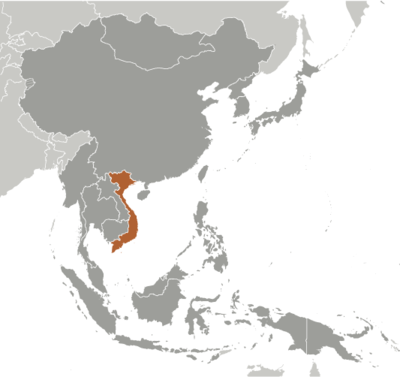
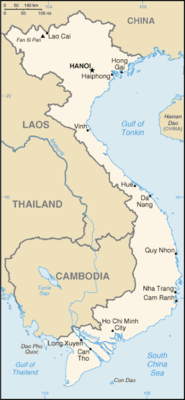
- Southeastern Asia, bordering the Gulf of Thailand, Gulf of Tonkin, and South China Sea, as well as China, Laos, and Cambodia
- Area
- 331,210 sq km
- Climate
- tropical in south; monsoonal in north with hot, rainy season (May to September) and warm, dry season (October to March)
- Terrain
- low, flat delta in south and north; central highlands; hilly, mountainous in far north and northwest
- Natural resources
- antimony, phosphates, coal, manganese, rare earth elements, bauxite, chromate, offshore oil and gas deposits, timber, hydropower, arable land
- Coastline
- 3,444 km (excludes islands)
- Natural hazards
- occasional typhoons (May to January) with extensive flooding, especially in the Mekong River delta
People & society
- Population
- 106,688,169 (2025 est.)
- Nationality
- Vietnamese (singular and plural)
- Ethnic groups
- Kinh (Viet) 85.3%, Tay 1.9%, Thai 1.9%, Muong 1.5%, Khmer 1.4%, Mong 1.4%, Nung 1.1%, other 5.5% (2019 est.)
- Languages
- Vietnamese (official); English (often as a second language); some French, Chinese, and Khmer; mountain-area languages (including Mon-Khmer and Malayo-Polynesian)
- Religions
- Catholic 6.1%, Buddhist 5.8%, Protestant 1%, other 0.8%, none 86.3% (2019 est.)
- Median age
- 33.5 years (2025 est.)
- Life expectancy at birth
- 76.1 years (2024 est.)
- Literacy
- 96.1% (2022 est.)
Economy
- Economic overview
- lower middle-income socialist East Asian economy; rapid economic growth since Đổi Mới reforms; strong investment and productivity growth; tourism and manufacturing hub; TPP signatory; declining poverty aside from ethnic minorities; systemic corruption
- Industries
- food processing, garments, shoes, machine-building; mining, coal, steel; cement, chemical fertilizer, glass, tires, oil, mobile phones
- Agricultural products
- rice, vegetables, sugarcane, cassava, maize, pork, fruits, bananas, coconuts, coffee (2023)
- Exports - partners
- USA 28%, China 20%, Japan 6%, Hong Kong 4%, Germany 3% (2023)
- Imports - partners
- China 49%, Singapore 6%, Japan 6%, Hong Kong 5%, Taiwan 4% (2023)
Government
- Government type
- communist party-led state
- Capital
- Hanoi (Ha Noi)
- Independence
- 2 September 1945 (from France)
- Constitution
- several previous; latest adopted 28 November 2013, effective 1 January 2014
- Executive branch
- President Luong CUONG (since 21 Oct 2024)
- Legislative branch
- National Assembly (Quoc-Hoi)
Full reference data
Every field, by section, CIA World Factbook. Open a topic to expand it.
Introduction
Travel Facts
Please visit the following links to find further information about your desired destination.
World Health Organization (WHO) - To learn what vaccines and health precautions to take while visiting your destination.
US State Dept Travel Information - Overall information about foreign travel for US citizens.
To obtain an international driving permit (IDP). Only two organizations in the US issue IDPs: American Automobile Association (AAA) and American Automobile Touring Alliance (AATA)
How to get help in an emergency? Contact the nearest US embassy or consulate, or call one of these numbers: from the US or Canada - 1-888-407-4747 or from Overseas - +1 202-501-4444
Page last updated: Wednesday, June 26, 2024