
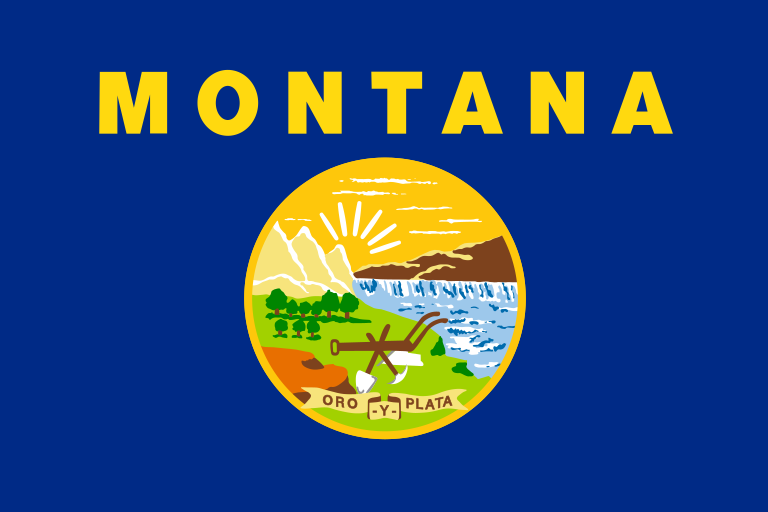
State of · MT
Montana
Greg Gianforte
Governor
RepublicanState Government 101
How Montana’s Government Works
Montana governs under a modern, rights-conscious 1972 constitution, one that guarantees a "clean and healthful environment" and an unusually strong right to know and to privacy. Its part-time Legislature meets just 90 days every two years, a plural executive includes a powerful elected Land Board, and citizens hold strong initiative and referendum powers.
- Governor term
- 4 years
- Governor term limit
- 8 years in any 16-year period
- Legislature
- Montana Legislature
- State Senate
- 50 seats · 4-yr terms
- House of Representatives
- 100 seats · 2-yr terms
- Legislator term limit
- 8 years per chamber in any 16-year period
- Sessions
- Biennial (odd years, convenes January)
- Session length
- 90 legislative days
- Legislature type
- Part-time / citizen legislature
- Legislator pay
- $128.86/legislative day in session + $206/day per diem
- Veto override
- Two-thirds of each chamber
- Line-item veto
- Yes (appropriations)
The Executive Branch, Who Runs the State
Montana has a plural executive of five statewide elected officials: the Governor, the Lieutenant Governor, the Secretary of State, the Attorney General, and the State Auditor (who also serves as Commissioner of Securities and Insurance). The Governor and Lieutenant Governor run together as a single ticket, so they share a party; the others are elected independently.
What sets Montana apart is the Land Board. The Governor, Secretary of State, Attorney General, Auditor, and Superintendent of Public Instruction sit together as the State Board of Land Commissioners, which manages roughly five million acres of state trust land, leasing it for grazing, timber, and minerals to fund public schools. That collective board, rather than a single official, controls a major piece of state resource policy, and its meetings are a regular venue for consequential decisions. The Governor appoints the heads of the executive agencies that aren’t separately elected.
The Legislature, Who Writes the Laws
The Montana Legislature is bicameral: a 50-seat State Senate (four-year terms) and a 100-seat House of Representatives (two-year terms), with members limited to eight years per chamber within any sixteen-year period. It is a genuinely part-time, citizen legislature, paid a daily rate while in session.
The defining constraint is the calendar: Montana’s Legislature meets in regular session only in odd-numbered years, and that session is capped at 90 legislative days. Everything the state does for a two-year budget cycle must be enacted in that single roughly-three-month window, after which lawmakers go home for the better part of two years. The framers of the 1972 constitution deliberately kept the Legislature part-time and close to the citizenry.
How a Bill Becomes Law
A bill is introduced, referred to committee, and, if it advances, voted on the floor of each chamber within the 90-day biennial session, with differences reconciled before final passage. The Governor can sign a bill, veto it, or let it become law, and holds a line-item veto over appropriations; a veto override takes two-thirds of each chamber. Because the Legislature usually adjourns before the veto deadline, the Secretary of State can poll lawmakers by mail on whether to override a post-session veto, an unusual mechanism for a body that is out of session most of the time.
Montana has strong direct democracy: citizens can enact statutes and propose constitutional amendments by initiative and overturn laws by referendum. Those tools, combined with the rights written into the 1972 constitution, mean Montana voters and courts play an active role in shaping policy between the Legislature’s brief sessions.
What the Governor Can (and Can’t) Do
The Governor appoints the heads of the non-elected agencies, proposes the budget, can call special sessions, holds emergency powers, wields a line-item veto, and holds the clemency power (acting with a Board of Pardons and Parole). A term limit caps service at eight years in any sixteen-year span. Because the Legislature meets so briefly and rarely, the Governor’s control of administration between sessions gives the office substantial practical reach.
The Governor also shares power in a distinctive way through the Land Board, sitting alongside four other elected officials to manage state trust lands collectively. The main internal checks are the independently elected Secretary of State, Attorney General, and Auditor, the two-thirds override, and the strong initiative and rights protections of the state constitution.
The Courts
Montana elects its judges in nonpartisan elections. The Montana Supreme Court sits at the top, above the trial-level District Courts (Montana has no permanent intermediate appeals court, so the Supreme Court hears appeals directly). The Governor fills mid-term judicial vacancies by appointment, after which the appointee must stand in the next nonpartisan election. The court has been an active interpreter of the 1972 constitution’s strong individual-rights and environmental guarantees, making judicial elections increasingly closely watched.
What makes Montana’s government distinctive
- A modern 1972 constitution with unusually strong guarantees, including a right to a "clean and healthful environment," a right to know, and a right to privacy.
- A part-time Legislature that meets just 90 days every two years.
- A five-member elected Land Board manages about five million acres of state trust land collectively, rather than through a single official.
- When the Legislature is out of session, vetoes can be overridden by a mail poll of lawmakers conducted by the Secretary of State.
- Strong citizen initiative and referendum powers paired with an unusually rights-protective constitution.
See how Montana is governed right now
Jump from the explainer into the live record for Montana.
Executive branch
Orders, rulemaking & official actions
State-specific
Montana Board of Land Commissioners
Constitutional ex-officio body managing state trust lands.
5 members · 78 meetings →
State-specific
State-Tribal Compacts
Formal agreements with federally recognized tribal nations.
13 compacts · 7 nations →
Recent activity
View all →- Press Release·Oct 22, 2026Open ↗
State Auditor James Brown Secures More Than $72K for Montana Securities Fraud Restitution Fund Through Enforcement Settlements in 2026
- Press Release·Oct 21, 2026Open ↗
Montana Helps Win Settlement After Major Wall Street Firms Overcharge Investors
- Press Release·Oct 21, 2026Open ↗
Governor Gianforte Proclaims Montana Forest Products Week
- Press Release·Oct 21, 2026Open ↗
Big Horn County woman sentenced in elder fraud case
- Press Release·Oct 20, 2026Open ↗
Montana Auditor James Brown Joins $4.4M Multistate Settlement With Wells Fargo, Merrill Lynch After Firms Caught Charging Unreasonable Commissions
- Press Release·Oct 20, 2026Open ↗
Montana’s Unemployment Rate Falls to 3.1%
- land_board_decision·Oct 19, 2026
Land Board meeting — 2026-10-19
- Press Release·Oct 19, 2026Open ↗
State Auditor James Brown Joins Land Board Colleagues in Approving More Than $927K in New Revenue for Montana Schools at October Meeting
Legislative branch
Constitution, statutes & bills
1,759 bills tracked · 70th Legislature, Regular Session (2027)
Foundational
Montana Constitution
14 articles · 157 sections · 0 paragraphs
Codified
Montana Statutes
53 titles · 30,303 sections
- SB 437signed
Revise definition of sex in Montana law
Carl GlimmRepublican
Last action Mar 25, 2026
- HB 259signed
Revise fish and wildlife commission techniques for gray wolf management
Paul FielderRepublican
Last action Sep 29, 2025
- HB 831vetoed
Increase elderly homeowner and renter income tax credit
George NikolakakosRepublican
Last action Jul 23, 2025
- HB 628vetoed
Revise early literacy targeted intervention laws
Melissa NikolakakosRepublican
Last action Jul 23, 2025
- HB 643became law
Revise reimbursement costs to detention centers holding inmates in state custody
Tracy SharpRepublican
Last action Jul 22, 2025
- SB 410vetoed
Provide for Montana genomic security act
Daniel ZolnikovRepublican
Last action Jul 19, 2025
- HB 861vetoed
Provide statewide access to a K-12 digital toolkit
Eric TillemanRepublican
Last action Jul 15, 2025
- HB 585vetoed
Revise provider rate laws for physical therapists, speech-language pathologists, and occupational therapists
Ed ButtreyRepublican
Last action Jul 15, 2025
Frequently asked questions
What is special about Montana’s 1972 constitution?
Montana rewrote its constitution in 1972, and the result is one of the more rights-conscious state charters in the country. It explicitly guarantees a right to a "clean and healthful environment," a strong "right to know" about government, and an express right of individual privacy, protections that go beyond what many state constitutions contain and that Montana courts have actively enforced.
How often does the Montana Legislature meet?
Just once every two years. Montana’s Legislature convenes in regular session only in odd-numbered years, and the session is capped at 90 legislative days. Everything for the two-year budget cycle has to be done in that roughly three-month window, after which lawmakers are out of session for most of two years.
What is the Montana Land Board?
The State Board of Land Commissioners is made up of five elected officials, the Governor, Secretary of State, Attorney General, Auditor, and Superintendent of Public Instruction, who together manage roughly five million acres of state trust land, leasing it for grazing, timber, and minerals to fund public schools. Having a board of elected officials control state lands collectively, rather than a single appointee, is a distinctive feature of Montana government.
How does Montana override a veto when the Legislature has gone home?
Because the Legislature meets only briefly every other year, it is usually adjourned when the governor vetoes a bill. In that case the Secretary of State can poll legislators by mail on whether to override, allowing a veto to be overturned without the Legislature reconvening, an unusual mechanism suited to a body that is out of session most of the time.
Can Montana voters pass their own laws?
Yes. Montana has strong direct democracy: citizens can enact statutes and propose constitutional amendments by initiative and repeal laws by referendum, each by gathering enough valid signatures and winning a majority at the ballot. Combined with the strong rights in the 1972 constitution, that gives voters and courts an active role between the Legislature’s short sessions.