
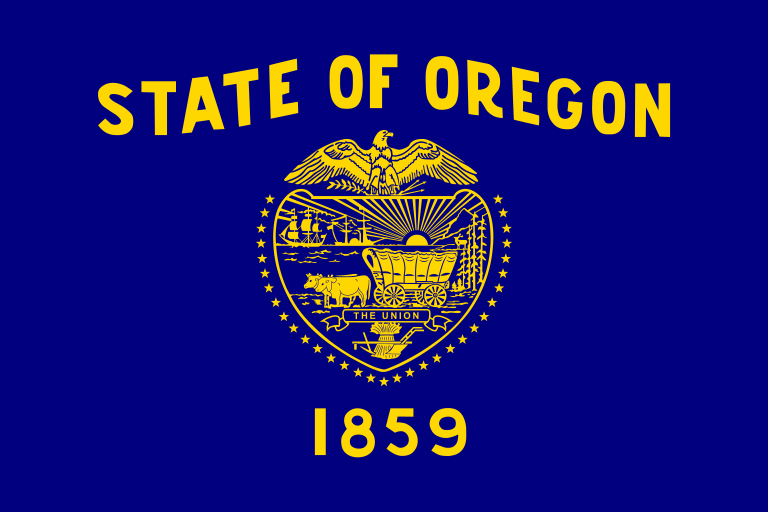
State of · OR
Oregon
Tina Kotek
Governor
DemocratState Government 101
How Oregon’s Government Works
Oregon helped invent modern direct democracy, the "Oregon System" of initiative, referendum, and recall adopted in 1902 became a model copied across the West, and it remains a state where voters routinely make law alongside a hybrid Legislature that meets annually and has no lieutenant governor above it. It has no sales tax and runs all its elections by mail.
- Governor term
- 4 years
- Governor term limit
- 8 years in any 12-year period
- Legislature
- Oregon Legislative Assembly
- State Senate
- 30 seats · 4-yr terms
- House of Representatives
- 60 seats · 2-yr terms
- Legislator term limit
- None
- Sessions
- Annual (long ~160 days odd years / short ~35 days even years)
- Session length
- Capped: ~160 / ~35 days by year
- Legislature type
- Hybrid
- Legislator pay
- $43,440/yr + $178/day per diem in session
- Veto override
- Two-thirds of each chamber
- Line-item veto
- Yes (appropriations)
The Executive Branch, Who Runs the State
Oregon elects a short slate of statewide officials and has no lieutenant governor. The Governor is joined by an independently elected Secretary of State, State Treasurer, and Attorney General. Because there is no lieutenant governor, the Secretary of State is first in the line of succession, a path that has actually elevated secretaries to the governorship.
That compact structure gives the Governor a relatively strong hand within the executive branch, though the independently elected Secretary of State (who also serves as the state’s chief elections officer and auditor), Treasurer, and Attorney General each run their own domains. The Governor appoints the heads of the executive agencies that aren’t separately elected.
The Legislature, Who Writes the Laws
The Oregon Legislative Assembly is bicameral: a 30-seat State Senate (four-year terms) and a 60-seat House of Representatives (two-year terms). It is a hybrid legislature, lawmakers spend roughly two-thirds of a full-time job on the work, though most keep outside careers, with pay of $43,440 a year plus a $178-a-day per diem in session, and there are no term limits.
Until recently Oregon’s Legislature met only every other year; voters changed the constitution in 2010 to add annual sessions, so it now holds a long session of about 160 days in odd-numbered years and a short session of about 35 days in even years. Oregon legislators have also drawn national attention for using walkouts, denying the chamber a quorum by leaving the state, as a minority tactic, prompting voters to pass a measure penalizing repeated unexcused absences.
How a Bill Becomes Law
A bill is introduced, sent to committee, and, if it advances, voted on the floor of each chamber, with differences reconciled before final passage. The Governor can sign a bill, veto it, or let it become law, and holds a line-item veto over appropriations; a veto override takes two-thirds of each chamber.
But Oregon is, above all, a direct-democracy state. The "Oregon System," adopted in 1902, gave citizens three powerful tools that the state pioneered and still uses heavily: the initiative (to enact statutes and constitutional amendments), the referendum (to repeal laws the Legislature passed), and the recall (to remove elected officials mid-term). A large share of major Oregon policy, tax measures, land-use rules, drug policy, assisted dying, has been written directly by voters at the ballot, sometimes against the Legislature’s wishes.
What the Governor Can (and Can’t) Do
The Governor appoints the heads of the non-elected agencies, proposes the budget, can call special sessions, holds broad emergency powers, wields a line-item veto, and holds the clemency power, while a term limit caps service at eight years within any twelve-year span. With only three other statewide elected officials, the Governor leads a comparatively uncluttered executive branch.
The defining limit is the electorate. Because the initiative, referendum, and recall are so deeply embedded in Oregon politics, voters can enact laws the Governor opposes, repeal laws the Governor signed, and even remove officials between elections, making direct democracy, not a rival officer, the real counterweight to the office.
The Courts
Oregon elects its judges in officially nonpartisan elections at every level. The Supreme Court of Oregon sits at the top, above the Court of Appeals and the trial-level Circuit Courts. As in other elected-judiciary states, the Governor fills mid-term vacancies by appointment, after which the new judge must stand in the next nonpartisan election.
What makes Oregon’s government distinctive
- The "Oregon System" (1902) pioneered the modern initiative, referendum, and recall, a model copied across the Western states.
- No sales tax, one of only a handful of states without one, and voters have repeatedly rejected proposals to create it.
- All elections are conducted by mail; Oregon was the first state to vote entirely by mail.
- No lieutenant governor, the Secretary of State is first in the line of succession.
- Legislative walkouts that deny a quorum have become a notable minority tactic, prompting a voter-approved penalty for repeated absences.
See how Oregon is governed right now
Jump from the explainer into the live record for Oregon.
Executive branch
Orders, rulemaking & official actions
Recent activity
View all →- Press Release·Oct 20, 2026Open ↗
Attorney General Rayfield Backs Challenge to Unlawful Warrantless Immigration Arrests
- Press Release·Oct 20, 2026Open ↗
Attorney General Rayfield Takes Action Against Contractor for Silencing Customers’ Online Reviews
- Press Release·Oct 14, 2026Open ↗
Attorney General Rayfield Takes Action to Protect Kids and Consumers in Character.AI Bankruptcy
- Executive Order·Oct 13, 2026Open ↗
Protecting Access to Health Care
- Press Release·Oct 12, 2026Open ↗
Governor Kotek Reaffirms Commitment to Immigrant and Refugee Communities Amid Increased ICE Activity
- Press Release·Oct 9, 2026Open ↗
Attorney General Dan Rayfield Challenges Trump Administration’s Funding Cuts to Unemployment System and Fraud Prevention
- Press Release·Oct 8, 2026Open ↗
Oregon Recovers $32.8 Million for Consumers as Federal Protections Weakened
- Press Release·Oct 2, 2026Open ↗
Attorney General Rayfield: Advantage Dental to Pay $4.5 Million for Improperly Billing Phone Calls to the Oregon Health Plan
Legislative branch
Constitution, statutes & bills
3,773 bills tracked · Mock Session 2026
Foundational
Oregon Constitution
33 articles · 155 sections · 0 paragraphs
Codified
Oregon Statutes
60 titles · 39,226 sections
- HB 4177vetoed
Relating to public meetings; and prescribing an effective date.
Last action Apr 16, 2026
- SB 5703signed
Relating to state financial administration; and declaring an emergency.
Last action Apr 14, 2026
- SB 1515signed
Relating to wrongful convictions; and declaring an emergency.
Last action Apr 14, 2026
- SB 1509signed
Relating to electors of President and Vice President of the United States; and prescribing an effective date.
Last action Apr 14, 2026
- SB 1575signed
Relating to hospice licensure; and declaring an emergency.
Deb PattersonDemocrat
Last action Apr 14, 2026
- SB 5702signed
Relating to state financial administration; and declaring an emergency.
Last action Apr 14, 2026
- SB 1585signed
Relating to matching grants for cities; and prescribing an effective date.
James Manning Jr.Democrat
Last action Apr 14, 2026
- SB 5701signed
Relating to state financial administration; and declaring an emergency.
Last action Apr 14, 2026
Frequently asked questions
What is the "Oregon System"?
It is the name for the package of direct-democracy tools Oregon adopted in 1902: the initiative (citizens write and pass their own statutes and constitutional amendments), the referendum (voters repeal laws the Legislature passed), and the recall (voters remove an elected official mid-term). Oregon pioneered this system, and it became a model that many Western states copied.
Does Oregon have a sales tax?
No. Oregon is one of only a handful of states with no statewide sales tax, and its voters have repeatedly rejected ballot measures to create one. The state relies more heavily on income taxes instead.
How does Oregon run its elections?
Entirely by mail. Oregon was the first state to adopt universal vote-by-mail, sending ballots to every registered voter rather than operating traditional polling places. The Secretary of State, an independently elected official, serves as the chief elections officer.
Does Oregon have a lieutenant governor?
No. Oregon is one of the few states without a lieutenant governor. The separately elected Secretary of State is first in the line of succession, a path that has actually made several secretaries governor.
How often does the Oregon Legislature meet?
Every year, but unevenly. Oregon used to meet only every other year; a 2010 constitutional change added annual sessions, so it now holds a long session of about 160 days in odd-numbered years and a short session of about 35 days in even years.