
Country exposure · CH
Switzerland
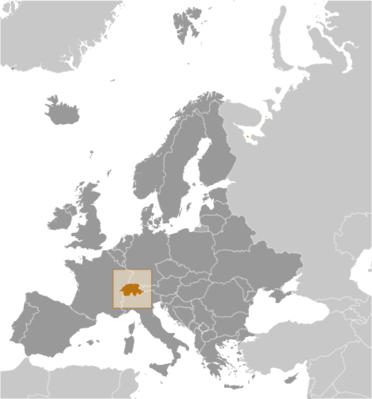
Europe · Bern · federal republic (formally a confederation)
What Switzerland means for your money, the prices you pay, the tariffs in motion, and where U.S. policy could change both.
$106.2B
U.S. imports, 2025
+67.5%
change in one year
$73.7B
U.S. exports, 2025
9M
Population
$936.6B
GDP
In your house
What you buy that Switzerland makes
America bought $106.2B in goods from Switzerland in 2025, up 67.5% in a single year. Of every $100 of it, here's where the money went.
Finished metal shapes
Pharmaceutical preparations
medicines and pharmacy items
Nonmonetary gold
Jewelry
jewelry
U.s. goods returned, and reimports
Cell phones and other household goods, n.e.c.
cell phones and home electronics
Medicinal equipment
medical devices and equipment
Other foods
Chemicals-organic
Industrial machines, other
2026 so far (through July): $28.6B in imports. Source: U.S. Census Bureau, International Trade in Goods (customs basis).
The other direction
What America sells to Switzerland
$73.7B in 2025, a trade rupture cuts both ways, for American producers as well as American prices.
Nonmonetary gold
$47.9BFinished metal shapes
$8.7BPharmaceutical preparations
$3.3Bmedicines and pharmacy items
Jewelry, etc.
$1.9Bjewelry
Artwork, antiques, stamps, etc.
$1.7BCivilian aircraft, engines, equipment, and parts
$1.5BMinimum value shipments
$1.4BGem diamonds
$1.3BPrecious metals, other
$1.1BWhere you stand
U.S. tariff posture toward Switzerland
Switzerland endured one of the steepest U.S. tariffs of any developed economy — 39% from August 7, 2025, a shock to its export-heavy economy — before the November 14, 2025 framework among the U.S., Switzerland, and Liechtenstein cut the rate to 15% (the higher of MFN or a 15% all-in rate), with exemptions for certain agricultural goods, non-patented pharmaceuticals, civil aircraft, and unavailable natural resources. Executive Order 14389 (Ending Certain Tariff Actions, Feb 20, 2026) then terminated the IEEPA reciprocal duties, and Proclamation 11012 replaced it with a 10% Section 122 temporary import surcharge effective February 24, 2026. Switzerland has no Section 232 steel/aluminum exposure; a full Agreement on Fair, Balanced, and Reciprocal Trade was targeted for March 31, 2026.
Reciprocal tariff (assigned, terminated)
31%
The rate this country was assigned under the EO 14257 reciprocal Annex, no longer in force. The Supreme Court struck down the IEEPA tariffs and they were terminated February 24, 2026 (EO 14389), replaced by a universal ~10% Section 122 surcharge. See the timeline below for the current effective rate.
Policy in motion
Tariff status: a moving target
U.S. tariff policy toward Switzerland has changed 5 times since 2025. This page tracks it.
2026-02-24
IEEPA reciprocal tariffs terminated — replaced by 10% Section 122
In effectExecutive Order 14389 (Ending Certain Tariff Actions) terminated the IEEPA tariff duties effective February 24, 2026, replacing the reciprocal regime — including Switzerland's 15% rate — with a 10% Section 122 temporary import surcharge under Proclamation 11012 (capped at 150 days).
91 FR 9437 →2025-11-14
U.S.-Switzerland-Liechtenstein framework cuts rate to 15%
AgreementA framework agreement reduced the reciprocal rate to the higher of MFN or a 15% all-in rate (down from 39%), and newly exempted certain agricultural goods, non-patented pharmaceuticals, civil aircraft, and unavailable natural resources. The modified rates applied from November 14, 2025, subject to negotiating a full agreement by March 31, 2026.
Source ↗2025-08-07
Reciprocal rate raised to 39% — among the steepest imposed
In effectExecutive Order 14326 set the post-pause Annex I reciprocal rates; Switzerland was assigned 39% — one of the highest rates applied to any developed economy and well above the 31% originally set — a significant shock to its export sector.
90 FR 37963 →2025-04-10
Elevated reciprocal rates paused to 10% for 90 days
In effectExecutive Order 14266 suspended the higher country-specific reciprocal rates — including Switzerland's 31% — back to the 10% baseline for 90 days to allow negotiations.
90 FR 15625 →2025-04-05
Reciprocal tariff regime begins — Switzerland assigned 31%
In effectExecutive Order 14257 imposed a 10% universal reciprocal duty effective April 5 and a higher country-specific rate of 31% for Switzerland scheduled to take effect April 9 under Annex I.
90 FR 15041 →
Made for America
What Switzerland makes for America
Switzerland is a direct U.S. source of 12 essential goods Americans rely on, the items themselves, shipped finished off the line.
health
17% of U.S.OTC medicines
$13.8B to the U.S.
materials
88% of U.S.Watches
$5.3B to the U.S.
health
4% of U.S.Cancer and specialty drugs
$3.0B to the U.S.
food
9% of U.S.Coffee
$1.3B to the U.S.
materials
3% of U.S.Jewelry
$511M to the U.S.
health
9% of U.S.Blood products
$511M to the U.S.
health
2% of U.S.Surgical and sterile supplies
$280M to the U.S.
materials
2% of U.S.Power & hand tools
$186M to the U.S.
materials
1% of U.S.Plumbing pipes and fittings
$182M to the U.S.
food
2% of U.S.Chocolate and cocoa products
$140M to the U.S.
materials
1% of U.S.Aluminum and aluminum products
$129M to the U.S.
food
1% of U.S.Soft drinks & juices
$95M to the U.S.
Go deeper
The supply chain view
Switzerland sits upstream of 24 essential American goods through 12 tracked inputs.
manufactured
94%Mechanical Watch Movement (Ébauche)
manufactured
78%Watch Hairspring (Balance Spring)
manufactured
78%Watch Dial, Hands & Indices
manufactured
78%Synthetic Sapphire Watch Crystal
manufactured
65%Gold Refining & Assaying (LBMA Good Delivery)
chemical
35%Seed Treatment Fungicide Active Ingredients
Reference
The country itself
Europe · Geography, people, economy, and government, public-domain data from the CIA World Factbook.
The Swiss Confederation was founded in 1291 as a defensive alliance among three cantons. In succeeding years, other localities joined the original three. The Swiss Confederation secured its independence from the Holy Roman Empire in 1499. A constitution of 1848, which was modified in 1874 to allow voters to introduce referenda on proposed laws, replaced the confederation with a centralized federal government. The major European powers have long honored Switzerland's sovereignty and neutrality, and the country was not involved in either World War. The political and economic integration of Europe over the past half-century, as well as Switzerland's role in many UN and international organizations, has strengthened Switzerland's ties with its neighbors. However, the country did not officially become a UN member until 2002. Switzerland remains active in many UN and international organizations but retains a strong commitment to neutrality.
Geography
- Location
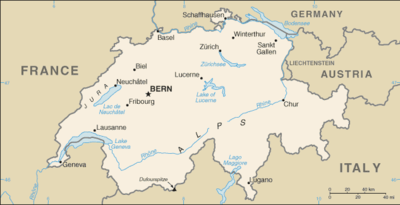
- Central Europe, east of France, north of Italy
- Area
- 41,277 sq km
- Climate
- temperate, but varies with altitude; cold, cloudy, rainy/snowy winters; cool to warm, cloudy, humid summers with occasional showers
- Terrain
- mostly mountains (Alps in south, Jura in northwest) with a central plateau of rolling hills, plains, and large lakes
- Natural resources
- hydropower potential, timber, salt
- Coastline
- 0 km (landlocked)
- Natural hazards
- avalanches, landslides; flash floods
People & society
- Population
- 8,925,741 (2025 est.)
- Nationality
- Swiss (singular and plural)
- Ethnic groups
- Swiss 69.2%, German 4.2%, Italian 3.2%, Portuguese 2.5%, French 2.1%, Kosovan 1.1%, Turkish 1%, other 16.7% (2020 est.)
- Languages
- German (or Swiss German) (official) 62.1%, French (official) 22.8%, Italian (official) 8%, English 5.7%, Portuguese 3.5%, Albanian 3.3%, Serbo-Croatian 2.3%, Spanish 2.3%, Romansh (official) 0.5%, other 7.9% (2019 est.)
- Religions
- Roman Catholic 34.4%, Protestant 22.5%, other Christian 5.7%, Muslim 5.4%, other 1.5%, none 29.4%, unspecified 1.1% (2020 est.)
- Median age
- 44.4 years (2025 est.)
- Life expectancy at birth
- 83.9 years (2024 est.)
Economy
- Economic overview
- high-income, non-EU European economy; top ten in GDP per capita; renowned banking and financial hub; low unemployment and inflation; slowed GDP growth post-pandemic; highly skilled but aging workforce; key pharmaceutical and precision manufacturing exporter; leader in innovation and competitiveness indices
- Industries
- machinery, chemicals, watches, textiles, precision instruments, tourism, banking, insurance, pharmaceuticals
- Agricultural products
- milk, sugar beets, wheat, potatoes, pork, apples, barley, beef, maize, grapes (2023)
- Exports - partners
- Germany 14%, China 12%, USA 11%, Italy 5%, Turkey 5% (2023)
- Imports - partners
- Germany 17%, USA 9%, Italy 8%, France 6%, China 5% (2023)
Government
- Government type
- federal republic (formally a confederation)
- Capital
- Bern
- Independence
- 1 August 1291 (founding of the Swiss Confederation)
- Constitution
- previous 1848, 1874; latest adopted by referendum 18 April 1999, effective 1 January 2000
- Executive branch
- President of the Swiss Confederation Guy PARMELIN (since 1 January 2026)
- Legislative branch
- Federal Assembly (Bundesversammlung - Assemblée fédérale - Assemblea federale)
Full reference data
Every field, by section, CIA World Factbook. Open a topic to expand it.
Introduction
Travel Facts
Please visit the following links to find further information about your desired destination.
World Health Organization (WHO) - To learn what vaccines and health precautions to take while visiting your destination.
US State Dept Travel Information - Overall information about foreign travel for US citizens.
To obtain an international driving permit (IDP). Only two organizations in the US issue IDPs: American Automobile Association (AAA) and American Automobile Touring Alliance (AATA)
How to get help in an emergency? Contact the nearest US embassy or consulate, or call one of these numbers: from the US or Canada - 1-888-407-4747 or from Overseas - +1 202-501-4444
Page last updated: Wednesday, June 26, 2024