
Country exposure · EE

Estonia
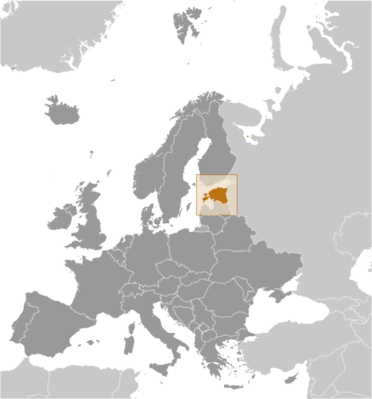
Europe · Tallinn · parliamentary republic
What Estonia means for your money, the prices you pay, the tariffs in motion, and where U.S. policy could change both.
$1.0B
U.S. imports, 2025
-4.3%
change in one year
$396M
U.S. exports, 2025
1M
Population
$42.8B
GDP
In your house
What you buy that Estonia makes
America bought $1.0B in goods from Estonia in 2025. Of every $100 of it, here's where the money went.
Telecommunications equipment
phones, routers, networking gear
Measuring, testing, control instruments
Shingles, wallboard
Medicinal equipment
medical devices and equipment
Generators, accessories
Electric apparatus
Furniture, household goods, etc.
furniture, mattresses, lamps
Toys, games, and sporting goods
toys, games, sporting goods
Other parts and accessories of vehicles
car parts and accessories
Chemicals-organic
2026 so far (through July): $644M in imports. Source: U.S. Census Bureau, International Trade in Goods (customs basis).
The other direction
What America sells to Estonia
$396M in 2025, a trade rupture cuts both ways, for American producers as well as American prices.
Tanks, artillery, missiles, rockets, guns and ammunition
$41MLaboratory testing instruments
$38MTelecommunications equipment
$31Mphones, routers, networking gear
Civilian aircraft, engines, equipment, and parts
$25MNumismatic coins
$22MPetroleum products, other
$22MSemiconductors
$19Msemiconductors and chips
Civilian aircraft
$15MApparel, household goods - textile
$13Mcotton clothing and linens
Where you stand
U.S. tariff posture toward Estonia
Since February 24, 2026 most EU goods face the universal 10% Section 122 temporary import surcharge, which replaced the framework's 15% all-inclusive IEEPA structure when EO 14389 terminated the reciprocal tariffs. The framework's Section 232 terms persist: EU autos at 15%, and the April 2026 metals expansion expressly preserved the EU's trade-agreement-partner treatment (steel and aluminum otherwise at 50%).
The United States negotiates tariffs with the European Union as a single market, every measure here applies to Estonia as an EU member.
Reciprocal tariff (assigned, terminated)
20%
The rate this country was assigned under the EO 14257 reciprocal Annex, no longer in force. The Supreme Court struck down the IEEPA tariffs and they were terminated February 24, 2026 (EO 14389), replaced by a universal ~10% Section 122 surcharge. See the timeline below for the current effective rate.
Section 232 sectors
Autos, Wood
Steel, aluminum, autos, and similar national-security tariffs that name this country.
Policy in motion
Tariff status: a moving target
U.S. tariff policy toward the European Union, and with it Estonia, has changed 11 times since 2025. This page tracks it.
2026-04-06
EU treatment preserved in expanded metals tariffs
In effectThe April 2026 proclamation expanding Section 232 coverage of aluminum, steel, and copper derivatives expressly does not alter or supersede the prior U.S.–EU agreement implementation, and lists the EU among 'Trade Agreement Partners' eligible for its exclusion process.
91 FR 18201 →2026-02-24
IEEPA reciprocal tariffs terminated — replaced by 10% Section 122
In effectExecutive Order 14389 (Ending Certain Tariff Actions) terminated the IEEPA tariff duties — including those under EO 14257, the basis of the EU's 15% all-inclusive structure — effective February 24, 2026. A flat 10% Section 122 temporary import surcharge (Proclamation 11012 of February 20, 2026) replaced them. The framework's Section 232 terms (the 15% EU autos cap, metals carve-outs) rest on separate authority and were expressly unaffected.
91 FR 9437 →2025-09-25
Framework implemented: preferential treatment for certain EU goods
In effectActing under the September 8, 2025 procedures order, Commerce and USTR modified the HTSUS to implement the framework — preferential (zero) reciprocal treatment for certain EU goods and a reduction of the Section 232 automobile and parts duty to 15% for EU-origin vehicles.
90 FR 46136 →2025-08-21
U.S.–EU Framework Agreement joint statement
AgreementThe United States and the European Union issued the Joint Statement on a Framework on an Agreement on Reciprocal, Fair, and Balanced Trade: the U.S. committed to the 15% all-inclusive ceiling, zero reciprocal duty on certain products, and a cut of the Section 232 automobile duty to 15%; the EU committed to eliminate tariffs on U.S. industrial goods and expand agricultural access, plus $750B in U.S. energy procurement through 2028.
Source ↗2025-08-07
15% all-inclusive structure replaces the 20% rate
In effectThe July 31, 2025 order ('Further Modifying the Reciprocal Tariff Rates') gave the EU a unique structure effective August 7, 2025: for goods with an MFN (Column 1) rate below 15%, the reciprocal duty tops the total up to exactly 15%; goods with an MFN rate of 15% or higher pay no additional reciprocal duty.
Federal Register · 2025-15010 →2025-07-09
Reciprocal-rate pause extended to August 1
In effectThe July 7, 2025 order extended the suspension of country-specific reciprocal rates through August 1, 2025, keeping the EU at the 10% baseline while framework talks continued.
90 FR 30823 →2025-06-04
Section 232 steel and aluminum duties doubled to 50%
In effectThe June 3, 2025 proclamation raised Section 232 duties on steel and aluminum articles and derivatives from 25% to 50% effective June 4, 2025, with no EU carve-out.
90 FR 24199 →2025-04-10
90-day pause suspends the 20% rate back to 10%
In effectThe April 9, 2025 modification order suspended country-specific reciprocal rates for 90 days for all partners except China, returning the EU to the 10% universal baseline effective April 10, 2025 while negotiations proceeded.
90 FR 15625 →2025-04-09
EU country-specific reciprocal rate of 20% takes effect
In effectAnnex I of Executive Order 14257 assigned the European Union a 20% country-specific reciprocal rate, effective April 9, 2025 — the rate still carried for the EU in the HTS Chapter 99 Subchapter III note.
Federal Register · 2025-06063 →2025-04-05
Universal 10% reciprocal baseline takes effect
In effectExecutive Order 14257 (signed April 2, 2025) imposed a 10% ad valorem reciprocal duty on imports from all trading partners, including the EU, effective April 5, 2025. The order singled out the EU's 5% average MFN rate and 10% passenger-vehicle tariff as examples of non-reciprocal treatment.
Federal Register · 2025-06063 →2025-03-12
Section 232 steel and aluminum arrangements terminated — 25% duties on EU metals
In effectProclamations of February 10, 2025 ended the EU's tariff-rate-quota arrangements for steel and aluminum and raised the aluminum duty from 10% to 25%, applying 25% Section 232 duties to EU steel and aluminum effective March 12, 2025.
90 FR 9817 →
Made for America
What Estonia makes for America
Estonia is a direct U.S. source of 7 essential goods Americans rely on, the items themselves, shipped finished off the line.
digital
Fiber optic cables and networking
$287M to the U.S.
materials
Lumber and wood products
$49M to the U.S.
materials
2% of U.S.Paint and architectural coatings
$33M to the U.S.
home
Sporting goods & fitness equipment
$22M to the U.S.
materials
Furniture
$15M to the U.S.
materials
Auto parts and repairs
$13M to the U.S.
materials
HVAC systems and equipment
$7M to the U.S.
Go deeper
The supply chain view
Estonia sits upstream of 9 essential American goods through 8 tracked inputs.
mineral
5%Dysprosium (Dy) Metal
mineral
5%Terbium (Tb) Metal
mineral
3%Neodymium-Praseodymium (NdPr) Oxide/Metal
manufactured
3%Eyewear Frame Metal Alloy (Monel/Titanium)
manufactured
2%Zipper Fasteners (Garment)
mineral
1%Rare Earth Oxides (Nd, Pr, Dy, Tb)
Reference
The country itself
Europe · Geography, people, economy, and government, public-domain data from the CIA World Factbook.
After centuries of Danish, Swedish, German, and Russian rule, Estonia attained independence in 1918. Forcibly incorporated into the USSR in 1940 -- an action never recognized by the US and many other countries -- it regained its freedom in 1991 with the collapse of the Soviet Union. Since the last Russian troops left in 1994, Estonia has been free to promote economic and political ties with the West. It joined both NATO and the EU in 2004, formally joined the OECD in 2010, and adopted the euro as its official currency in 2011.
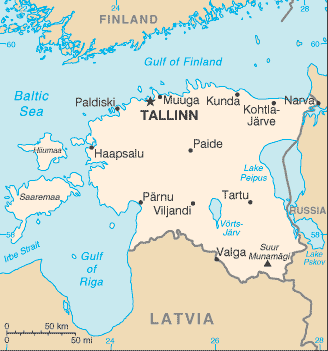
Geography
- Location
- Eastern Europe, bordering the Baltic Sea and Gulf of Finland, between Latvia and Russia
- Area
- 45,228 sq km
- Climate
- maritime; wet, moderate winters, cool summers
- Terrain
- marshy, lowlands; flat in the north, hilly in the south
- Natural resources
- oil shale, peat, rare earth elements, phosphorite, clay, limestone, sand, dolomite, arable land, sea mud
- Coastline
- 3,794 km
- Natural hazards
- sometimes flooding occurs in the spring
People & society
- Population
- 1,340,478 (2025 est.)
- Nationality
- Estonian(s)
- Ethnic groups
- Estonian 69.1%, Russian 23.7%, Ukrainian 2.1%, other 4.6%, unspecified 0.5% (2021 est.)
- Languages
- Estonian (official) 67.2%, Russian 28.5%, other 3.7%, unspecified 0.6% (2021est.)
- Religions
- Orthodox 16.5%, Protestant 9.2% (Lutheran 7.7%, other Protestant 1.5%), other 3% (includes Roman Catholic, Muslim, Jehovah's Witness, Pentecostal, Buddhist, and Taara Believer), none 58.4%, unspecified 12.9% (2021 est.)
- Median age
- 42.9 years (2025 est.)
- Life expectancy at birth
- 78.4 years (2024 est.)
Economy
- Economic overview
- high-income, service-based EU and eurozone economy; rebound in exports playing a role in economic recovery; rising food prices contributing to inflation; decrease in labor force participation and rising unemployment rate; recovery depends on boosting private investment and productivity rates
- Industries
- food, engineering, electronics, wood and wood products, textiles; information technology, telecommunications
- Agricultural products
- milk, wheat, barley, rapeseed, peas, oats, potatoes, rye, pork, triticale (2023)
- Exports - partners
- Finland 14%, Latvia 10%, Lithuania 9%, Sweden 7%, Russia 6% (2023)
- Imports - partners
- Finland 11%, Germany 11%, China 10%, Lithuania 6%, Poland 6% (2023)
Government
- Government type
- parliamentary republic
- Capital
- Tallinn
- Independence
- 24 February 1918 (from Soviet Russia); 20 August 1991 (declared from the Soviet Union); 6 September 1991 (recognized by the Soviet Union)
- Constitution
- several previous; latest adopted 28 June 1992, entered into force 3 July 1992
- Executive branch
- President Alar KARIS (since 11 October 2021)
- Legislative branch
- The Estonian Parliament (Riigikogu)
Full reference data
Every field, by section, CIA World Factbook. Open a topic to expand it.
Introduction
Travel Facts
Please visit the following links to find further information about your desired destination.
World Health Organization (WHO) - To learn what vaccines and health precautions to take while visiting your destination.
US State Dept Travel Information - Overall information about foreign travel for US citizens.
To obtain an international driving permit (IDP). Only two organizations in the US issue IDPs: American Automobile Association (AAA) and American Automobile Touring Alliance (AATA)
How to get help in an emergency? Contact the nearest US embassy or consulate, or call one of these numbers: from the US or Canada - 1-888-407-4747 or from Overseas - +1 202-501-4444
Page last updated: Wednesday, May 03, 2023