
Country exposure · GE

Georgia
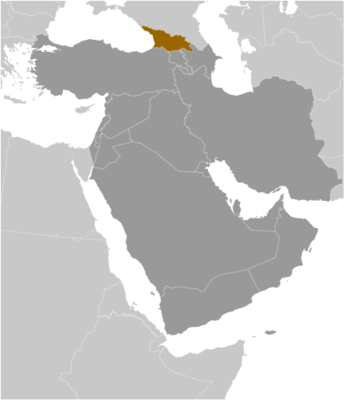
Middle East · Tbilisi · semi-presidential republic
What Georgia means for your money, the prices you pay, the tariffs in motion, and where U.S. policy could change both.
$102M
U.S. imports, 2025
-38.3%
change in one year
$2.1B
U.S. exports, 2025
5M
Population
$33.8B
GDP
In your house
What you buy that Georgia makes
America bought $102M in goods from Georgia in 2025, down 38.3% in a single year. Of every $100 of it, here's where the money went.
Steelmaking materials
Apparel, textiles, nonwool or cotton
synthetic and performance apparel
Drilling & oilfield equipment
Fruits, frozen juices
fruit and frozen juices
Plywood and veneers
Wine, beer, and related products
wine and beer
Other foods
Other parts and accessories of vehicles
car parts and accessories
U.s. goods returned, and reimports
Nuclear fuel materials
2026 so far (through July): $86M in imports. Source: U.S. Census Bureau, International Trade in Goods (customs basis).
The other direction
What America sells to Georgia
$2.1B in 2025, a trade rupture cuts both ways, for American producers as well as American prices.
Passenger cars, new and used
$1.6Bnew and used cars
Other parts and accessories of vehicles
$106Mcar parts and accessories
Civilian aircraft, engines, equipment, and parts
$90MMeat, poultry, etc.
$55MNuts
$43MTrucks, buses, and special purpose vehicles
$38Mtrucks, buses, SUVs
Telecommunications equipment
$23Mphones, routers, networking gear
Toys, games, and sporting goods
$20Mtoys, games, sporting goods
Cell phones and other household goods, n.e.c.
$17Mcell phones and home electronics
Where you stand
U.S. tariff posture toward Georgia
No U.S. tariff action singles this country out. Its goods face the universal 10% temporary import surcharge under Section 122 of the Trade Act (which replaced the IEEPA reciprocal baseline in February 2026) plus the sectoral Section 232 duties — steel and aluminum at 50% — that apply to all countries. The Section 122 surcharge is statutorily temporary — scheduled to lapse on or about July 23, 2026 (a 150-day cap) unless extended or replaced.
Reciprocal tariff (universal baseline)
10%
The universal 10% floor, a Section 122 import surcharge since February 2026, previously the EO 14257 reciprocal baseline, applies to nearly all U.S. imports. This country has no higher assigned rate of its own.
Policy in motion
Tariff status: a moving target
No U.S. tariff action names Georgia. These are the universal measures, applied to every country without a country-specific arrangement, that set its treatment.
2026-04-06
Section 232 metals coverage expanded
In effectThe April 2026 proclamation strengthening Section 232 actions on aluminum, steel, and copper expanded derivative-product coverage for all countries, keeping the general metals rate at 50%.
91 FR 18201 →2026-02-24
IEEPA reciprocal tariffs terminated — replaced by 10% Section 122 surcharge
In effectExecutive Order 14389 (Ending Certain Tariff Actions) terminated the IEEPA tariff duties — including the EO 14257 reciprocal baseline — effective February 24, 2026. A flat 10% Section 122 temporary import surcharge (Proclamation 11012 of February 20, 2026) replaced them, leaving the universal rate unchanged at 10% on a different statutory basis. Section 122 caps such surcharges at 150 days, so this 10% surcharge is scheduled to lapse on or about July 23, 2026 absent further action (the administration has signaled it could raise the rate toward the 15% statutory maximum).
91 FR 9437 →2025-11-13
Agricultural products exempted from reciprocal tariffs
In effectExecutive Order 14360 of November 14, 2025 removed reciprocal duties from certain agricultural products listed in its annexes (coffee, cocoa, bananas, and other goods the U.S. does not produce in sufficient quantity), retroactive to November 13, 2025 — for all countries subject to the reciprocal tariff.
90 FR 54091 →2025-06-04
Section 232 steel and aluminum duties doubled to 50%
In effectThe June 3, 2025 proclamation raised Section 232 duties on steel and aluminum articles and derivatives from 25% to 50% for all countries, effective June 4, 2025.
90 FR 24199 →2025-04-05
Universal 10% reciprocal baseline takes effect
In effectExecutive Order 14257 (signed April 2, 2025) imposed a 10% ad valorem reciprocal duty on imports from all trading partners, effective April 5, 2025. Countries without a higher Annex I rate remain at this baseline.
Federal Register · 2025-06063 →2025-03-12
Section 232 steel and aluminum duties set at 25% for all countries
In effectProclamations of February 10, 2025 terminated all country exemptions and quota arrangements and applied 25% Section 232 duties to steel and aluminum imports from every country, effective March 12, 2025.
90 FR 9817 →
Made for America
What Georgia makes for America
Georgia is a direct U.S. source of 5 essential goods Americans rely on, the items themselves, shipped finished off the line.
Go deeper
The supply chain view
Georgia sits upstream of 1 essential American goods through 1 tracked inputs.
Full supply-map profile →Reference
The country itself
Middle East · Geography, people, economy, and government, public-domain data from the CIA World Factbook.
The region of present-day Georgia once contained the ancient kingdoms of Colchis (known as Egrisi locally) and Kartli-Iberia. The area came under Roman influence in the first centuries A.D., and Christianity became the state religion in the 330s. Persian, Arab, and Turk domination was followed by a Georgian golden age (11th-13th centuries) that was cut short when the Mongols invaded in 1236. Subsequently, the Ottoman and Persian empires competed for influence in the region. Georgia was absorbed into the Russian Empire in the 19th century. Independent for three years (1918-1921) following the Russian revolution, it was forcibly incorporated into the USSR in 1921 and regained its independence when the Soviet Union dissolved in 1991. In 2003, mounting public discontent over rampant corruption, ineffective government services, and a government attempt to manipulate parliamentary elections touched off widespread protests that led to the resignation of Eduard SHEVARDNADZE, who had been president since 1995. In the aftermath of this "Rose Revolution," new elections in 2004 swept Mikheil SAAKASHVILI and his United National Movement (UNM) party into power. SAAKASHVILI made progress on market reforms and governance, but he faced accusations of abuse of office. Progress was further complicated when Russian support for the separatist regions of Abkhazia and South Ossetia led to a five-day conflict between Russia and Georgia in August 2008, which included Russia invading large portions of Georgian territory. Russia initially pledged to pull back from most Georgian territory but then unilaterally recognized the independence of Abkhazia and South Ossetia, and Russian military forces have remained in those regions. Billionaire Bidzina IVANISHVILI's unexpected entry into politics in 2011 brought the divided opposition together under his Georgian Dream coalition, which won a majority of seats in the 2012 parliamentary elections and removed UNM from power. Conceding defeat, SAAKASHVILI named IVANISHVILI as prime minister and left the country after his presidential term ended in 2013. IVANISHVILI voluntarily resigned from office after the presidential succession, and in the years since, the prime minister position has seen frequent turnover. In 2021, SAAKASHVILI returned to Georgia, where he was immediately arrested to serve six years in prison on outstanding abuse-of-office convictions. Popular support for integration with the West is high in Georgia. Joining the EU and NATO are among the country's top foreign policy goals, and Georgia applied for EU membership in 2022, becoming a candidate country in December 2023. Georgia and the EU have a Deep and Comprehensive Free Trade Agreement, and since 2017, Georgian citizens have been able to travel to the Schengen area without a visa.
Geography
- Location
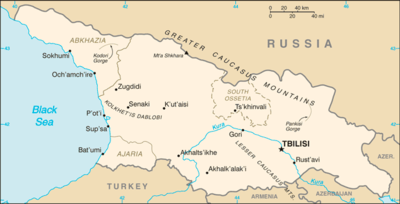
- Southwestern Asia, bordering the Black Sea, between Turkey and Russia, with a sliver of land north of the Caucasus extending into Europe; note - Georgia views itself as part of Europe; geopolitically, it can be classified as falling within Europe, the Middle East, or both
- Area
- 69,700 sq km
- Climate
- warm and pleasant; Mediterranean-like on Black Sea coast
- Terrain
- largely mountainous with Great Caucasus Mountains in the north and Lesser Caucasus Mountains in the south; Kolkhet'is Dablobi (Kolkhida Lowland) opens to the Black Sea in the west; Mtkvari River Basin in the east; fertile soils in river valley flood plains and foothills of Kolkhida Lowland
- Natural resources
- timber, hydropower, manganese deposits, iron ore, copper, minor coal and oil deposits; coastal climate and soils allow for important tea and citrus growth
- Coastline
- 310 km
- Natural hazards
- earthquakes
People & society
- Population
- 4,900,961 (2024 est.)
- Nationality
- Georgian(s)
- Ethnic groups
- Georgian 86.8%, Azeri 6.3%, Armenian 4.5%, other 2.3% (includes Russian, Ossetian, Yazidi, Ukrainian, Kist, Greek) (2014 est.)
- Languages
- Georgian (official) 87.6%, Azeri 6.2%, Armenian 3.9%, Russian 1.2%, other 1% (including Abkhaz, the official language in Abkhazia) (2014 est.)
- Religions
- Eastern Orthodox Christian (official) 83.4%, Muslim 10.7%, Armenian Apostolic Christian 2.9%, other 1.2% (includes Roman Catholic Christian, Jehovah's Witness, Yazidi, Protestant Christian, Jewish), none 0.5%, unspecified/no answer 1.2% (2014 est.)
- Median age
- 38.6 years (2025 est.)
- Life expectancy at birth
- 72.8 years (2024 est.)
- Literacy
- 99.7% (2024 est.)
Economy
- Economic overview
- upper-middle income, fast-growing South Caucasus economy; regionally focused exporter of cars, metal ores, and energy; financial and migrant inflows resulting from Ukraine conflict; EU accession talks suspended over disputed election and foreign influence law; low inflation but persistent high unemployment
- Industries
- steel, machine tools, electrical appliances, mining (manganese, copper, gold), chemicals, wood products, wine
- Agricultural products
- milk, grapes, potatoes, maize, wheat, tangerines/mandarins, tomatoes, barley, apples, eggs (2023)
- Exports - partners
- Azerbaijan 13%, Turkey 11%, Armenia 11%, Russia 10%, Kyrgyzstan 8% (2023)
- Imports - partners
- Turkey 16%, USA 13%, Russia 11%, China 8%, Germany 6% (2023)
Government
- Government type
- semi-presidential republic
- Capital
- Tbilisi
- Independence
- 9 April 1991 (from the Soviet Union); notable earlier date: A.D. 1008 (Georgia unified under King BAGRAT III)
- Constitution
- previous 1921, 1978 (based on 1977 Soviet Union constitution); latest approved 24 August 1995, effective 17 October 1995
- Executive branch
- President Mikheil KAVELASHVILI (since 29 December 2024)
- Legislative branch
- Parliament (Sakartvelos Parlamenti)
Full reference data
Every field, by section, CIA World Factbook. Open a topic to expand it.
Introduction
Travel Facts
Please visit the following links to find further information about your desired destination.
World Health Organization (WHO) - To learn what vaccines and health precautions to take while visiting your destination.
US State Dept Travel Information - Overall information about foreign travel for US citizens.
To obtain an international driving permit (IDP). Only two organizations in the US issue IDPs: American Automobile Association (AAA) and American Automobile Touring Alliance (AATA)
How to get help in an emergency? Contact the nearest US embassy or consulate, or call one of these numbers: from the US or Canada - 1-888-407-4747 or from Overseas - +1 202-501-4444
Page last updated: Wednesday, July 20, 2022