
Country exposure · GY

Guyana
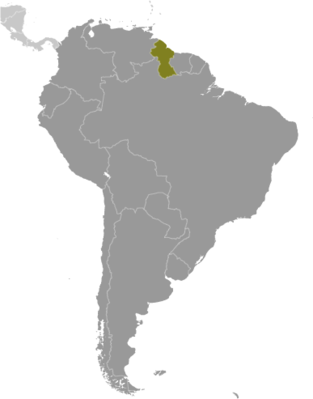
South America · Georgetown · parliamentary republic
What Guyana means for your money, the prices you pay, the tariffs in motion, and where U.S. policy could change both.
$5.1B
U.S. imports, 2025
-5%
change in one year
$1.5B
U.S. exports, 2025
794K
Population
$24.8B
GDP
In your house
What you buy that Guyana makes
America bought $5.1B in goods from Guyana in 2025. Of every $100 of it, here's where the money went.
Crude oil
U.s. goods returned, and reimports
Bauxite and aluminum
aluminum for cans and autos
Fish and shellfish
fish, shrimp, shellfish
Alcoholic beverages, excluding wine
spirits and liquor
Nonmonetary gold
Cane and beet sugar
cane and beet sugar
Lumber
lumber for homebuilding
Shingles, wallboard
Other foods
2026 so far (through July): $4.1B in imports. Source: U.S. Census Bureau, International Trade in Goods (customs basis).
The other direction
What America sells to Guyana
$1.5B in 2025, a trade rupture cuts both ways, for American producers as well as American prices.
Industrial machines, other
$209MDrilling & oilfield equipment
$109MFinished metal shapes
$95MIndustrial engines
$69MCell phones and other household goods, n.e.c.
$65Mcell phones and home electronics
Minimum value shipments
$57MMeasuring, testing, control instruments
$55MPetroleum products, other
$53MFuel oil
$52MWhere you stand
U.S. tariff posture toward Guyana
Guyana was assigned 38% in April 2025, but the impact is minimal: crude petroleum, gold, and aluminum (bauxite) ore — about 90% of Guyana's exports to the U.S. — are exempt, leaving only roughly 2% of GDP in exports actually exposed. The rate was reduced to 15% in August 2025. Executive Order 14389 (Ending Certain Tariff Actions, Feb 20, 2026) terminated the IEEPA reciprocal duties, and Proclamation 11012 replaced it with a 10% Section 122 temporary import surcharge effective February 24, 2026; the energy and mineral exemptions continue. Guyana has no Section 232 steel/aluminum exposure.
Reciprocal tariff (assigned, terminated)
38%
The rate this country was assigned under the EO 14257 reciprocal Annex, no longer in force. The Supreme Court struck down the IEEPA tariffs and they were terminated February 24, 2026 (EO 14389), replaced by a universal ~10% Section 122 surcharge. See the timeline below for the current effective rate.
Policy in motion
Tariff status: a moving target
U.S. tariff policy toward Guyana has changed 4 times since 2025. This page tracks it.
2026-02-24
IEEPA reciprocal tariffs terminated — replaced by 10% Section 122
In effectExecutive Order 14389 (Ending Certain Tariff Actions) terminated the IEEPA tariff duties effective February 24, 2026, replacing Guyana's 15% reciprocal rate with a 10% Section 122 temporary import surcharge under Proclamation 11012 (capped at 150 days); the energy and mineral exemptions continue.
91 FR 9437 →2025-08-07
Rate reduced to 15%
In effectExecutive Order 14326 set the post-pause Annex I reciprocal rates; Guyana's rate was lowered from 38% to 15% effective August 7, 2025, with the oil, gold, and bauxite exemptions intact.
90 FR 37963 →2025-04-10
Elevated reciprocal rates paused to 10% for 90 days
In effectExecutive Order 14266 suspended the higher country-specific reciprocal rates — including Guyana's 38% — back to the 10% baseline for 90 days.
90 FR 15625 →2025-04-05
Reciprocal tariff regime begins — Guyana assigned 38% (oil, gold, bauxite exempt)
In effectExecutive Order 14257 imposed a 10% universal reciprocal duty effective April 5 and a 38% country-specific rate for Guyana scheduled to take effect April 9 — but crude petroleum, gold, and aluminum ore, about 90% of Guyana's U.S. exports, were carved out.
90 FR 15041 →
Made for America
What Guyana makes for America
Guyana is a direct U.S. source of 4 essential goods Americans rely on, the items themselves, shipped finished off the line.
Go deeper
The supply chain view
Guyana sits upstream of 4 essential American goods through 5 tracked inputs.
mineral
37%Bauxite (aluminum ore)
mineral
37%Bauxite Ore (Primary Aluminum Feedstock)
energy
4%Canadian crude oil imports
energy
4%Gulf Coast crude oil feedstock (jet fraction)
energy
3%Crude Oil Feedstock
Reference
The country itself
South America · Geography, people, economy, and government, public-domain data from the CIA World Factbook.
Originally a Dutch colony in the 17th century, by 1815 Guyana had become a British possession. The abolition of slavery led to former slaves settling urban areas and indentured servants being imported from India to work the sugar plantations. The resulting ethnocultural divide has persisted and has led to turbulent politics. Guyana achieved independence from the UK in 1966, and since then primarily socialist-oriented governments have ruled the country. In 1992, Cheddi JAGAN was elected president in what is considered the country's first free and fair election since independence. After his death five years later, his wife, Janet JAGAN, became president but resigned in 1999 due to poor health. Her successor, Bharrat JAGDEO, was elected in 2001 and again in 2006. Donald RAMOTAR won in 2011, but early elections held in 2015 resulted in the first change in governing party, and David GRANGER took office. After a 2018 no-confidence vote against the GRANGER government, the administration ignored a constitutional requirement to hold elections and remained in place until the 2020 elections, when Irfaan ALI became president. The discovery of massive offshore oil reserves in 2015 has been Guyana's primary economic and political focus, with many hoping the reserves will transform one of the poorest countries in the region. Guyana is the only English-speaking country in South America and shares cultural and historical bonds with the Anglophone Caribbean.
Geography
- Location
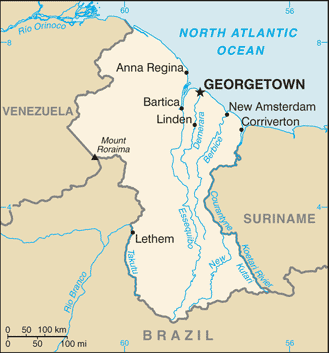
- Northern South America, bordering the North Atlantic Ocean, between Suriname and Venezuela
- Area
- 214,969 sq km
- Climate
- tropical; hot, humid, moderated by northeast trade winds; two rainy seasons (May to August, November to January)
- Terrain
- mostly rolling highlands; low coastal plain; savanna in south
- Natural resources
- bauxite, gold, diamonds, hardwood timber, shrimp, fish
- Coastline
- 459 km
- Natural hazards
- flash flood threat during rainy seasons
People & society
- Population
- 794,099 (2024 est.)
- Nationality
- Guyanese (singular and plural)
- Ethnic groups
- East Indian 39.8%, African descent 29.3%, mixed 19.9%, Indigenous 10.5%, other 0.5% (includes Portuguese, Chinese, White) (2012 est.)
- Languages
- English (official), Guyanese Creole, Amerindian languages (including Caribbean and Arawak languages), Indian languages (including Caribbean Hindustani, a dialect of Hindi), Chinese (2014 est.)
- Religions
- Protestant 34.8% (Pentecostal 22.8%, Seventh Day Adventist 5.4%, Anglican 5.2%, Methodist 1.4%), Hindu 24.8%, other Christian 20.8%, Roman Catholic 7.1%, Muslim 6.8%, Jehovah's Witness 1.3%, Rastafarian 0.5%, other 0.9%, none 3.1% (2012 est.)
- Median age
- 28.7 years (2025 est.)
- Life expectancy at birth
- 72.4 years (2024 est.)
- Literacy
- 85.6% (2020 est.)
Economy
- Economic overview
- small, hydrocarbon-driven South American export economy; major forest coverage being leveraged in carbon credit offsets to encourage preservation; strengthening financial sector; large bauxite and gold resources
- Industries
- bauxite, sugar, rice milling, timber, textiles, gold mining
- Agricultural products
- rice, sugarcane, plantains, cassava, papayas, pumpkins/squash, chicken, milk, ginger, eggplants (2023)
- Exports - partners
- USA 20%, Trinidad & Tobago 11%, Netherlands 10%, Singapore 10%, Germany 7% (2023)
- Imports - partners
- USA 28%, China 13%, Trinidad & Tobago 11%, Brazil 5%, Bahamas, The 4% (2023)
Government
- Government type
- parliamentary republic
- Capital
- Georgetown
- Independence
- 26 May 1966 (from the UK)
- Constitution
- several previous; latest promulgated 6 October 1980
- Executive branch
- President Mohammed Irfaan ALI (since 2 August 2020)
- Legislative branch
- Parliament of the Co-operative Republic of Guyana
Full reference data
Every field, by section, CIA World Factbook. Open a topic to expand it.
Introduction
Travel Facts
Please visit the following links to find further information about your desired destination.
World Health Organization (WHO) - To learn what vaccines and health precautions to take while visiting your destination.
US State Dept Travel Information - Overall information about foreign travel for US citizens.
To obtain an international driving permit (IDP). Only two organizations in the US issue IDPs: American Automobile Association (AAA) and American Automobile Touring Alliance (AATA)
How to get help in an emergency? Contact the nearest US embassy or consulate, or call one of these numbers: from the US or Canada - 1-888-407-4747 or from Overseas - +1 202-501-4444
Page last updated: Wednesday, July 20, 2022