
Country exposure · IT

Italy
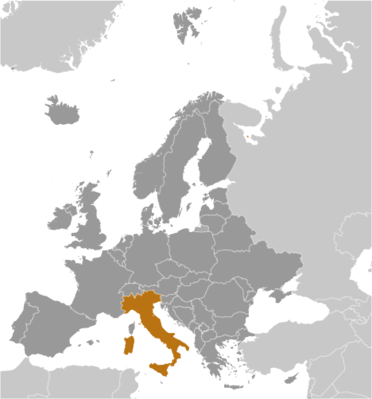
Europe · Rome · parliamentary republic
What Italy means for your money, the prices you pay, the tariffs in motion, and where U.S. policy could change both.
$74.4B
U.S. imports, 2025
-2.1%
change in one year
$43.1B
U.S. exports, 2025
61M
Population
$2.4T
GDP
In your house
What you buy that Italy makes
America bought $74.4B in goods from Italy in 2025. Of every $100 of it, here's where the money went.
Pharmaceutical preparations
medicines and pharmacy items
U.s. goods returned, and reimports
Industrial machines, other
Other foods
Passenger cars, new and used
new and used cars
Wine, beer, and related products
wine and beer
Cell phones and other household goods, n.e.c.
cell phones and home electronics
Toiletries and cosmetics
toiletries and cosmetics
Jewelry
jewelry
Industrial engines
2026 so far (through July): $44.0B in imports. Source: U.S. Census Bureau, International Trade in Goods (customs basis).
The other direction
What America sells to Italy
$43.1B in 2025, a trade rupture cuts both ways, for American producers as well as American prices.
Pharmaceutical preparations
$17.8Bmedicines and pharmacy items
Gas-natural
$3.0BCrude oil
$2.6BPrecious metals, other
$2.3BMinimum value shipments
$1.1BCivilian aircraft, engines, equipment, and parts
$997MIndustrial engines
$763MIndustrial machines, other
$740MTelecommunications equipment
$637Mphones, routers, networking gear
Where you stand
U.S. tariff posture toward Italy
Since February 24, 2026 most EU goods face the universal 10% Section 122 temporary import surcharge, which replaced the framework's 15% all-inclusive IEEPA structure when EO 14389 terminated the reciprocal tariffs. The framework's Section 232 terms persist: EU autos at 15%, and the April 2026 metals expansion expressly preserved the EU's trade-agreement-partner treatment (steel and aluminum otherwise at 50%).
The United States negotiates tariffs with the European Union as a single market, every measure here applies to Italy as an EU member.
Reciprocal tariff (assigned, terminated)
20%
The rate this country was assigned under the EO 14257 reciprocal Annex, no longer in force. The Supreme Court struck down the IEEPA tariffs and they were terminated February 24, 2026 (EO 14389), replaced by a universal ~10% Section 122 surcharge. See the timeline below for the current effective rate.
Section 232 sectors
Autos, Wood
Steel, aluminum, autos, and similar national-security tariffs that name this country.
Policy in motion
Tariff status: a moving target
U.S. tariff policy toward the European Union, and with it Italy, has changed 11 times since 2025. This page tracks it.
2026-04-06
EU treatment preserved in expanded metals tariffs
In effectThe April 2026 proclamation expanding Section 232 coverage of aluminum, steel, and copper derivatives expressly does not alter or supersede the prior U.S.–EU agreement implementation, and lists the EU among 'Trade Agreement Partners' eligible for its exclusion process.
91 FR 18201 →2026-02-24
IEEPA reciprocal tariffs terminated — replaced by 10% Section 122
In effectExecutive Order 14389 (Ending Certain Tariff Actions) terminated the IEEPA tariff duties — including those under EO 14257, the basis of the EU's 15% all-inclusive structure — effective February 24, 2026. A flat 10% Section 122 temporary import surcharge (Proclamation 11012 of February 20, 2026) replaced them. The framework's Section 232 terms (the 15% EU autos cap, metals carve-outs) rest on separate authority and were expressly unaffected.
91 FR 9437 →2025-09-25
Framework implemented: preferential treatment for certain EU goods
In effectActing under the September 8, 2025 procedures order, Commerce and USTR modified the HTSUS to implement the framework — preferential (zero) reciprocal treatment for certain EU goods and a reduction of the Section 232 automobile and parts duty to 15% for EU-origin vehicles.
90 FR 46136 →2025-08-21
U.S.–EU Framework Agreement joint statement
AgreementThe United States and the European Union issued the Joint Statement on a Framework on an Agreement on Reciprocal, Fair, and Balanced Trade: the U.S. committed to the 15% all-inclusive ceiling, zero reciprocal duty on certain products, and a cut of the Section 232 automobile duty to 15%; the EU committed to eliminate tariffs on U.S. industrial goods and expand agricultural access, plus $750B in U.S. energy procurement through 2028.
Source ↗2025-08-07
15% all-inclusive structure replaces the 20% rate
In effectThe July 31, 2025 order ('Further Modifying the Reciprocal Tariff Rates') gave the EU a unique structure effective August 7, 2025: for goods with an MFN (Column 1) rate below 15%, the reciprocal duty tops the total up to exactly 15%; goods with an MFN rate of 15% or higher pay no additional reciprocal duty.
Federal Register · 2025-15010 →2025-07-09
Reciprocal-rate pause extended to August 1
In effectThe July 7, 2025 order extended the suspension of country-specific reciprocal rates through August 1, 2025, keeping the EU at the 10% baseline while framework talks continued.
90 FR 30823 →2025-06-04
Section 232 steel and aluminum duties doubled to 50%
In effectThe June 3, 2025 proclamation raised Section 232 duties on steel and aluminum articles and derivatives from 25% to 50% effective June 4, 2025, with no EU carve-out.
90 FR 24199 →2025-04-10
90-day pause suspends the 20% rate back to 10%
In effectThe April 9, 2025 modification order suspended country-specific reciprocal rates for 90 days for all partners except China, returning the EU to the 10% universal baseline effective April 10, 2025 while negotiations proceeded.
90 FR 15625 →2025-04-09
EU country-specific reciprocal rate of 20% takes effect
In effectAnnex I of Executive Order 14257 assigned the European Union a 20% country-specific reciprocal rate, effective April 9, 2025 — the rate still carried for the EU in the HTS Chapter 99 Subchapter III note.
Federal Register · 2025-06063 →2025-04-05
Universal 10% reciprocal baseline takes effect
In effectExecutive Order 14257 (signed April 2, 2025) imposed a 10% ad valorem reciprocal duty on imports from all trading partners, including the EU, effective April 5, 2025. The order singled out the EU's 5% average MFN rate and 10% passenger-vehicle tariff as examples of non-reciprocal treatment.
Federal Register · 2025-06063 →2025-03-12
Section 232 steel and aluminum arrangements terminated — 25% duties on EU metals
In effectProclamations of February 10, 2025 ended the EU's tariff-rate-quota arrangements for steel and aluminum and raised the aluminum duty from 10% to 25%, applying 25% Section 232 duties to EU steel and aluminum effective March 12, 2025.
90 FR 9817 →
Made for America
What Italy makes for America
Italy is a direct U.S. source of 12 essential goods Americans rely on, the items themselves, shipped finished off the line.
health
6% of U.S.OTC medicines
$4.7B to the U.S.
health
3% of U.S.Cancer and specialty drugs
$2.5B to the U.S.
materials
3% of U.S.Clothing and apparel
$2.5B to the U.S.
food
11% of U.S.Beer, wine, and spirits
$2.4B to the U.S.
materials
1% of U.S.Vehicles and light trucks
$2.3B to the U.S.
materials
8% of U.S.Footwear
$2.0B to the U.S.
materials
10% of U.S.Jewelry
$2.0B to the U.S.
home
13% of U.S.Luggage, handbags & travel goods
$1.4B to the U.S.
materials
4% of U.S.Furniture
$1.3B to the U.S.
materials
1% of U.S.Auto parts and repairs
$1.1B to the U.S.
materials
5% of U.S.Plumbing pipes and fittings
$1.0B to the U.S.
home
38% of U.S.Eyewear (frames & sunglasses)
$939M to the U.S.
Go deeper
The supply chain view
Italy sits upstream of 24 essential American goods through 12 tracked inputs.
chemical
69%Vinegar / Acetic Acid (Condiment Acidulant)
manufactured
50%Nasopharyngeal Flocked Nylon Swabs
manufactured
50%Consumer MEMS Sensors (Accelerometers, Gyroscopes, Environmental)
manufactured
37%Sawmill cutting tooling
manufactured
35%Yankee Dryer Cylinder (Steel or Cast-Iron Tissue Machine)
pharmaceutical
35%Budesonide API
Reference
The country itself
Europe · Geography, people, economy, and government, public-domain data from the CIA World Factbook.
Italy became a nation-state in 1861 when the regional states of the peninsula, along with Sardinia and Sicily, were united under King Victor EMMANUEL II. An era of parliamentary government came to a close in the early 1920s when Benito MUSSOLINI established a Fascist dictatorship. His alliance with Nazi Germany led to Italy's defeat in World War II. A democratic republic replaced the monarchy in 1946, and economic revival followed. Italy is a charter member of NATO, as well as the European Economic Community (EEC) and its successors, the EC and the EU. It has been at the forefront of European economic and political unification, joining the Economic and Monetary Union in 1999. Persistent problems include sluggish economic growth, high youth and female unemployment, organized crime, corruption, and economic disparities between southern Italy and the more prosperous north.
Geography
- Location
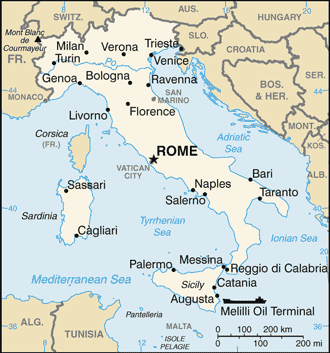
- Southern Europe, a peninsula extending into the central Mediterranean Sea, northeast of Tunisia
- Area
- 301,340 sq km
- Climate
- predominantly Mediterranean; alpine in far north; hot, dry in south
- Terrain
- mostly rugged and mountainous; some plains, coastal lowlands
- Natural resources
- coal, antimony, mercury, zinc, potash, marble, barite, asbestos, pumice, fluorspar, feldspar, pyrite (sulfur), natural gas and crude oil reserves, fish, arable land
- Coastline
- 7,600 km
- Natural hazards
- regional risks include landslides, mudflows, avalanches, earthquakes, volcanic eruptions, flooding; land subsidence in Venice volcanism: significant volcanic activity; Etna (3,330 m) is Europe's most active volcano, and its flank eruptions pose a threat to nearby Sicilian villages; Etna, along with the famous Vesuvius, have both been deemed Decade Volcanoes by the International Association of Volcanology and Chemistry of the Earth's Interior, worthy of study due to their explosive history and close proximity to human populations; Stromboli, on its namesake island, has also been continuously active with moderate volcanic activity; other historically active volcanoes include Campi Flegrei, Ischia, Larderello, Pantelleria, Vulcano, and Vulsini
People & society
- Population
- 60,924,851 (2025 est.)
- Nationality
- Italian(s)
- Ethnic groups
- Italian (includes small clusters of German-, French-, and Slovene-Italians in the north, Albanian-Italians, Croat-Italians, and Greek-Italians in the south)
- Languages
- Italian (official), German (parts of Trentino-Alto Adige region are predominantly German-speaking), French (small French-speaking minority in Valle d'Aosta region), Slovene (Slovene-speaking minority in the Trieste-Gorizia area), Croatian (in Molise)
- Religions
- Christian 80.8% (overwhelmingly Roman Catholic with very small groups of Jehovah's Witnesses and Protestants), Muslim 4.9%, unaffiliated 13.4%, other 0.9% (2020 est.)
- Median age
- 48.8 years (2025 est.)
- Life expectancy at birth
- 83 years (2024 est.)
- Literacy
- 99.3% (2019 est.)
Economy
- Economic overview
- high-income, core EU economy; strong services, manufacturing, and tourism sectors; modest growth supported by net exports, low inflation, and public investments via EU funds; tight labor market with aging workforce and shortages in specialized skills; high public debt levels
- Industries
- tourism, machinery, iron and steel, chemicals, food processing, textiles, motor vehicles, clothing, footwear, ceramics
- Agricultural products
- milk, wheat, grapes, tomatoes, maize, olives, apples, oranges, sugar beets, rice (2023)
- Exports - partners
- Germany 11%, USA 11%, France 10%, Spain 5%, UK 5% (2023)
- Imports - partners
- Germany 15%, France 9%, China 8%, Netherlands 6%, Spain 5% (2023)
Government
- Government type
- parliamentary republic
- Capital
- Rome
- Independence
- 17 March 1861
- Constitution
- previous 1848 (originally for the Kingdom of Sardinia and adopted by the Kingdom of Italy in 1861); latest enacted 22 December 1947, adopted 27 December 1947, entered into force 1 January 1948
- Executive branch
- President Sergio MATTARELLA (since 3 February 2015)
- Legislative branch
- Parliament (Il Parlamento)
Full reference data
Every field, by section, CIA World Factbook. Open a topic to expand it.
Introduction
Travel Facts
Please visit the following links to find further information about your desired destination.
World Health Organization (WHO) - To learn what vaccines and health precautions to take while visiting your destination.
US State Dept Travel Information - Overall information about foreign travel for US citizens.
To obtain an international driving permit (IDP). Only two organizations in the US issue IDPs: American Automobile Association (AAA) and American Automobile Touring Alliance (AATA)
How to get help in an emergency? Contact the nearest US embassy or consulate, or call one of these numbers: from the US or Canada - 1-888-407-4747 or from Overseas - +1 202-501-4444
Page last updated: Tuesday, June 04, 2024