
Country exposure · PA
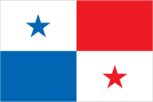
Panama
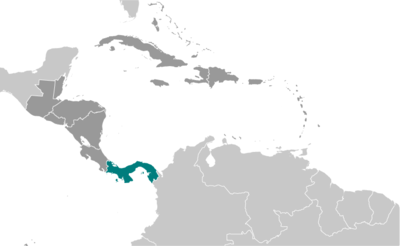
Central America N Caribbean · Panama City · presidential republic
What Panama means for your money, the prices you pay, the tariffs in motion, and where U.S. policy could change both.
$659M
U.S. imports, 2025
+19.3%
change in one year
$8.9B
U.S. exports, 2025
5M
Population
$86.3B
GDP
In your house
What you buy that Panama makes
America bought $659M in goods from Panama in 2025, up 19.3% in a single year. Of every $100 of it, here's where the money went.
U.s. goods returned, and reimports
Nonmonetary gold
Fish and shellfish
fish, shrimp, shellfish
Electric apparatus
Cane and beet sugar
cane and beet sugar
Generators, accessories
Fruits, frozen juices
fruit and frozen juices
Cell phones and other household goods, n.e.c.
cell phones and home electronics
Minimum value shipments
Copper
copper for wiring
2026 so far (through July): $653M in imports. Source: U.S. Census Bureau, International Trade in Goods (customs basis).
The other direction
What America sells to Panama
$8.9B in 2025, a trade rupture cuts both ways, for American producers as well as American prices.
Fuel oil
$1.8BPetroleum products, other
$1.5BCivilian aircraft, engines, equipment, and parts
$1.0BCrude oil
$505MPharmaceutical preparations
$379Mmedicines and pharmacy items
Minimum value shipments
$333MToiletries and cosmetics
$218Mtoiletries and cosmetics
Gas-natural
$198MOther foods
$145MWhere you stand
U.S. tariff posture toward Panama
No U.S. tariff action singles this country out. Its goods face the universal 10% temporary import surcharge under Section 122 of the Trade Act (which replaced the IEEPA reciprocal baseline in February 2026) plus the sectoral Section 232 duties — steel and aluminum at 50% — that apply to all countries. The Section 122 surcharge is statutorily temporary — scheduled to lapse on or about July 23, 2026 (a 150-day cap) unless extended or replaced.
Reciprocal tariff (universal baseline)
10%
The universal 10% floor, a Section 122 import surcharge since February 2026, previously the EO 14257 reciprocal baseline, applies to nearly all U.S. imports. This country has no higher assigned rate of its own.
Policy in motion
Tariff status: a moving target
No U.S. tariff action names Panama. These are the universal measures, applied to every country without a country-specific arrangement, that set its treatment.
2026-04-06
Section 232 metals coverage expanded
In effectThe April 2026 proclamation strengthening Section 232 actions on aluminum, steel, and copper expanded derivative-product coverage for all countries, keeping the general metals rate at 50%.
91 FR 18201 →2026-02-24
IEEPA reciprocal tariffs terminated — replaced by 10% Section 122 surcharge
In effectExecutive Order 14389 (Ending Certain Tariff Actions) terminated the IEEPA tariff duties — including the EO 14257 reciprocal baseline — effective February 24, 2026. A flat 10% Section 122 temporary import surcharge (Proclamation 11012 of February 20, 2026) replaced them, leaving the universal rate unchanged at 10% on a different statutory basis. Section 122 caps such surcharges at 150 days, so this 10% surcharge is scheduled to lapse on or about July 23, 2026 absent further action (the administration has signaled it could raise the rate toward the 15% statutory maximum).
91 FR 9437 →2025-11-13
Agricultural products exempted from reciprocal tariffs
In effectExecutive Order 14360 of November 14, 2025 removed reciprocal duties from certain agricultural products listed in its annexes (coffee, cocoa, bananas, and other goods the U.S. does not produce in sufficient quantity), retroactive to November 13, 2025 — for all countries subject to the reciprocal tariff.
90 FR 54091 →2025-06-04
Section 232 steel and aluminum duties doubled to 50%
In effectThe June 3, 2025 proclamation raised Section 232 duties on steel and aluminum articles and derivatives from 25% to 50% for all countries, effective June 4, 2025.
90 FR 24199 →2025-04-05
Universal 10% reciprocal baseline takes effect
In effectExecutive Order 14257 (signed April 2, 2025) imposed a 10% ad valorem reciprocal duty on imports from all trading partners, effective April 5, 2025. Countries without a higher Annex I rate remain at this baseline.
Federal Register · 2025-06063 →2025-03-12
Section 232 steel and aluminum duties set at 25% for all countries
In effectProclamations of February 10, 2025 terminated all country exemptions and quota arrangements and applied 25% Section 232 duties to steel and aluminum imports from every country, effective March 12, 2025.
90 FR 9817 →
Made for America
What Panama makes for America
Panama is a direct U.S. source of 8 essential goods Americans rely on, the items themselves, shipped finished off the line.
food
Seafood and fish
$81M to the U.S.
food
2% of U.S.Sugar
$29M to the U.S.
materials
Copper and electrical wiring
$29M to the U.S.
grocery
Fresh produce staples
$24M to the U.S.
digital
Smartphones and tablets
$10M to the U.S.
materials
Jewelry
$6M to the U.S.
food
Coffee
$6M to the U.S.
food
Beer, wine, and spirits
$6M to the U.S.
Go deeper
The supply chain view
Panama sits upstream of 2 essential American goods through 2 tracked inputs.
manufactured
1%Copper scrap (secondary copper)
agricultural
1%Banana supply chain (plantation, sea transport, ripening)
Reference
The country itself
Central America N Caribbean · Geography, people, economy, and government, public-domain data from the CIA World Factbook.
Explored and settled by the Spanish in the 16th century, Panama broke with Spain in 1821 and joined a union of Colombia, Ecuador, and Venezuela that was named the Republic of Gran Colombia. When the union dissolved in 1830, Panama remained part of Colombia. With US backing, Panama seceded from Colombia in 1903 and promptly signed a treaty with the US allowing for the construction of a canal and US sovereignty over a strip of land known as the Panama Canal Zone on either side of the structure. The US Army Corps of Engineers built the Panama Canal between 1904 and 1914. In 1977, an agreement was signed for the complete transfer of the Canal from the US to Panama by the end of the century. Certain portions of the Zone and increasing responsibility over the Canal were turned over in the subsequent decades. With US help, Panamanian dictator Manuel NORIEGA was deposed in 1989. The entire Panama Canal, the area supporting the Canal, and remaining US military bases were transferred to Panama by the end of 1999. An ambitious expansion project to more than double the Canal's capacity by allowing for more Canal transits and larger ships was carried out between 2007 and 2016.
Geography
- Location
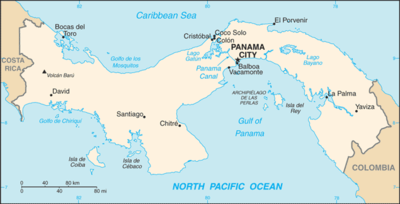
- Central America, bordering both the Caribbean Sea and the North Pacific Ocean, between Colombia and Costa Rica
- Area
- 75,420 sq km
- Climate
- tropical maritime; hot, humid, cloudy; prolonged rainy season (May to January), short dry season (January to May)
- Terrain
- interior mostly steep, rugged mountains with dissected, upland plains; coastal plains with rolling hills
- Natural resources
- copper, mahogany forests, shrimp, hydropower
- Coastline
- 2,490 km
- Natural hazards
- occasional severe storms and forest fires in the Darien area
People & society
- Population
- 4,536,008 (2025 est.)
- Nationality
- Panamanian(s)
- Ethnic groups
- Mestizo (mixed Indigenous and White) 65%, Indigenous 12.3% (Ngabe 7.6%, Kuna 2.4%, Embera 0.9%, Bugle 0.8%, other 0.4%, unspecified 0.2%), Black or African descent 9.2%, Mulatto 6.8%, White 6.7% (2010 est.)
- Languages
- Spanish (official), Indigenous languages (including Ngabere (Guaymi), Buglere, Kuna, Embera, Wounaan, Naso (Teribe), and Bri Bri), Panamanian English Creole (a mixture of English and Spanish with elements of Ngabere, also known as Guari Guari and Colon Creole), English, Chinese (Yue and Hakka), Arabic, French Creole, other (Yiddish, Hebrew, Korean, Japanese)
- Religions
- Evangelical 55%, Roman Catholic 33.4%, none 10.1%, unspecified 1.5% (2023 est.)
- Median age
- 31.7 years (2025 est.)
- Life expectancy at birth
- 79.2 years (2024 est.)
- Literacy
- 96.3% (2024 est.)
Economy
- Economic overview
- upper middle-income Central American economy; increasing Chinese trade; US dollar user; canal expansion fueling broader infrastructure investment; services sector dominates economy; historic money-laundering and illegal drug hub
- Industries
- construction, brewing, cement and other construction materials, sugar milling
- Agricultural products
- sugarcane, rice, bananas, oranges, oil palm fruit, chicken, plantains, maize, milk, pineapples (2023)
- Exports - partners
- China 25%, Japan 10%, USA 6%, Thailand 5%, Costa Rica 5% (2023)
- Imports - partners
- USA 15%, Colombia 13%, China 13%, Ecuador 13%, Japan 11% (2023)
Government
- Government type
- presidential republic
- Capital
- Panama City
- Independence
- 3 November 1903 (from Colombia); 28 November 1821 (from Spain)
- Constitution
- several previous; latest effective 11 October 1972
- Executive branch
- President José Raúl MULINO Quintero (since 1 July 2024)
- Legislative branch
- National Assembly (Asamblea Nacional)
Full reference data
Every field, by section, CIA World Factbook. Open a topic to expand it.
Introduction
Travel Facts
Please visit the following links to find further information about your desired destination.
World Health Organization (WHO) - To learn what vaccines and health precautions to take while visiting your destination.
US State Dept Travel Information - Overall information about foreign travel for US citizens.
To obtain an international driving permit (IDP). Only two organizations in the US issue IDPs: American Automobile Association (AAA) and American Automobile Touring Alliance (AATA)
How to get help in an emergency? Contact the nearest US embassy or consulate, or call one of these numbers: from the US or Canada - 1-888-407-4747 or from Overseas - +1 202-501-4444
Page last updated: Wednesday, July 20, 2022