
Country exposure · RU
Russia
Central Asia · Moscow · semi-presidential federation
What Russia means for your money, the prices you pay, the tariffs in motion, and where U.S. policy could change both.
$3.8B
U.S. imports, 2025
+25.6%
change in one year
$583M
U.S. exports, 2025
140M
Population
$2.2T
GDP
In your house
What you buy that Russia makes
America bought $3.8B in goods from Russia in 2025, up 25.6% in a single year. Of every $100 of it, here's where the money went.
Chemicals-fertilizers
Nuclear fuel materials
Other precious metals
Engines-civilian aircraft
Plywood and veneers
Parts-civilian aircraft
Chemicals-inorganic
Feedstuff and foodgrains
Nonferrous metals, other
Food oils, oilseeds
2026 so far (through July): $2.0B in imports. Source: U.S. Census Bureau, International Trade in Goods (customs basis).
The other direction
What America sells to Russia
$583M in 2025, a trade rupture cuts both ways, for American producers as well as American prices.
Pharmaceutical preparations
$197Mmedicines and pharmacy items
Medicinal equipment
$94Mmedical devices and equipment
Other foods
$45MApparel, household goods - textile
$35Mcotton clothing and linens
Cell phones and other household goods, n.e.c.
$35Mcell phones and home electronics
Laboratory testing instruments
$34MAgric. farming-unmanufactured
$25MPulpwood and woodpulp
$17MChemicals-other
$15MWhere you stand
U.S. tariff posture toward Russia
Russia is the exception to the entire tariff regime: it was deliberately left off the April 2025 reciprocal tariff list because pre-existing sanctions over the war in Ukraine had already cut U.S.-Russia trade to negligible levels. Russian energy (crude oil, petroleum products) is barred from the U.S. under IEEPA sanctions (Executive Order 14066, 2022), and Russian aluminum carries a 200% duty imposed in 2023 — far above the 50% Section 232 rate applied to other countries. Rather than tariff Russia directly, the administration used the threat of secondary tariffs on third countries buying Russian oil (Executive Order 14329, August 2025) as leverage — the basis for India's 25% penalty. Executive Order 14389 (Ending Certain Tariff Actions, Feb 2026) ended the IEEPA tariff duties, but Russia's Section 232 metals duties and its energy-import sanctions are separate authorities and remain in force.
Section 232 sectors
Aluminum
Steel, aluminum, autos, and similar national-security tariffs that name this country.
Policy in motion
Tariff status: a moving target
U.S. tariff policy toward Russia has changed 5 times since 2025. This page tracks it.
2026-02-24
IEEPA tariffs ended — Russia's metals duties and sanctions unaffected
In effectExecutive Order 14389 (Ending Certain Tariff Actions, Feb 20, 2026) ended IEEPA-based tariffs, collapsing the secondary-tariff leverage on Russian-oil buyers. Russia's Section 232 metals duties (including the 200% on aluminum) and its energy-import sanctions rest on separate authorities and remain in force.
91 FR 9437 →2025-08-06
Secondary-tariff threat on buyers of Russian oil
ThreatenedExecutive Order 14329 (Addressing Threats to the United States by the Government of the Russian Federation) authorized additional duties on third countries importing Russian oil — the mechanism used to impose a 25% penalty on India — pressuring Russia indirectly rather than tariffing its goods directly.
91 FR 6501 →2025-06-04
Section 232 steel and aluminum general rate doubled to 50%
In effectProclamation 10947 raised the standard Section 232 steel and aluminum tariff to 50%. For Russia this affected steel, while Russian aluminum continued at the higher 200% rate.
90 FR 24199 →2025-04-05
Russia excluded from the reciprocal tariff regime
In effectExecutive Order 14257 omitted Russia from the reciprocal tariff list entirely. The administration cited pre-existing sanctions over the invasion of Ukraine — including the prohibition on importing Russian oil and petroleum under Executive Order 14066 — which had already reduced bilateral trade to negligible levels.
90 FR 15041 →2025-03-12
Section 232 metals — Russian aluminum remains at 200%
In effectAs Section 232 steel and aluminum duties were reset for all countries, Russian aluminum and any products containing Russian-origin aluminum continued to carry the 200% duty imposed in 2023 (Proclamation 10522) — the binding rate on Russian metals, well above the standard Section 232 tariff.
Source ↗
Made for America
What Russia makes for America
Russia is a direct U.S. source of 6 essential goods Americans rely on, the items themselves, shipped finished off the line.
agriculture
26% of U.S.Ammonia and nitrogen fertilizers
$1.2B to the U.S.
agriculture
8% of U.S.Potash and phosphate fertilizers
$388M to the U.S.
materials
Lumber and wood products
$76M to the U.S.
agriculture
1% of U.S.Animal feed
$23M to the U.S.
agriculture
4% of U.S.Fertilizers and crop inputs
$19M to the U.S.
food
Snacks & confectionery
$7M to the U.S.
Go deeper
The supply chain view
Russia sits upstream of 24 essential American goods through 12 tracked inputs.
mineral
100%PGM Sulfide Ore — Russian Arctic (Norilsk/Taimyr)
chemical
54%UAN Solution (Urea Ammonium Nitrate, 28-32% N)
mineral
46%Low-Enriched Uranium (LEU) Nuclear Fuel
pharmaceutical
45%Carbon-13 (C-13) Stable Isotope (Medical Diagnostics & Pharmaceutical)
mineral
44%Low-Enriched Uranium (LEU) Nuclear Fuel
mineral
40%PGM Sulfide Ore — Bushveld Complex (South Africa)
Reference
The country itself
Central Asia · Geography, people, economy, and government, public-domain data from the CIA World Factbook.
Founded in the 12th century, the Principality of Muscovy emerged from over 200 years of Mongol domination (13th-15th centuries) and gradually conquered and absorbed surrounding principalities. In the early 17th century, a new ROMANOV dynasty continued this policy of expansion across Siberia to the Pacific. Under PETER I (1682-1725), hegemony was extended to the Baltic Sea and the country was renamed the Russian Empire. During the 19th century, more territorial acquisitions were made in Europe and Asia. Defeat in the Russo-Japanese War of 1904-05 contributed to the Revolution of 1905, which resulted in the formation of a parliament and other reforms. Devastating defeats and food shortages in World War I led to widespread rioting in the major cities of the Russian Empire and to the overthrow of the ROMANOV Dynasty in 1917. The communists under Vladimir LENIN seized power soon after and formed the Union of Soviet Socialist Republics (USSR). The brutal rule of Iosif STALIN (1928-53) strengthened communist control and Russian dominance of the Soviet Union at a cost of tens of millions of lives. After defeating Germany in World War II as part of an alliance with the US (1939-1945), the USSR expanded its territory and influence in Eastern Europe and emerged as a global power. The USSR was the principal US adversary during the Cold War (1947-1991). The Soviet economy and society stagnated in the decades following Stalin's rule, until General Secretary Mikhail GORBACHEV (1985-91) introduced glasnost (openness) and perestroika (restructuring) in an attempt to modernize communism. His initiatives inadvertently released political and economic forces that by December 1991 led to the dissolution of the USSR into Russia and 14 other independent states. In response to the ensuing turmoil during President Boris YELTSIN's term (1991-99), Russia shifted toward a centralized authoritarian state under President Vladimir PUTIN (2000-2008, 2012-present) in which the regime seeks to legitimize its rule through managed elections, populist appeals, a foreign policy focused on enhancing the country's geopolitical influence, and commodity-based economic growth. In 2014, Russia purported to annex Ukraine's Crimean Peninsula and occupied large portions of two eastern Ukrainian oblasts. In sporadic fighting over the next eight years, more than 14,000 civilians were killed or wounded as a result of the Russian invasion in eastern Ukraine. On 24 February 2022, Russia escalated its conflict with Ukraine by invading the country on several fronts in what has become the largest conventional military attack on a sovereign state in Europe since World War II. The invasion received near-universal international condemnation, and many countries imposed sanctions on Russia and supplied humanitarian and military aid to Ukraine. In September 2022, Russia unilaterally declared its annexation of four Ukrainian oblasts -- Donetsk, Kherson, Luhansk, and Zaporizhzhia -- even though none were fully under Russian control. The annexations remain unrecognized by the international community.
Geography
- Location
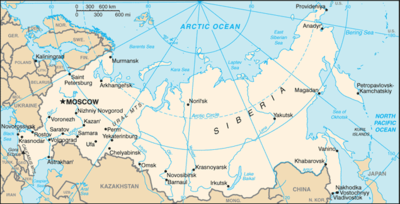
- North Asia bordering the Arctic Ocean, extending from Eastern Europe (the portion west of the Urals) to the North Pacific Ocean
- Area
- 17,098,242 sq km
- Climate
- ranges from steppes in the south through humid continental in much of European Russia; subarctic in Siberia to tundra climate in the polar north; winters vary from cool along Black Sea coast to frigid in Siberia; summers vary from warm in the steppes to cool along Arctic coast
- Terrain
- broad plain with low hills west of Urals; vast coniferous forest and tundra in Siberia; uplands and mountains along southern border regions
- Natural resources
- wide natural-resource base including major deposits of oil, natural gas, coal, and many strategic minerals, bauxite, reserves of rare earth elements, timber
- Coastline
- 37,653 km
- Natural hazards
- permafrost over much of Siberia is a major impediment to development; volcanic activity in the Kuril Islands; volcanoes and earthquakes on the Kamchatka Peninsula; spring floods and summer/autumn forest fires in Siberia and parts of European Russia volcanism: Kamchatka Peninsula is home to 29 historically active volcanoes, with dozens more in the Kuril Islands; Kliuchevskoi (4,835 m) is Kamchatka's most active volcano; Avachinsky and Koryaksky volcanoes, which pose a threat to the city of Petropavlovsk-Kamchatsky, have been deemed Decade Volcanoes by the International Association of Volcanology and Chemistry of the Earth's Interior, worthy of study due to their explosive history and close proximity to human populations; other notable historically active volcanoes include Bezymianny, Chikurachki, Ebeko, Gorely, Grozny, Karymsky, Ketoi, Kronotsky, Ksudach, Medvezhia, Mutnovsky, Sarychev Peak, Shiveluch, Tiatia, Tolbachik, and Zheltovsky; see note 2 under "Geography - note"
People & society
- Population
- 140,134,279 (2025 est.)
- Nationality
- Russian(s)
- Ethnic groups
- Russian 77.7%, Tatar 3.7%, Ukrainian 1.4%, Bashkir 1.1%, Chuvash 1%, Chechen 1%, other 10.2%, unspecified 3.9% (2010 est.)
- Languages
- Russian (official) 85.7%, Tatar 3.2%, Chechen 1%, other 10.1% (2010 est.)
- Religions
- Russian Orthodox 15-20%, Muslim 10-15%, other Christian 2% (2006 est.)
- Median age
- 42.3 years (2025 est.)
- Life expectancy at birth
- 72.3 years (2024 est.)
- Literacy
- 99.9% (2021 est.)
Economy
- Economic overview
- natural resource-rich Eurasian economy; leading energy exporter to Europe and Asia; decreased oil export reliance; endemic corruption, Ukrainian invasion, and lack of green infrastructure limit investment and have led to sanctions
- Industries
- complete range of mining and extractive industries producing coal, oil, gas, chemicals, and metals; all forms of machine building from rolling mills to high-performance aircraft and space vehicles; defense industries (including radar, missile production, advanced electronic components), shipbuilding; road and rail transportation equipment; communications equipment; agricultural machinery, tractors, and construction equipment; electric power generating and transmitting equipment; medical and scientific instruments; consumer durables, textiles, foodstuffs, handicrafts
- Agricultural products
- wheat, sugar beets, milk, barley, potatoes, sunflower seeds, maize, soybeans, chicken, pork (2023)
- Exports - partners
- China 33%, India 17%, Turkey 8%, Kazakhstan 4%, Brazil 3% (2023)
- Imports - partners
- China 53%, Turkey 5%, Germany 5%, Kazakhstan 5%, Italy 2% (2023)
Government
- Government type
- semi-presidential federation
- Capital
- Moscow
- Independence
- 25 December 1991 (from the Soviet Union; Russian SFSR renamed Russian Federation); notable earlier dates: 1157 (Principality of Vladimir-Suzdal created); 16 January 1547 (Tsardom of Muscovy established); 22 October 1721 (Russian Empire proclaimed); 30 December 1922 (Soviet Union established)
- Constitution
- several previous (during Russian Empire and Soviet era); latest drafted 12 July 1993, adopted by referendum 12 December 1993, effective 25 December 1993
- Executive branch
- President Vladimir Vladimirovich PUTIN (since 7 May 2012)
- Legislative branch
- Federal Assembly (Federalnoye Sobraniye)
Full reference data
Every field, by section, CIA World Factbook. Open a topic to expand it.
Introduction
Travel Facts
Please visit the following links to find further information about your desired destination.
CDC - To learn what vaccines and health precautions to take while visiting your destination.
US State Dept Travel Information - Overall information about foreign travel for US citizens.
To obtain an international driving permit (IDP). Only two organizations in the US issue IDPs: American Automobile Association (AAA) and American Automobile Touring Alliance (AATA)
How to get help in an emergency? Contact the nearest US embassy or consulate, or call one of these numbers: from the US or Canada - 1-888-407-4747 or from Overseas - +1 202-501-4444
Page last updated: Friday, June 28, 2024