
Country exposure · VE
Venezuela
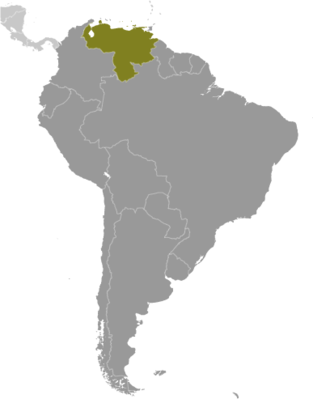
South America · Caracas · federal presidential republic
What Venezuela means for your money, the prices you pay, the tariffs in motion, and where U.S. policy could change both.
$3.7B
U.S. imports, 2025
-38.6%
change in one year
$3.0B
U.S. exports, 2025
32M
Population
$139.4B
GDP
In your house
What you buy that Venezuela makes
America bought $3.7B in goods from Venezuela in 2025, down 38.6% in a single year. Of every $100 of it, here's where the money went.
Crude oil
Petroleum products, other
gasoline and petroleum products
Fish and shellfish
fish, shrimp, shellfish
Chemicals-organic
Electric apparatus
Green coffee
green coffee for roasters
Cocoa beans
cocoa for chocolate
Alcoholic beverages, excluding wine
spirits and liquor
Tobacco, waxes, etc.
Bakery products
2026 so far (through July): $8.2B in imports. Source: U.S. Census Bureau, International Trade in Goods (customs basis).
The other direction
What America sells to Venezuela
$3.0B in 2025, a trade rupture cuts both ways, for American producers as well as American prices.
Petroleum products, other
$1.0BAnimal feeds, n.e.c.
$224MOilseeds, food oils
$175Mdairy and eggs
Cell phones and other household goods, n.e.c.
$151Mcell phones and home electronics
Passenger cars, new and used
$137Mnew and used cars
Plastic materials
$136Mplastics for packaging and goods
Wheat
$135Mgreen coffee for roasters
Corn
$79MElectric apparatus
$66MWhere you stand
U.S. tariff posture toward Venezuela
Venezuela's direct trade with the U.S. is minimal under longstanding sanctions, so the 15% reciprocal tariff has little practical bite. The more consequential measure was Executive Order 14245 (March 2025), a novel 25% 'secondary tariff' on any country importing Venezuelan oil — a lever aimed at the Maduro regime rather than a duty on Venezuelan goods. Both rested on IEEPA: Executive Order 14389 (Ending Certain Tariff Actions) terminated them effective February 24, 2026, replacing the reciprocal with a 10% Section 122 temporary import surcharge (Proclamation 11012) and collapsing the secondary-tariff mechanism. Venezuela has no Section 232 steel/aluminum exposure.
Reciprocal tariff (assigned, terminated)
15%
The rate this country was assigned under the EO 14257 reciprocal Annex, no longer in force. The Supreme Court struck down the IEEPA tariffs and they were terminated February 24, 2026 (EO 14389), replaced by a universal ~10% Section 122 surcharge. See the timeline below for the current effective rate.
Policy in motion
Tariff status: a moving target
U.S. tariff policy toward Venezuela has changed 4 times since 2025. This page tracks it.
2026-02-24
IEEPA tariffs terminated — reciprocal and Venezuelan-oil secondary tariff struck down
EndedExecutive Order 14389 (Ending Certain Tariff Actions) terminated the IEEPA tariff duties effective February 24, 2026 — replacing Venezuela's 15% reciprocal rate with a 10% Section 122 temporary import surcharge (Proclamation 11012) and collapsing the EO 14245 secondary-tariff mechanism on Venezuelan-oil buyers.
91 FR 9437 →2025-08-07
15% reciprocal rate takes effect
In effectExecutive Order 14326 set the post-pause Annex I reciprocal rates; Venezuela's 15% rate took effect August 7, 2025, with little practical impact given the sanctions regime.
90 FR 37963 →2025-04-05
Reciprocal tariff regime begins — Venezuela assigned 15%
In effectExecutive Order 14257 imposed a 10% universal reciprocal duty effective April 5 and a 15% country-specific rate for Venezuela scheduled to take effect April 9 — though sanctions already kept direct Venezuela-U.S. trade minimal.
90 FR 15041 →2025-03-24
EO 14245 — 25% secondary tariff on buyers of Venezuelan oil
In effectExecutive Order 14245 authorized a novel 25% 'secondary tariff' on all goods from any country importing Venezuelan oil, directly or indirectly, on or after April 2, 2025 — pressuring the Maduro regime by targeting its oil customers rather than tariffing Venezuelan goods.
Federal Register · 2025-05440 →
Made for America
What Venezuela makes for America
Venezuela is a direct U.S. source of 6 essential goods Americans rely on, the items themselves, shipped finished off the line.
Go deeper
The supply chain view
Venezuela sits upstream of 7 essential American goods through 9 tracked inputs.
energy
8%Bitumen / Asphalt Binder
energy
5%Oxidized Asphalt / Bitumen
energy
4%Crude Oil Feedstock
manufactured
3%Silicon Carbide Abrasive Grain (Grinding/Lapping/Wire Saw)
energy
2%Gulf Coast crude oil feedstock (jet fraction)
energy
2%Canadian crude oil imports
Reference
The country itself
South America · Geography, people, economy, and government, public-domain data from the CIA World Factbook.
Venezuela was one of three countries that emerged from the collapse of Gran Colombia in 1830, the others being Ecuador and New Granada (Colombia). For most of the first half of the 20th century, military strongmen ruled Venezuela and promoted the oil industry while allowing some social reforms. Democratically elected governments largely held sway until 1999, but Hugo CHAVEZ, who was president from 1999 to 2013, exercised authoritarian control over other branches of government. This trend continued in 2018 when Nicolas MADURO claimed the presidency for his second term in an election boycotted by most opposition parties and widely viewed as fraudulent. The legislative elections in 2020 were also seen as fraudulent, and most opposition parties and many international actors consider the resulting National Assembly illegitimate. In 2021, many opposition parties broke a three-year election boycott and participated in mayoral and gubernatorial elections, despite flawed conditions. As a result, the opposition more than doubled its representation at the mayoral level and retained four of 23 governorships. The 2021 regional elections marked the first time since 2006 that the EU was allowed to send an electoral observation mission to Venezuela. MADURO has placed strong restrictions on free speech and the press. Since CHAVEZ, the ruling party has expanded the state's role in the economy through expropriations of major enterprises, strict currency exchange and price controls, and over-dependence on the petroleum industry for revenues. Years of economic mismanagement left Venezuela ill-prepared to weather the global drop in oil prices in 2014, sparking an economic decline that has resulted in reduced government social spending, shortages of basic goods, and high inflation. Worsened living conditions have prompted nearly 8 million Venezuelans to emigrate, mainly settling in nearby countries. The US imposed financial sanctions on MADURO and his representatives in 2017 and on sectors of the Venezuelan economy in 2018. Limited sanctions relief followed when the MADURO administration began making democratic and electoral concessions. The government's mismanagement and lack of investment in infrastructure has also weakened the country's energy sector. Caracas has relaxed some controls to mitigate the impact of its sustained economic crisis, such as allowing increased import flexibility for the private sector and the informal use of US dollars and other international currencies. Ongoing concerns include human rights abuses, rampant violent crime, political manipulation of the judicial and electoral systems, and corruption.
Geography
- Location
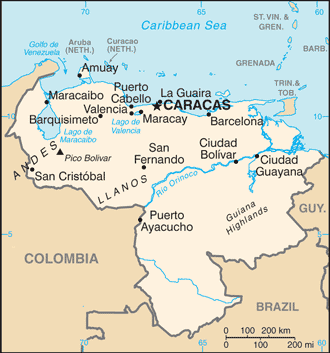
- Northern South America, bordering the Caribbean Sea and the North Atlantic Ocean, between Colombia and Guyana
- Area
- 912,050 sq km
- Climate
- tropical; hot, humid; more moderate in highlands
- Terrain
- Andes Mountains and Maracaibo Lowlands in northwest; central plains (llanos); Guiana Highlands in southeast
- Natural resources
- petroleum, natural gas, iron ore, gold, bauxite, other minerals, hydropower, diamonds
- Coastline
- 2,800 km
- Natural hazards
- subject to floods, rockslides, mudslides; periodic droughts
People & society
- Population
- 31,755,435 (2025 est.)
- Nationality
- Venezuelan(s)
- Ethnic groups
- unspecified Spanish, Italian, Portuguese, Arab, German, African, Indigenous
- Languages
- Spanish (official) 98.2%, indigenous 1.3%, Portuguese 0.1%, other 0.4% (2023 est.)
- Religions
- Roman Catholic 48.1%, Protestant 31.6% (Evangelical 31.4%, Adventist 0.2%), Jehovah's Witness 1.4%, African American/umbanda 0.7%, other 0.1%, believer 3.5%, agnostic 0.1%, atheist, 0.4%, none 13.6%, unspecified 0.6% (2023 est.)
- Median age
- 31.3 years (2025 est.)
- Life expectancy at birth
- 74.5 years (2024 est.)
- Literacy
- 97.2% (2017 est.)
Economy
- Economic overview
- South American economy; ongoing hyperinflation since mid-2010s; chaotic economy due to political corruption, infrastructure cuts, and human rights abuses; in debt default; oil exporter; hydropower consumer; rising Chinese relations
- Industries
- agricultural products, livestock, raw materials, machinery and equipment, transport equipment, construction materials, medical equipment, pharmaceuticals, chemicals, iron and steel products, crude oil and petroleum products
- Agricultural products
- milk, sugarcane, maize, rice, plantains, oil palm fruit, bananas, chicken, pineapples, potatoes (2023)
- Exports - partners
- USA 50%, China 10%, Spain 9%, Brazil 6%, Turkey 5% (2023)
- Imports - partners
- China 35%, USA 24%, Brazil 12%, Colombia 7%, Turkey 4% (2023)
Government
- Government type
- federal presidential republic
- Capital
- Caracas
- Independence
- 5 July 1811 (from Spain)
- Constitution
- many previous; latest adopted 15 December 1999, effective 30 December 1999
- Executive branch
- Interim President Delcy Eloína RODRíGUEZ Gómez (since 5 January 2026)
- Legislative branch
- National Assembly (Asamblea Nacional)
Full reference data
Every field, by section, CIA World Factbook. Open a topic to expand it.
Introduction
Travel Facts
Please visit the following links to find further information about your desired destination.
World Health Organization (WHO) - To learn what vaccines and health precautions to take while visiting your destination.
US State Dept Travel Information - Overall information about foreign travel for US citizens.
To obtain an international driving permit (IDP). Only two organizations in the US issue IDPs: American Automobile Association (AAA) and American Automobile Touring Alliance (AATA)
How to get help in an emergency? Contact the nearest US embassy or consulate, or call one of these numbers: from the US or Canada - 1-888-407-4747 or from Overseas - +1 202-501-4444
Page last updated: Wednesday, June 26, 2024