
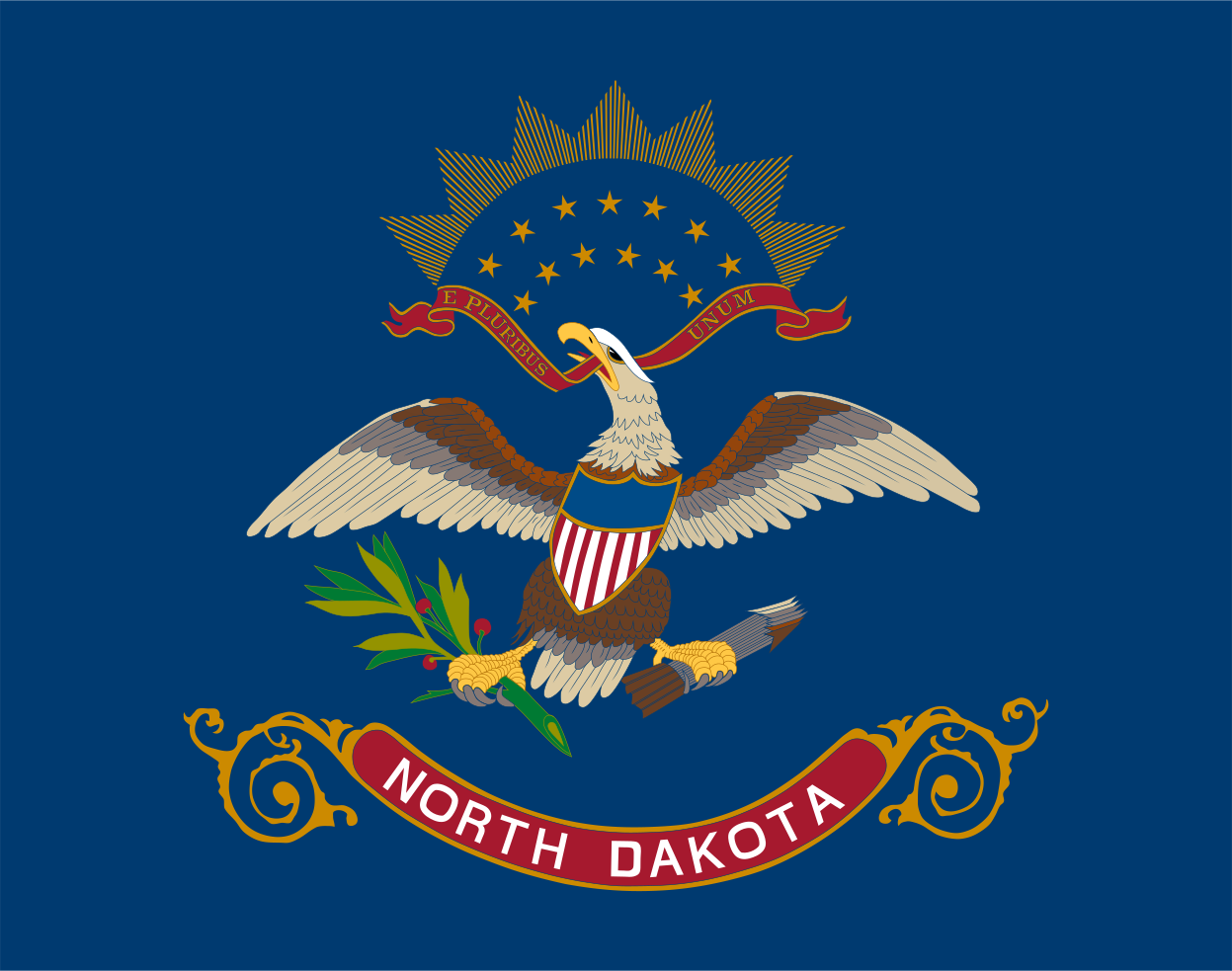
State of · ND
North Dakota
Kelly Armstrong
Governor
RepublicanState Government 101
How North Dakota’s Government Works
North Dakota is the only state with no voter registration, eligible residents simply show up and vote, a legacy of its small towns and populist past. That same Progressive-era movement left it with institutions found nowhere else: the country’s only state-owned bank and state-owned mill. A part-time Legislature meets just once every two years, beneath a large plural executive.
- Governor term
- 4 years
- Governor term limit
- Two terms (8 years), lifetime (voter-adopted 2022)
- Legislature
- North Dakota Legislative Assembly
- State Senate
- 47 seats · 4-yr terms
- House of Representatives
- 94 seats · 4-yr terms
- Legislator term limit
- 8 years per chamber (voter-adopted 2022)
- Sessions
- Biennial (odd years; capped at 80 legislative days per biennium)
- Session length
- 80 legislative days per two-year biennium
- Legislature type
- Part-time / citizen legislature
- Legislator pay
- $213/day in session + $592/mo salary
- Veto override
- Two-thirds of each chamber
- Line-item veto
- Yes (appropriations)
The Executive Branch, Who Runs the State
North Dakota has a large plural executive of statewide elected officials: the Governor, the Lieutenant Governor, the Secretary of State, the Attorney General, the State Treasurer, the State Auditor, the Agriculture Commissioner, the Tax Commissioner, the Insurance Commissioner, the three-member Public Service Commission, and more. Since the 1960s the Governor and Lieutenant Governor have run together as a single ticket; most of the others are elected independently.
This crowded ballot is itself a legacy of the state’s populist, anti-concentration political tradition, the same impulse that produced its state-owned enterprises (below). The Governor appoints the heads of the executive agencies that aren’t separately elected, but shares the executive branch with a long roster of officers who answer to the voters.
The Legislature, Who Writes the Laws
The North Dakota Legislative Assembly is bicameral: a 47-seat State Senate and a 94-seat House of Representatives, with members of both chambers serving four-year terms. In 2022 voters adopted term limits, eight years per chamber, for the first time. It is a part-time, citizen legislature, paid mainly a daily rate while in session.
Its defining feature is how rarely it meets. North Dakota is one of only a handful of states with a biennial legislature: the Assembly convenes in regular session only in odd-numbered years and is capped at 80 legislative days across the two-year biennium. Lawmakers often hold a few days in reserve so they can return briefly if needed, but for most of any two-year period the Legislature is simply not in session.
How a Bill Becomes Law
A bill is introduced, referred to committee (North Dakota gives essentially every bill a public hearing), and, if it advances, voted on the floor of each chamber within the 80-day biennial window, with differences reconciled before final passage. The Governor can sign a bill, veto it, or let it become law, and holds a line-item veto over appropriations; a veto override takes two-thirds of each chamber.
North Dakota has strong direct democracy: citizens can enact statutes and propose constitutional amendments by initiative and overturn laws by referendum, tools rooted in the same early-1900s populist movement that shaped the state. And North Dakota is unique in election administration: it is the only state with no voter registration at all. Eligible residents simply appear at the polls with proof of identity and residence and cast a ballot, a system the state attributes to its tradition of small communities where neighbors knew one another.
What the Governor Can (and Can’t) Do
The Governor appoints the heads of the non-elected agencies, proposes the budget, can call special sessions, holds emergency powers, wields a line-item veto, and holds the clemency power (with a Pardon Advisory Board advising). Since 2022 the Governor is capped at two terms (eight years), but the office still accumulates substantial influence, especially because the Legislature is out of session most of the time, leaving day-to-day governance to the executive branch.
The main internal checks are the unusually large field of independently elected statewide officers, the two-thirds override, and the citizen initiative. Between biennial sessions, the Governor’s control of the budget proposal and administration gives the office substantial practical reach.
The Courts
North Dakota elects its judges in nonpartisan elections. The North Dakota Supreme Court sits at the top, above the trial-level District Courts; the state has a small, sparingly used temporary Court of Appeals rather than a permanent intermediate court, reflecting its small population and caseload. The Governor fills mid-term judicial vacancies by appointment from a nominating committee’s list, after which the appointee must stand in the next nonpartisan election.
What makes North Dakota’s government distinctive
- The only state with no voter registration, eligible residents simply show up and vote with proof of identity and residence.
- Home to the country’s only state-owned bank (the Bank of North Dakota) and only state-owned mill and elevator, relics of its Progressive-era populist movement.
- One of only a handful of states whose legislature meets just once every two years, capped at 80 legislative days per biennium.
- A large plural executive with a long list of independently elected officers, including an elected Tax Commissioner and Public Service Commission.
- Adopted legislative term limits for the first time only in 2022, by ballot measure.
See how North Dakota is governed right now
Jump from the explainer into the live record for North Dakota.
Executive branch
Orders, rulemaking & official actions
Recent activity
View all →- Press Release·May 29, 2026Open ↗
ATTORNEY GENERAL WRIGLEYWARNS ABOUT TRANSIENT ASPHALT PAVING SCAMS
- Press Release·May 29, 2026Open ↗
Return June Primary Election Absentee Ballots
- Press Release·May 27, 2026Open ↗
Don't Overlook the June 9 Primary Election
- Press Release·May 22, 2026Open ↗
Tax Commissioner Releases First Quarter 2026 Taxable Sales Data
- Press Release·May 21, 2026Open ↗
Armstrong statement on U.S. Army Corps releasing Record of Decision for Dakota Access Pipeline
- Press Release·May 21, 2026Open ↗
Governor directs flags flown at half-staff on Monday until noon in observance of Memorial Day
- Press Release·May 20, 2026Open ↗
Meeting Notice: Agricultural Products Utilization Commission
- Press Release·May 20, 2026Open ↗
Armstrong names Mandan Middle School and Bottineau High as 2026 Governor's Band and Chorus
Legislative branch
Constitution, statutes & bills
1,101 bills tracked · 2025 Regular Session
Foundational
North Dakota Constitution
16 articles · 202 sections · 0 paragraphs
Codified
North Dakota Statutes
69 titles · 22,801 sections
- SB 2401became law
AN ACT to create and enact a new subdivision to subsection 2 of section 12-60-24 of the North Dakota Century Code, relating to criminal history record checks by the board of occupational therapy practice; to amend and reenact section 43-17-27.1 of the North Dakota Century Code, relating to physician continuing education requirements; to provide a statement of legislative intent; and to provide an effective date.
Legislative Management
Last action Jan 28, 2026
- SB 2402became law
AN ACT to create and enact two new sections to chapter 43-15 and a new subsection to section 43-48-03 of the North Dakota Century Code, relating to the prescriptive authority of pharmacists and therapeutic substitution; to amend and reenact subsection 1 of section 26.1-36.11-01 and section 43-15-01 of the North Dakota Century Code, relating to the scope of practice of pharmacists; to repeal section 43-15-25.3 of the North Dakota Century Code, relating to approved laboratory tests; and to provide an effective date.
Legislative Management
Last action Jan 28, 2026
- SB 2403became law
AN ACT to amend and reenact section 6-09-47 of the North Dakota Century Code, relating to a medical facility emergency operating loan program under the medical facility infrastructure loan fund; to provide an appropriation; to provide a transfer; to provide an effective date; and to provide an expiration date.
Donald SchaibleRepublican
Last action Jan 28, 2026
- SB 2404became law
AN ACT to provide appropriations to the information technology department and public service commission; to provide contingent loan authorization; and to provide an effective date.
David HogueRepublican
Last action Jan 28, 2026
- HB 1622became law
AN ACT to create and enact chapter 43-17.5 of the North Dakota Century Code, relating to the physician assistant licensure compact; to amend and reenact section 43-17-01, subsection 1 of section 43-17-02.1, and sections 43-17-02.2 and 43-17-46 of the North Dakota Century Code, relating to the requirements of physician assistants privileged to practice under the physician assistant licensure compact; and to provide an effective date.
Legislative Management
Last action Jan 28, 2026
- HB 1623became law
AN ACT to provide an appropriation to the department of health and human services for federal rural health transformation program grant funds; to provide an appropriation to the Bank of North Dakota to administer a loan program; to provide for a transfer; to amend and reenact section 6-09-47 of the North Dakota Century Code, relating to a rural health loan program under the medical facility infrastructure loan fund; to provide an exemption; to provide for a legislative management report; to provide for application; to provide a report; and to provide an effective date.
Legislative Management
Last action Jan 28, 2026
- HB 1626became law
AN ACT to amend and reenact subdivision d of subsection 1 of section 57-02-08.9, section 57-20-09, and subsection 1 of section 57-55-03 of the North Dakota Century Code, relating to application of the primary residence credit and discount for early payment of tax; and to provide an effective date.
Craig HeadlandRepublican
Last action Jan 28, 2026
- HB 1621became law
AN ACT to amend and reenact subsection 1 of section 15.1-21-01 and section 15.1-21-02 of the North Dakota Century Code, relating to requiring the presidential physical fitness test in physical education courses in elementary, middle, and high schools and providing exceptions to the test; and to provide an effective date.
Legislative Management
Last action Jan 28, 2026
Frequently asked questions
Is North Dakota really the only state with no voter registration?
Yes. North Dakota is the only state that does not register voters at all. Eligible residents simply go to the polls and vote after showing proof of identity and residence. The state traces the practice to its history of small towns and rural communities, where election officials were presumed to know who lived in the precinct.
Does North Dakota really own a bank?
Yes, the Bank of North Dakota, founded in 1919, is the only state-owned, state-run bank in the country. It came out of the same early-1900s populist movement (the Nonpartisan League) that also created the state-owned North Dakota Mill and Elevator. Both still operate today and are genuinely distinctive features of the state.
How often does the North Dakota legislature meet?
Just once every two years. North Dakota is one of only a handful of states with a biennial legislature: it convenes in regular session in odd-numbered years and is limited to 80 legislative days across the entire two-year biennium. Lawmakers often reserve a few days in case they need to return, but the Legislature is out of session for most of any two-year period.
Does North Dakota have legislative term limits?
Yes, but only recently. In 2022 voters approved term limits for the first time, capping legislators at eight years per chamber. Before that, North Dakota legislators could serve without limit.
How many statewide officials does North Dakota elect?
A lot. Beyond the Governor and Lieutenant Governor (who run as a ticket), voters independently elect the Secretary of State, Attorney General, Treasurer, Auditor, Agriculture Commissioner, Tax Commissioner, Insurance Commissioner, and a three-member Public Service Commission, among others, a large plural executive rooted in the state’s anti-concentration political tradition.
Free app
Get alerted when anything here changes.
Download the free app to watch the North Dakota hub. We’ll ping you when a new Superfund site is added, your representative votes on something that affects your wallet, FEMA redraws the flood map, or any of 50+ data sources move.
- Proactive alerts tuned to the datasets you choose to watch.
- Push notifications when a watched datapoint changes meaningfully.