
Country exposure · CN
China
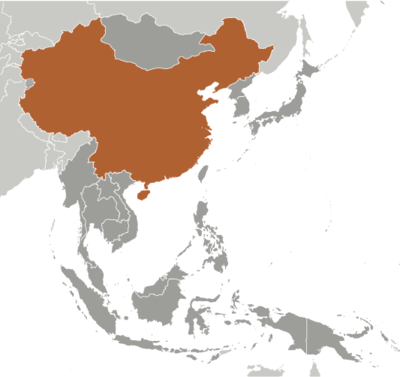
East N Southeast Asia · Beijing · communist party-led state
What China means for your money, the prices you pay, the tariffs in motion, and where U.S. policy could change both.
$308.7B
U.S. imports, 2025
-29.9%
change in one year
$106.0B
U.S. exports, 2025
1.41B
Population
$18.7T
GDP
In your house
What you buy that China makes
America bought $308.7B in goods from China in 2025, down 29.9% in a single year. Of every $100 of it, here's where the money went.
Cell phones and other household goods, n.e.c.
cell phones and home electronics
Electric apparatus
Toys, games, and sporting goods
toys, games, sporting goods
Apparel, textiles, nonwool or cotton
synthetic and performance apparel
Other parts and accessories of vehicles
car parts and accessories
Computer accessories
keyboards, drives, computer parts
Industrial machines, other
Household appliances
household appliances
Telecommunications equipment
phones, routers, networking gear
Computers
laptops, desktops, monitors
2026 so far (through July): $156.4B in imports. Source: U.S. Census Bureau, International Trade in Goods (customs basis).
The other direction
What America sells to China
$106.0B in 2025, a trade rupture cuts both ways, for American producers as well as American prices.
Civilian aircraft, engines, equipment, and parts
$15.9BSemiconductors
$10.9Bsemiconductors and chips
Pharmaceutical preparations
$9.5Bmedicines and pharmacy items
Industrial machines, other
$5.4BNatural gas liquids
$4.9BMedicinal equipment
$4.3Bmedical devices and equipment
Plastic materials
$4.2Bplastics for packaging and goods
Measuring, testing, control instruments
$3.2BSoybeans
$3.0Bmeat at the counter
Where you stand
U.S. tariff posture toward China
China carried the highest U.S. tariff exposure of any country through 2025 — a 10% reciprocal tariff (suspended down from a 125% peak under the November 2025 U.S.-China economic and trade arrangement) plus a 10% fentanyl-related IEEPA tariff, layered on top of longstanding Section 301 duties. Executive Order 14389 (Ending Certain Tariff Actions, Feb 20, 2026) terminated BOTH IEEPA components effective February 24, 2026, replacing them with a 10% Section 122 temporary import surcharge (Proclamation 11012). Critically, China's Section 301 tariffs — the 2018-19 measures covering roughly $370B of goods at 7.5-25%, the backbone of U.S. tariff pressure — and its Section 232 metals duties survive untouched. So China removed about 20 points of IEEPA duties but remains the most heavily tariffed major economy via Section 301.
Reciprocal tariff (assigned, terminated)
34%
The rate this country was assigned under the EO 14257 reciprocal Annex, no longer in force. The Supreme Court struck down the IEEPA tariffs and they were terminated February 24, 2026 (EO 14389), replaced by a universal ~10% Section 122 surcharge. See the timeline below for the current effective rate.
Section 232 sectors
Steel
Steel, aluminum, autos, and similar national-security tariffs that name this country.
Section 301
Active
Subject to Section 301 tariffs on a defined list of products.
Policy in motion
Tariff status: a moving target
U.S. tariff policy toward China has changed 8 times since 2025. This page tracks it.
2026-02-24
IEEPA fentanyl and reciprocal tariffs terminated — Section 301 survives
In effectExecutive Order 14389 (Ending Certain Tariff Actions) terminated the IEEPA tariff duties effective February 24, 2026 — removing both China's 10% reciprocal tariff and its 10% fentanyl tariff. A 10% Section 122 temporary import surcharge (Proclamation 11012) replaced them. China's Section 301 duties (the 2018-19 measures at 7.5-25%) and Section 232 metals tariffs rest on separate authorities and remain in force, keeping China the most heavily tariffed major economy.
91 FR 9437 →2025-11-10
Fentanyl tariff reduced 20% → 10%
AgreementFollowing the October 30 Xi–Trump meeting, the fentanyl-related IEEPA tariff was halved from 20% to 10%.
90 FR 50725 (EO 14357) →2025-11-04
Economic & trade arrangement: 10% reciprocal held to Nov 2026
AgreementThe U.S.–China economic and trade arrangement maintained the 10% reciprocal rate and extended the suspension of the higher rate to November 10, 2026.
90 FR 50729 (EO 14358) →2025-08-11
Reciprocal suspension extended
AgreementThe 10% reciprocal rate and suspension of the higher rate were extended to reflect ongoing discussions with China.
90 FR 39305 →2025-05-14
Geneva agreement cuts reciprocal rate to 10%
AgreementAfter U.S.–China discussions, the reciprocal tariff was cut from 125% to 10% and the higher rate suspended for a 90-day negotiating window.
90 FR 21831 →2025-04-10
Reciprocal tariff escalated to 125% amid retaliation
In effectAs most countries' reciprocal rates were paused to 10%, China's was raised sharply to 125% in response to Chinese retaliation.
90 FR 15625 →2025-04-07
34% reciprocal tariff imposed on China
In effectAnnex I of EO 14257 assigned China (incl. Hong Kong and Macau) a 34% reciprocal tariff on top of existing duties.
90 FR 15041 (EO 14257) →2025-02-04
20% fentanyl tariff imposed on China
In effectIEEPA tariff to address the synthetic opioid supply chain — an additional 20% on virtually all Chinese goods, separate from the trade-deficit reciprocal program.
90 FR 9121 →
Made for America
What China makes for America
China is a direct U.S. source of 12 essential goods Americans rely on, the items themselves, shipped finished off the line.
digital
45% of U.S.Smartphones and tablets
$23.6B to the U.S.
materials
15% of U.S.Clothing and apparel
$12.0B to the U.S.
digital
59% of U.S.Lithium-ion batteries
$11.7B to the U.S.
home
65% of U.S.Toys & games
$10.0B to the U.S.
digital
17% of U.S.Computers and laptops
$9.1B to the U.S.
materials
7% of U.S.Auto parts and repairs
$9.0B to the U.S.
materials
21% of U.S.Furniture
$6.7B to the U.S.
materials
26% of U.S.Footwear
$6.6B to the U.S.
digital
7% of U.S.Fiber optic cables and networking
$5.8B to the U.S.
home
58% of U.S.Small kitchen appliances
$5.4B to the U.S.
home
68% of U.S.Tableware & dishware
$4.4B to the U.S.
home
50% of U.S.Sporting goods & fitness equipment
$3.9B to the U.S.
Go deeper
The supply chain view
China sits upstream of 24 essential American goods through 12 tracked inputs.
mineral
98%Gallium
mineral
95%Terbium (Tb) Metal
manufactured
95%Artificial Plant Plastics (PE/PP/PVC + Wire)
manufactured
95%Stroller Wheels & Tires
mineral
94%Gallium (Primary, Refined)
manufactured
94%Solar-Grade Polysilicon
Reference
The country itself
East N Southeast Asia · Geography, people, economy, and government, public-domain data from the CIA World Factbook.
China's historical civilization dates to at least the 13th century B.C., first under the Shang (to 1046 B.C.) and then the Zhou (1046-221 B.C.) dynasties. The imperial era of China began in 221 B.C. under the Qin Dynasty and lasted until the fall of the Qing Dynasty in 1912. During this period, China alternated between periods of unity and disunity under a succession of imperial dynasties. In the 19th century, the Qing Dynasty suffered heavily from overextension by territorial conquest, insolvency, civil war, imperialism, military defeats, and foreign expropriation of ports and infrastructure. It collapsed following the Revolution of 1911, and China became a republic under SUN Yat-sen of the Kuomintang (KMT or Nationalist) Party. However, the republic was beset by division, warlordism, and continued foreign intervention. In the late 1920s, a civil war erupted between the ruling KMT-controlled government, led by CHIANG Kai-shek, and the Chinese Communist Party (CCP). Japan occupied much of northeastern China in the early 1930s, and then launched a full-scale invasion of the country in 1937. The resulting eight years of warfare devastated the country and cost up to 20 million Chinese lives by the time of Japan’s defeat in 1945. The Nationalist-Communist civil war continued with renewed intensity after the end of World War II and culminated with a CCP victory in 1949, under the leadership of MAO Zedong. MAO and the CCP established an autocratic socialist system that, while ensuring the PRC's sovereignty, imposed strict controls over everyday life and launched agricultural, economic, political, and social policies -- such as the Great Leap Forward (1958-1962) and the Cultural Revolution (1966-1976) -- that cost the lives of millions of people. MAO died in 1976. Beginning in 1978, leaders DENG Xiaoping, JIANG Zemin, and HU Jintao focused on market-oriented economic development and opening up the country to foreign trade, while maintaining the rule of the CCP. Since the change, China has been among the world’s fastest growing economies, with real gross domestic product averaging over 9% growth annually through 2021, lifting an estimated 800 million people out of poverty and dramatically improving overall living standards. By 2011, the PRC’s economy was the second largest in the world. Current leader XI Jinping has continued these policies but has also maintained tight political controls. Over the past decade, China has increased its global outreach, including military deployments, participation in international organizations, and a global connectivity plan in 2013 called the "Belt and Road Initiative" (BRI). Many nations have signed on to BRI agreements to attract PRC investment, but others have expressed concerns about such issues as the opaque nature of the projects, financing, and potentially unsustainable debt obligations. XI Jinping assumed the positions of General Secretary of the Chinese Communist Party and Chairman of the Central Military Commission in 2012 and President in 2013. In 2018, the PRC’s National People’s Congress passed an amendment abolishing presidential term limits, which allowed XI to gain a third five-year term in 2023.
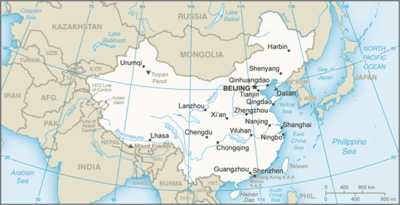
Geography
- Location
- Eastern Asia, bordering the East China Sea, Korea Bay, Yellow Sea, and South China Sea, between North Korea and Vietnam
- Area
- 9,596,960 sq km
- Climate
- extremely diverse; tropical in south to subarctic in north
- Terrain
- mostly mountains, high plateaus, deserts in west; plains, deltas, and hills in east
- Natural resources
- coal, iron ore, helium, petroleum, natural gas, arsenic, bismuth, cobalt, cadmium, ferrosilicon, gallium, germanium, hafnium, indium, lithium, mercury, tantalum, tellurium, tin, titanium, tungsten, antimony, manganese, magnesium, molybdenum, selenium, strontium, vanadium, magnetite, aluminum, lead, zinc, rare earth elements, uranium, hydropower potential (world's largest), arable land
- Coastline
- 14,500 km
- Natural hazards
- frequent typhoons (about five per year along southern and eastern coasts); damaging floods; tsunamis; earthquakes; droughts; land subsidence volcanism: China contains some historically active volcanoes including Changbaishan (also known as Baitoushan, Baegdu, or P'aektu-san), Hainan Dao, and Kunlun although most have been relatively inactive in recent centuries
People & society
- Population
- 1,407,181,209 (2025 est.)
- Nationality
- Chinese (singular and plural)
- Ethnic groups
- Han Chinese 91.1%, ethnic minorities 8.9% (includes Zhang, Hui, Manchu, Uighur, Miao, Yi, Tujia, Tibetan, Mongol, Dong, Buyei, Yao, Bai, Korean, Hani, Li, Kazakh, Dai, and other nationalities) (2021 est.)
- Languages
- Standard Chinese or Mandarin (official; Putonghua, based on the Beijing dialect), Yue (Cantonese), Wu (Shanghainese), Minbei (Fuzhou), Minnan (Hokkien-Taiwanese), Xiang, Gan, Hakka dialects, minority languages; note - Zhuang is official in Guangxi Zhuang, Yue is official in Guangdong, Mongolian is official in Nei Mongol, Uyghur is official in Xinjiang Uygur, Kyrgyz is official in Xinjiang Uyghur, and Tibetan is official in Xizang (Tibet)
- Religions
- folk religion 21.9%, Buddhist 18.2%, Christian 5.1%, Muslim 1.8%, Hindu < 0.1%, Jewish < 0.1%, other 0.7% (includes Daoist (Taoist)), unaffiliated 52.1% (2021 est.)
- Median age
- 40.8 years (2025 est.)
- Life expectancy at birth
- 78.7 years (2024 est.)
- Literacy
- 96.7% (2020 est.)
Economy
- Economic overview
- world’s second-largest economy by nominal GDP; global leader in exports and manufacturing; historically strong growth slowing; challenges of aging workforce, weak productivity, rising youth unemployment, struggling property sector, and public debt; state-sponsored economic controls and infrastructure investments
- Industries
- world leader in gross value of industrial output; mining and ore processing, iron, steel, aluminum, and other metals, coal; machine building; armaments; textiles and apparel; petroleum; cement; chemicals; fertilizer; consumer products (including footwear, toys, and electronics); food processing; transportation equipment, including automobiles, railcars and locomotives, ships, aircraft; telecommunications equipment, commercial space launch vehicles, satellites
- Agricultural products
- maize, rice, vegetables, wheat, sugarcane, potatoes, cucumbers/gherkins, tomatoes, watermelons, pork (2023)
- Exports - partners
- USA 13%, Hong Kong 8%, Japan 5%, Germany 5%, S. Korea 4% (2023)
- Imports - partners
- S. Korea 7%, USA 7%, Japan 6%, Australia 6%, Russia 6% (2023)
Government
- Government type
- communist party-led state
- Capital
- Beijing
- Independence
- 1 October 1949 (People's Republic of China established); notable earlier dates: 221 B.C. (unification under the Qin Dynasty); 1 January 1912 (Qing Dynasty replaced by the Republic of China)
- Constitution
- several previous; latest promulgated 4 December 1982
- Executive branch
- President XI Jinping (since 14 March 2013)
- Legislative branch
- National People's Congress (Quanguo Renmin Daibiao Dahui)
Full reference data
Every field, by section, CIA World Factbook. Open a topic to expand it.
Introduction
Travel Facts
Please visit the following links to find further information about your desired destination.
CDC - To learn what vaccines and health precautions to take while visiting your destination.
US State Dept Travel Information - Overall information about foreign travel for US citizens.
To obtain an international driving permit (IDP). Only two organizations in the US issue IDPs: American Automobile Association (AAA) and American Automobile Touring Alliance (AATA)
How to get help in an emergency? Contact the nearest US embassy or consulate, or call one of these numbers: from the US or Canada - 1-888-407-4747 or from Overseas - +1 202-501-4444
Page last updated: Monday, December 02, 2024