
Country exposure · CO
Colombia
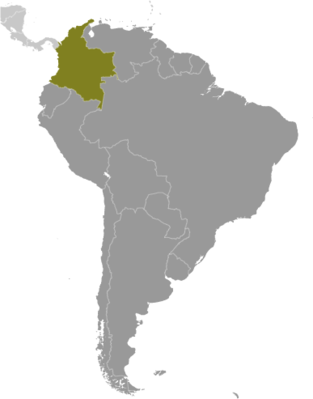
South America · Bogotá · presidential republic
What Colombia means for your money, the prices you pay, the tariffs in motion, and where U.S. policy could change both.
$17.9B
U.S. imports, 2025
+0.1%
change in one year
$19.5B
U.S. exports, 2025
50M
Population
$418.5B
GDP
In your house
What you buy that Colombia makes
America bought $17.9B in goods from Colombia in 2025. Of every $100 of it, here's where the money went.
Crude oil
Green coffee
green coffee for roasters
Nonmonetary gold
Nursery stock, etc.
Fuel oil
fuel oil
Fruits, frozen juices
fruit and frozen juices
Finished metal shapes
Minimum value shipments
Other foods
Generators, accessories
2026 so far (through July): $10.6B in imports. Source: U.S. Census Bureau, International Trade in Goods (customs basis).
The other direction
What America sells to Colombia
$19.5B in 2025, a trade rupture cuts both ways, for American producers as well as American prices.
Petroleum products, other
$2.6BCorn
$1.8BChemicals-organic
$952MAnimal feeds, n.e.c.
$919MCrude oil
$915MPlastic materials
$809Mplastics for packaging and goods
Pharmaceutical preparations
$715Mmedicines and pharmacy items
Civilian aircraft, engines, equipment, and parts
$649MFuel oil
$614MWhere you stand
U.S. tariff posture toward Colombia
No U.S. tariff action singles this country out. Its goods face the universal 10% temporary import surcharge under Section 122 of the Trade Act (which replaced the IEEPA reciprocal baseline in February 2026) plus the sectoral Section 232 duties — steel and aluminum at 50% — that apply to all countries. The Section 122 surcharge is statutorily temporary — scheduled to lapse on or about July 23, 2026 (a 150-day cap) unless extended or replaced.
Reciprocal tariff (universal baseline)
10%
The universal 10% floor, a Section 122 import surcharge since February 2026, previously the EO 14257 reciprocal baseline, applies to nearly all U.S. imports. This country has no higher assigned rate of its own.
Policy in motion
Tariff status: a moving target
No U.S. tariff action names Colombia. These are the universal measures, applied to every country without a country-specific arrangement, that set its treatment.
2026-04-06
Section 232 metals coverage expanded
In effectThe April 2026 proclamation strengthening Section 232 actions on aluminum, steel, and copper expanded derivative-product coverage for all countries, keeping the general metals rate at 50%.
91 FR 18201 →2026-02-24
IEEPA reciprocal tariffs terminated — replaced by 10% Section 122 surcharge
In effectExecutive Order 14389 (Ending Certain Tariff Actions) terminated the IEEPA tariff duties — including the EO 14257 reciprocal baseline — effective February 24, 2026. A flat 10% Section 122 temporary import surcharge (Proclamation 11012 of February 20, 2026) replaced them, leaving the universal rate unchanged at 10% on a different statutory basis. Section 122 caps such surcharges at 150 days, so this 10% surcharge is scheduled to lapse on or about July 23, 2026 absent further action (the administration has signaled it could raise the rate toward the 15% statutory maximum).
91 FR 9437 →2025-11-13
Agricultural products exempted from reciprocal tariffs
In effectExecutive Order 14360 of November 14, 2025 removed reciprocal duties from certain agricultural products listed in its annexes (coffee, cocoa, bananas, and other goods the U.S. does not produce in sufficient quantity), retroactive to November 13, 2025 — for all countries subject to the reciprocal tariff.
90 FR 54091 →2025-06-04
Section 232 steel and aluminum duties doubled to 50%
In effectThe June 3, 2025 proclamation raised Section 232 duties on steel and aluminum articles and derivatives from 25% to 50% for all countries, effective June 4, 2025.
90 FR 24199 →2025-04-05
Universal 10% reciprocal baseline takes effect
In effectExecutive Order 14257 (signed April 2, 2025) imposed a 10% ad valorem reciprocal duty on imports from all trading partners, effective April 5, 2025. Countries without a higher Annex I rate remain at this baseline.
Federal Register · 2025-06063 →2025-03-12
Section 232 steel and aluminum duties set at 25% for all countries
In effectProclamations of February 10, 2025 terminated all country exemptions and quota arrangements and applied 25% Section 232 duties to steel and aluminum imports from every country, effective March 12, 2025.
90 FR 9817 →
Made for America
What Colombia makes for America
Colombia is a direct U.S. source of 12 essential goods Americans rely on, the items themselves, shipped finished off the line.
food
21% of U.S.Coffee
$2.9B to the U.S.
energy
6% of U.S.Home heating oil
$1.2B to the U.S.
grocery
2% of U.S.Fresh produce staples
$589M to the U.S.
materials
14% of U.S.Glass and windows
$588M to the U.S.
materials
3% of U.S.Electric grid transformers
$326M to the U.S.
materials
Clothing and apparel
$210M to the U.S.
food
2% of U.S.Canned and shelf-stable foods
$151M to the U.S.
materials
1% of U.S.Plumbing pipes and fittings
$145M to the U.S.
food
7% of U.S.Sugar
$131M to the U.S.
home
3% of U.S.Personal care and hygiene
$131M to the U.S.
food
1% of U.S.Seafood and fish
$118M to the U.S.
materials
5% of U.S.Asphalt and paving materials
$103M to the U.S.
Go deeper
The supply chain view
Colombia sits upstream of 24 essential American goods through 12 tracked inputs.
mineral
86%Electrolytic Manganese Dioxide (EMD)
agricultural
26%Colorado River irrigation water allocation
agricultural
15%Refined Sugar
agricultural
10%Banana supply chain (plantation, sea transport, ripening)
agricultural
10%Green Coffee Beans — Arabica
chemical
9%PVC Resin for Pipe & Fittings
Reference
The country itself
South America · Geography, people, economy, and government, public-domain data from the CIA World Factbook.
Colombia was one of three countries that emerged after the dissolution of Gran Colombia in 1830 -- the others are Ecuador and Venezuela. A decades-long conflict among government forces, paramilitaries, and antigovernment insurgent groups heavily funded by the drug trade -- principally the Revolutionary Armed Forces of Colombia (FARC) -- escalated during the 1990s. In the wake of the paramilitary demobilization in the 2000s, new criminal groups arose that included some former paramilitaries. After four years of formal peace negotiations, the Colombian Government signed a final accord with the FARC in 2016 that called for its members to demobilize, disarm, and reincorporate into society and politics. The accord also committed the Colombian Government to create three new institutions to form a 'comprehensive system for truth, justice, reparation, and non-repetition,' including a truth commission, a special unit to coordinate the search for those who disappeared during the conflict, and a 'Special Jurisdiction for Peace' to administer justice for conflict-related crimes. Despite decades of internal conflict and drug-trade-related security challenges, Colombia maintains relatively strong and independent democratic institutions characterized by peaceful, transparent elections and the protection of civil liberties.
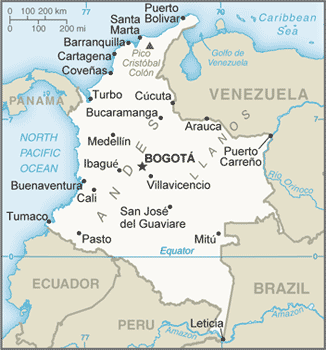
Geography
- Location
- Northern South America, bordering the Caribbean Sea, between Panama and Venezuela, and bordering the North Pacific Ocean, between Ecuador and Panama
- Area
- 1,138,910 sq km
- Climate
- tropical along coast and eastern plains; cooler in highlands
- Terrain
- flat coastal lowlands, central highlands, high Andes Mountains, eastern lowland plains (Llanos)
- Natural resources
- petroleum, natural gas, coal, iron ore, nickel, gold, copper, emeralds, hydropower
- Coastline
- 3,208 km (Caribbean Sea 1,760 km, North Pacific Ocean 1,448 km)
- Natural hazards
- highlands subject to volcanic eruptions; occasional earthquakes; periodic droughts volcanism: Galeras (4,276 m) is one of Colombia's most active volcanoes; it has been deemed a Decade Volcano by the International Association of Volcanology and Chemistry of the Earth's Interior, worthy of study due to its explosive history and close proximity to human populations; Nevado del Ruiz (5,321 m), 129 km (80 mi) west of Bogota, erupted in 1985, producing lahars (mudflows) that killed 23,000 people; the volcano last erupted in 1991; after 500 years of dormancy, Nevado del Huila reawakened in 2007 and has experienced frequent eruptions since then; other historically active volcanoes include Cumbal, Dona Juana, Nevado del Tolima, and Purace
People & society
- Population
- 49,842,298 (2025 est.)
- Nationality
- Colombian(s)
- Ethnic groups
- Mestizo and White 87.6%, Afro-Colombian (includes Mulatto, Raizal, and Palenquero) 6.8%, Indigenous 4.3%, unspecified 1.4% (2018 est.)
- Languages
- Spanish (official) 98.9%, indigenous 1%, Portuguese 0.1%; 65 indigenous languages exist (2023 est.)
- Religions
- Roman Catholic 63.6%, Protestant 17.2% (Evangelical 16.7%, Adventist 0.3%, other Protestant 0.2%), Jehovah's Witness 0.6%, Church of Jesus Christ 0.1%, other 0.3%, believer, 0.2%. agnostic 1%, atheist 1%, none 14.2%, unspecified 1.8% (2023 est.)
- Median age
- 33.1 years (2025 est.)
- Life expectancy at birth
- 74.9 years (2024 est.)
- Literacy
- 95.3% (2024 est.)
Economy
- Economic overview
- prior to COVID-19, one of the most consistent growth economies; declining poverty; large stimulus package has mitigated economic fallout, but delayed key infrastructure investments; successful inflation management; sound flexible exchange rate regime; domestic economy suffers from lack of trade integration and infrastructure
- Industries
- textiles, food processing, oil, clothing and footwear, beverages, chemicals, cement; gold, coal, emeralds
- Agricultural products
- sugarcane, oil palm fruit, milk, rice, plantains, potatoes, bananas, maize, chicken, avocados (2023)
- Exports - partners
- USA 27%, Panama 9%, India 5%, China 5%, Netherlands 4% (2023)
- Imports - partners
- USA 26%, China 22%, Brazil 6%, Mexico 5%, Germany 4% (2023)
Government
- Government type
- presidential republic
- Capital
- Bogotá
- Independence
- 20 July 1810 (from Spain)
- Constitution
- several previous; latest promulgated 4 July 1991
- Executive branch
- President Gustavo Francisco PETRO Urrego (since 7 August 2022)
- Legislative branch
- Congress (Congreso)
Full reference data
Every field, by section, CIA World Factbook. Open a topic to expand it.
Introduction
Travel Facts
Please visit the following links to find further information about your desired destination.
World Health Organization (WHO) - To learn what vaccines and health precautions to take while visiting your destination.
US State Dept Travel Information - Overall information about foreign travel for US citizens.
To obtain an international driving permit (IDP). Only two organizations in the US issue IDPs: American Automobile Association (AAA) and American Automobile Touring Alliance (AATA)
How to get help in an emergency? Contact the nearest US embassy or consulate, or call one of these numbers: from the US or Canada - 1-888-407-4747 or from Overseas - +1 202-501-4444
Page last updated: Wednesday, July 20, 2022