
Country exposure · DZ
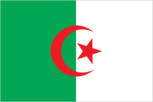
Algeria
Africa · Algiers · presidential republic
What Algeria means for your money, the prices you pay, the tariffs in motion, and where U.S. policy could change both.
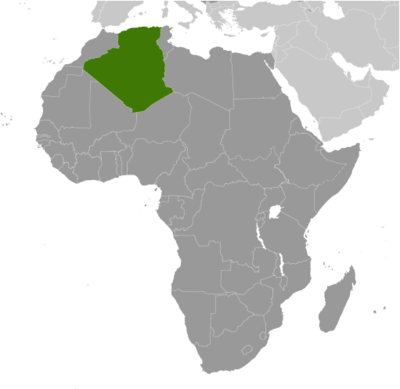
$2.2B
U.S. imports, 2025
-9.2%
change in one year
$1.3B
U.S. exports, 2025
48M
Population
$263.6B
GDP
In your house
What you buy that Algeria makes
America bought $2.2B in goods from Algeria in 2025. Of every $100 of it, here's where the money went.
Fuel oil
fuel oil
Crude oil
Chemicals-fertilizers
Iron and steel mill products
steel for cars and construction
Stone, sand, cement, etc.
cement, stone, sand
U.s. goods returned, and reimports
Fruits, frozen juices
fruit and frozen juices
Other precious metals
Chemicals-inorganic
Bakery products
2026 so far (through July): $1.7B in imports. Source: U.S. Census Bureau, International Trade in Goods (customs basis).
The other direction
What America sells to Algeria
$1.3B in 2025, a trade rupture cuts both ways, for American producers as well as American prices.
Soybeans
$246Mmeat at the counter
Plastic materials
$130Mplastics for packaging and goods
Industrial engines
$107MCivilian aircraft, engines, equipment, and parts
$86MNuts
$57MCorn
$54MPulpwood and woodpulp
$45MFuel oil
$45MDrilling & oilfield equipment
$43MWhere you stand
U.S. tariff posture toward Algeria
Algeria was assigned 30% in April 2025 and held that rate through August without a deal, but its dominant oil and gas exports fall under the energy carve-out, limiting real exposure. Executive Order 14389 (Ending Certain Tariff Actions, Feb 20, 2026) terminated the IEEPA reciprocal duties, and Proclamation 11012 replaced it with a 10% Section 122 temporary import surcharge effective February 24, 2026; energy imports remain exempt. Algeria has no Section 232 steel/aluminum exposure.
Reciprocal tariff (assigned, terminated)
30%
The rate this country was assigned under the EO 14257 reciprocal Annex, no longer in force. The Supreme Court struck down the IEEPA tariffs and they were terminated February 24, 2026 (EO 14389), replaced by a universal ~10% Section 122 surcharge. See the timeline below for the current effective rate.
Policy in motion
Tariff status: a moving target
U.S. tariff policy toward Algeria has changed 4 times since 2025. This page tracks it.
2026-02-24
IEEPA reciprocal tariffs terminated — replaced by 10% Section 122
In effectExecutive Order 14389 (Ending Certain Tariff Actions) terminated the IEEPA tariff duties effective February 24, 2026, replacing Algeria's 30% reciprocal rate with a 10% Section 122 temporary import surcharge under Proclamation 11012 (capped at 150 days); energy imports remain exempt.
91 FR 9437 →2025-08-07
30% rate takes effect — no deal reached
In effectExecutive Order 14326 set the post-pause Annex I reciprocal rates; Algeria's rate held at 30% effective August 7, 2025 with no bilateral agreement, the oil and gas exemption intact.
90 FR 37963 →2025-04-10
Elevated reciprocal rates paused to 10% for 90 days
In effectExecutive Order 14266 suspended the higher country-specific reciprocal rates — including Algeria's 30% — back to the 10% baseline for 90 days.
90 FR 15625 →2025-04-05
Reciprocal tariff regime begins — Algeria assigned 30% (oil/gas exempt)
In effectExecutive Order 14257 imposed a 10% universal reciprocal duty effective April 5 and a 30% country-specific rate for Algeria scheduled to take effect April 9 — but oil, gas, and refined products, the bulk of Algeria's exports, were carved out.
90 FR 15041 →
Made for America
What Algeria makes for America
Algeria is a direct U.S. source of 5 essential goods Americans rely on, the items themselves, shipped finished off the line.
Go deeper
The supply chain view
Algeria sits upstream of 22 essential American goods through 12 tracked inputs.
mineral
8%Liquid nitrogen (helium pre-cooling)
agricultural
8%Durum Wheat / Semolina
chemical
8%Urea Nitrogen Fertilizer (46-0-0)
chemical
8%Urea (Granular/Prilled, 46% N)
mineral
7%Semiconductor-Grade Helium (6N)
chemical
7%Helium (Grade 5.0 / Fiber-Drawing Grade)
Reference
The country itself
Africa · Geography, people, economy, and government, public-domain data from the CIA World Factbook.
Algeria has known many empires and dynasties, including the ancient Numidians (3rd century B.C.), Phoenicians, Carthaginians, Romans, Vandals, Byzantines, over a dozen different Arab and Amazigh dynasties, Spaniards, and Ottoman Turks. Under the Turks, the Barbary pirates operated from North Africa and preyed on shipping, from about 1500 until the French captured Algiers in 1830. The French southward conquest of Algeria proceeded throughout the 19th century and was marked by many atrocities. A bloody eight-year struggle culminated in Algerian independence in 1962. Algeria's long-dominant political party, the National Liberation Front (FLN), was established in 1954 as part of the struggle for independence and has since played a large role in politics, though it is falling out of favor with the youth and current President Abdelmadjid TEBBOUNE. The Government of Algeria in 1988 instituted a multi-party system in response to public unrest, but the surprising first-round success of the Islamic Salvation Front (FIS) in the 1991 legislative election led the Algerian military to intervene and postpone the second round of elections to prevent what the secular elite feared would be an extremist-led government from assuming power. An army crackdown on the FIS escalated into an FIS insurgency and intense violence from 1992-98 that resulted in over 100,000 deaths, many of which were attributed to extremist groups massacring villagers. The government gained the upper hand by the late 1990s, and FIS’s armed wing, the Islamic Salvation Army, disbanded in 2000. FIS membership is now illegal. In 1999, Abdelaziz BOUTEFLIKA won the presidency with the backing of the military, in an election that was boycotted by several candidates protesting alleged fraud. He won subsequent elections in 2004, 2009, and 2014. Widespread protests against his decision to seek a fifth term broke out in early 2019. BOUTEFLIKA resigned in April 2019, and in December 2019, Algerians elected former Prime Minister Abdelmadjid TEBBOUNE as the country’s new president. A longtime FLN member, TEBBOUNE ran for president as an independent. In 2020, Algeria held a constitutional referendum on governmental reforms, which TEBBOUNE enacted in 2021. Subsequent reforms to the national electoral law introduced open-list voting to curb corruption. The new law also eliminated gender quotas in Parliament, and the 2021 legislative elections saw female representation plummet. The referendum, parliamentary elections, and local elections saw record-low voter turnout.
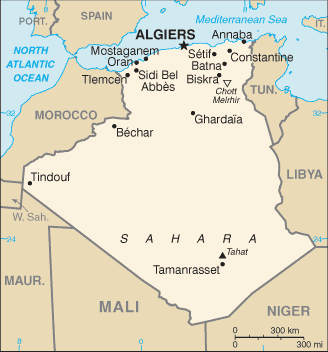
Geography
- Location
- Northern Africa, bordering the Mediterranean Sea, between Morocco and Tunisia
- Area
- 2,381,740 sq km
- Climate
- arid to semiarid; mild, wet winters with hot, dry summers along coast; drier with cold winters and hot summers on high plateau; sirocco is a hot, dust/sand-laden wind especially common in summer
- Terrain
- mostly high plateau and desert; Atlas Mountains in the far north and Hoggar Mountains in the south; narrow, discontinuous coastal plain
- Natural resources
- petroleum, natural gas, iron ore, phosphates, uranium, lead, zinc
- Coastline
- 998 km
- Natural hazards
- mountainous areas subject to severe earthquakes; mudslides and floods in rainy season; droughts
People & society
- Population
- 47,735,685 (2025 est.)
- Nationality
- Algerian(s)
- Ethnic groups
- Arab-Amazigh 99%, European less than 1%
- Languages
- Arabic (official), French (lingua franca), Tamazight (official) (dialects include Kabyle (Taqbaylit), Shawiya (Tacawit), Mzab, Tuareg (Tamahaq))
- Religions
- Muslim (official; predominantly Sunni) 99%, other (includes Christian, Jewish, Ahmadi Muslim, Shia Muslim, Ibadi Muslim) <1% (2012 est.)
- Median age
- 29.3 years (2025 est.)
- Life expectancy at birth
- 77.9 years (2024 est.)
- Literacy
- 74.2% (2019 est.)
Economy
- Economic overview
- suffering oil and gas economy; lack of sector and market diversification; political instability chilling domestic consumption; poor credit access and declines in business confidence; COVID-19 austerity policies; delayed promised socio-economic reforms
- Industries
- petroleum, natural gas, light industries, mining, electrical, petrochemical, food processing
- Agricultural products
- potatoes, watermelons, wheat, milk, onions, tomatoes, vegetables, oranges, dates, barley (2023)
- Exports - partners
- Italy 29%, France 14%, Spain 13%, USA 6%, Netherlands 4% (2023)
- Imports - partners
- China 24%, France 12%, Italy 8%, Turkey 7%, Brazil 6% (2023)
Government
- Government type
- presidential republic
- Capital
- Algiers
- Independence
- 5 July 1962 (from France)
- Constitution
- several previous; latest approved by referendum 1 November 2020
- Executive branch
- President Abdelmadjid TEBBOUNE (since 12 December 2019)
- Legislative branch
- Parliament (Barlaman)
Full reference data
Every field, by section, CIA World Factbook. Open a topic to expand it.
Introduction
Travel Facts
Please visit the following links to find further information about your desired destination.
CDC - To learn what vaccines and health precautions to take while visiting your destination.
US State Dept Travel Information - Overall information about foreign travel for US citizens.
To obtain an international driving permit (IDP). Only two organizations in the US issue IDPs: American Automobile Association (AAA) and American Automobile Touring Alliance (AATA)
How to get help in an emergency? Contact the nearest US embassy or consulate, or call one of these numbers: from the US or Canada - 1-888-407-4747 or from Overseas - +1 202-501-4444
Page last updated: Monday, September 30, 2024