
Country exposure · NI
Nicaragua
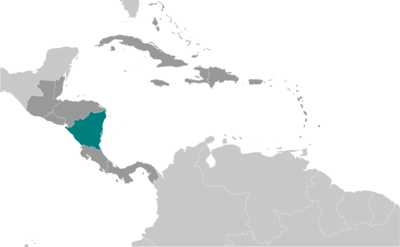
Central America N Caribbean · Managua · presidential republic
What Nicaragua means for your money, the prices you pay, the tariffs in motion, and where U.S. policy could change both.
$5.0B
U.S. imports, 2025
+7.9%
change in one year
$2.4B
U.S. exports, 2025
7M
Population
$19.7B
GDP
In your house
What you buy that Nicaragua makes
America bought $5.0B in goods from Nicaragua in 2025. Of every $100 of it, here's where the money went.
Apparel, household goods - cotton
cotton clothing and linens
Other parts and accessories of vehicles
car parts and accessories
Apparel, textiles, nonwool or cotton
synthetic and performance apparel
Nonmonetary gold
Meat products
meat at the counter
Green coffee
green coffee for roasters
Other consumer nondurables
Fish and shellfish
fish, shrimp, shellfish
Dairy products and eggs
dairy and eggs
Vegetables
vegetables
2026 so far (through July): $3.1B in imports. Source: U.S. Census Bureau, International Trade in Goods (customs basis).
The other direction
What America sells to Nicaragua
$2.4B in 2025, a trade rupture cuts both ways, for American producers as well as American prices.
Crude oil
$321MFuel oil
$259MPetroleum products, other
$259MApparel, household goods - textile
$165Mcotton clothing and linens
Corn
$124MMinimum value shipments
$99MElectric apparatus
$97MCell phones and other household goods, n.e.c.
$95Mcell phones and home electronics
Manmade cloth
$90MWhere you stand
U.S. tariff posture toward Nicaragua
Nicaragua faced an 18% reciprocal tariff from April 2025 (with apparel hit at 19%), held through August with no deal. Separately, a December 2025 USTR Section 301 action — framed around the Ortega government's labor, human-rights, and rule-of-law record — imposed a phased tariff on non-CAFTA-DR-originating Nicaraguan goods (0% from January 2026, rising to 10% in 2027 and 15% in 2028), while sparing CAFTA-compliant apparel and coffee. Executive Order 14389 (Ending Certain Tariff Actions, Feb 20, 2026) terminated the IEEPA reciprocal duties, and Proclamation 11012 replaced the 18% reciprocal with a 10% Section 122 temporary import surcharge (Proclamation 11012) effective February 24, 2026 — but the Section 301 measure rests on separate authority and survives. Nicaragua has no Section 232 steel/aluminum exposure.
Reciprocal tariff (assigned, terminated)
18%
The rate this country was assigned under the EO 14257 reciprocal Annex, no longer in force. The Supreme Court struck down the IEEPA tariffs and they were terminated February 24, 2026 (EO 14389), replaced by a universal ~10% Section 122 surcharge. See the timeline below for the current effective rate.
Policy in motion
Tariff status: a moving target
U.S. tariff policy toward Nicaragua has changed 5 times since 2025. This page tracks it.
2026-02-24
IEEPA reciprocal terminated — Section 122 replaces it, Section 301 survives
In effectExecutive Order 14389 (Ending Certain Tariff Actions) terminated the IEEPA tariff duties effective February 24, 2026, replacing Nicaragua's 18% reciprocal rate with a 10% Section 122 temporary import surcharge (Proclamation 11012). The separate Section 301 measure rests on different authority and remains in force.
91 FR 9437 →2025-12-10
Section 301 action targets Ortega government's rights record
In effectA USTR Section 301 determination found Nicaragua's labor, human-rights, and rule-of-law practices unreasonable and imposed a phased tariff on non-CAFTA-DR-originating Nicaraguan goods — 0% from January 1, 2026, rising to 10% in 2027 and 15% in 2028, stacking on the reciprocal tariff — while exempting CAFTA-compliant apparel and coffee.
Source ↗2025-08-07
18% rate takes effect — no deal reached
In effectExecutive Order 14326 set the post-pause Annex I reciprocal rates; with no bilateral agreement, Nicaragua's 18% reciprocal rate took effect August 7, 2025.
90 FR 37963 →2025-04-10
Elevated reciprocal rates paused to 10% for 90 days
In effectExecutive Order 14266 suspended the higher country-specific reciprocal rates — including Nicaragua's 18% — back to the 10% baseline for 90 days.
90 FR 15625 →2025-04-05
Reciprocal tariff regime begins — Nicaragua assigned 18%
In effectExecutive Order 14257 imposed a 10% universal reciprocal duty effective April 5 and an 18% country-specific rate for Nicaragua scheduled to take effect April 9, ending duty-free access for much of its apparel and coffee trade.
90 FR 15041 →
Made for America
What Nicaragua makes for America
Nicaragua is a direct U.S. source of 11 essential goods Americans rely on, the items themselves, shipped finished off the line.
materials
2% of U.S.Clothing and apparel
$1.9B to the U.S.
materials
1% of U.S.Auto parts and repairs
$817M to the U.S.
food
3% of U.S.Beef and ground beef
$412M to the U.S.
food
3% of U.S.Coffee
$397M to the U.S.
food
Seafood and fish
$87M to the U.S.
food
3% of U.S.Cheese
$56M to the U.S.
food
1% of U.S.Canned and shelf-stable foods
$33M to the U.S.
food
2% of U.S.Sugar
$28M to the U.S.
grocery
Fresh produce staples
$16M to the U.S.
food
Beer, wine, and spirits
$16M to the U.S.
health
Surgical and sterile supplies
$10M to the U.S.
Go deeper
The supply chain view
Nicaragua sits upstream of 3 essential American goods through 3 tracked inputs.
manufactured
5%Vehicle wiring harnesses
mineral
3%Refined Gold Bullion (Jewelry Grade)
manufactured
2%Cooking Charcoal / Briquettes
Reference
The country itself
Central America N Caribbean · Geography, people, economy, and government, public-domain data from the CIA World Factbook.
The Pacific coast of Nicaragua was settled as a Spanish colony in the early 16th century. Independence from Spain was declared in 1821, and the country became an independent republic in 1838. Britain occupied the Caribbean Coast in the first half of the 19th century, but gradually ceded control of the region in subsequent decades. By 1978, violent opposition to governmental manipulation and corruption resulted in a short-lived civil war that brought a civil-military coalition to power in 1979, spearheaded by Marxist Sandinista guerrillas led by Daniel ORTEGA Saavedra. Nicaraguan aid to leftist rebels in El Salvador prompted the US to sponsor anti-Sandinista Contra guerrillas through much of the 1980s. After losing free and fair elections in 1990, 1996, and 2001, ORTEGA was elected president in 2006, 2011, 2016, and most recently in 2021. Municipal, regional, and national-level elections since 2008 have been marred by widespread irregularities. Democratic institutions have lost their independence under the ORTEGA regime as the president has assumed full control over all branches of government, as well as cracking down on a nationwide pro-democracy protest movement in 2018 and shuttering over 3,300 civil society organizations between 2018 and 2024. In the lead-up to the 2021 presidential election, authorities arrested over 40 individuals linked to the opposition, including presidential candidates, private sector leaders, NGO workers, human rights defenders, and journalists. Only five lesser-known presidential candidates from mostly small parties allied to ORTEGA's Sandinistas were allowed to run against ORTEGA. He then awarded the Sandinistas control of all 153 of Nicaraguan municipalities in the 2022 municipal elections, consolidating one-party rule.
Geography
- Location
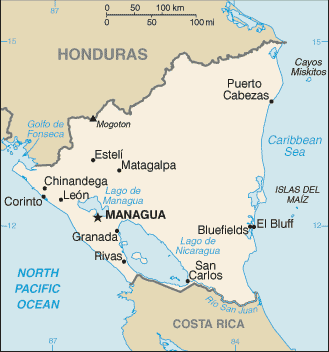
- Central America, bordering both the Caribbean Sea and the North Pacific Ocean, between Costa Rica and Honduras
- Area
- 130,370 sq km
- Climate
- tropical in lowlands, cooler in highlands
- Terrain
- extensive Atlantic coastal plains rising to central interior mountains; narrow Pacific coastal plain interrupted by volcanoes
- Natural resources
- gold, silver, copper, tungsten, lead, zinc, timber, fish
- Coastline
- 910 km
- Natural hazards
- destructive earthquakes; volcanoes; landslides; extremely susceptible to hurricanes volcanism: significant volcanic activity; Cerro Negro (728 m) is one of Nicaragua's most active volcanoes; its lava flows and ash have been known to cause significant damage to farmland and buildings; other historically active volcanoes include Concepcion, Cosiguina, Las Pilas, Masaya, Momotombo, San Cristobal, and Telica
People & society
- Population
- 6,739,380 (2025 est.)
- Nationality
- Nicaraguan(s)
- Ethnic groups
- Mestizo (mixed Indigenous and White) 69%, White 17%, Black 9%, Indigenous 5%
- Languages
- Spanish (official) 99.5%, Indigenous 0.3%, Portuguese 0.1%, other 0.1% (2020 est.)
- Religions
- Roman Catholic 44.9%, Protestant 38.7% (Evangelical 38.2, Adventist 0.5%), other 1.2%, (includes Jehovah's Witness and Church of Jesus Christ), believer but not belonging to a church 1%, agnostic or atheist 0.4%, none 13.7%, unspecified 0.2% (2020 est.)
- Median age
- 29.5 years (2025 est.)
- Life expectancy at birth
- 74.7 years (2024 est.)
Economy
- Economic overview
- low-income Central American economy; until 2018, nearly 20 years of sustained GDP growth; recent struggles due to COVID-19, political instability, and hurricanes; significant remittances; increasing poverty and food scarcity since 2005; sanctions limit investment
- Industries
- food processing, chemicals, machinery and metal products, knit and woven apparel, petroleum refining and distribution, beverages, footwear, wood, electric wire harness manufacturing, mining
- Agricultural products
- sugarcane, milk, rice, oil palm fruit, maize, plantains, cassava, groundnuts, beans, chicken (2023)
- Exports - partners
- USA 51%, Mexico 12%, El Salvador 6%, Canada 6%, Switzerland 4% (2023)
- Imports - partners
- USA 24%, China 13%, Mexico 9%, Honduras 9%, Guatemala 8% (2023)
Government
- Government type
- presidential republic
- Capital
- Managua
- Independence
- 15 September 1821 (from Spain)
- Constitution
- several previous; latest adopted 19 November 1986, effective 9 January 1987
- Executive branch
- President Jose Daniel ORTEGA Saavedra (since 10 January 2007)
- Legislative branch
- National Assembly (Asamblea Nacional)
Full reference data
Every field, by section, CIA World Factbook. Open a topic to expand it.
Introduction
Travel Facts
Please visit the following links to find further information about your desired destination.
World Health Organization (WHO) - To learn what vaccines and health precautions to take while visiting your destination.
US State Dept Travel Information - Overall information about foreign travel for US citizens.
To obtain an international driving permit (IDP). Only two organizations in the US issue IDPs: American Automobile Association (AAA) and American Automobile Touring Alliance (AATA)
How to get help in an emergency? Contact the nearest US embassy or consulate, or call one of these numbers: from the US or Canada - 1-888-407-4747 or from Overseas - +1 202-501-4444
Page last updated: Wednesday, July 20, 2022