
Country exposure · PH

Philippines
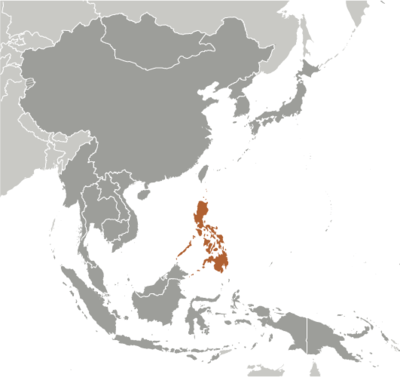
East N Southeast Asia · Manila · presidential republic
What Philippines means for your money, the prices you pay, the tariffs in motion, and where U.S. policy could change both.
$17.8B
U.S. imports, 2025
+25.5%
change in one year
$9.2B
U.S. exports, 2025
118M
Population
$461.6B
GDP
In your house
What you buy that Philippines makes
America bought $17.8B in goods from Philippines in 2025, up 25.5% in a single year. Of every $100 of it, here's where the money went.
Computer accessories
keyboards, drives, computer parts
Generators, accessories
Semiconductors
semiconductors and chips
Telecommunications equipment
phones, routers, networking gear
Other parts and accessories of vehicles
car parts and accessories
Cell phones and other household goods, n.e.c.
cell phones and home electronics
Electric apparatus
Food oils, oilseeds
Apparel, textiles, nonwool or cotton
synthetic and performance apparel
Fruits, frozen juices
fruit and frozen juices
2026 so far (through July): $14.6B in imports. Source: U.S. Census Bureau, International Trade in Goods (customs basis).
The other direction
What America sells to Philippines
$9.2B in 2025, a trade rupture cuts both ways, for American producers as well as American prices.
Semiconductors
$1.5Bsemiconductors and chips
Soybeans
$634Mmeat at the counter
Wheat
$630Mgreen coffee for roasters
Meat, poultry, etc.
$534MAnimal feeds, n.e.c.
$513MCivilian aircraft, engines, equipment, and parts
$493MTelecommunications equipment
$468Mphones, routers, networking gear
Computer accessories
$407Mkeyboards, drives, computer parts
Cell phones and other household goods, n.e.c.
$400Mcell phones and home electronics
Where you stand
U.S. tariff posture toward Philippines
The Philippines reached a trade deal on July 22, 2025 during President Marcos's White House visit, settling its reciprocal rate at 19% (effective August 7) — just below the 20% Trump had threatened, though above the 17% set in April — in exchange for zero tariffs on U.S. goods and commitments on digital trade, IP, labor, and security cooperation. Executive Order 14389 (Ending Certain Tariff Actions, Feb 20, 2026) terminated the IEEPA reciprocal duties, and Proclamation 11012 replaced it with a 10% Section 122 temporary import surcharge effective February 24, 2026. The Philippines has no Section 232 steel/aluminum exposure.
Reciprocal tariff (assigned, terminated)
17%
The rate this country was assigned under the EO 14257 reciprocal Annex, no longer in force. The Supreme Court struck down the IEEPA tariffs and they were terminated February 24, 2026 (EO 14389), replaced by a universal ~10% Section 122 surcharge. See the timeline below for the current effective rate.
Policy in motion
Tariff status: a moving target
U.S. tariff policy toward Philippines has changed 5 times since 2025. This page tracks it.
2026-02-24
IEEPA reciprocal tariffs terminated — replaced by 10% Section 122
In effectExecutive Order 14389 (Ending Certain Tariff Actions) terminated the IEEPA tariff duties effective February 24, 2026, replacing the Philippines' 19% reciprocal rate with a 10% Section 122 temporary import surcharge under Proclamation 11012 (capped at 150 days).
91 FR 9437 →2025-08-07
19% reciprocal rate takes effect for the Philippines
In effectExecutive Order 14326 set the post-pause Annex I reciprocal rates; the Philippines' rate was set at 19% effective for goods entered on or after August 7, 2025 — among the lowest in ASEAN.
90 FR 37963 →2025-07-22
U.S.-Philippines trade deal sets rate at 19%
AgreementDuring President Marcos's White House visit, the two sides reached a deal setting the Philippines' reciprocal rate at 19% — below the 20% threatened but above the 17% set in April — in exchange for zero tariffs on U.S. goods and commitments on digital trade, IP, labor, and security cooperation.
Source ↗2025-04-10
Elevated reciprocal rates paused to 10% for 90 days
In effectExecutive Order 14266 suspended the higher country-specific reciprocal rates — including the Philippines' 17% — back to the 10% baseline for 90 days, after which Trump threatened a 20% rate from August 1.
90 FR 15625 →2025-04-05
Reciprocal tariff regime begins — Philippines assigned 17%
In effectExecutive Order 14257 imposed a 10% universal reciprocal duty effective April 5 and a 17% country-specific rate for the Philippines scheduled to take effect April 9 under Annex I.
90 FR 15041 →
Made for America
What Philippines makes for America
Philippines is a direct U.S. source of 12 essential goods Americans rely on, the items themselves, shipped finished off the line.
digital
7% of U.S.Memory and storage chips
$1.2B to the U.S.
materials
1% of U.S.Auto parts and repairs
$996M to the U.S.
digital
1% of U.S.Fiber optic cables and networking
$900M to the U.S.
digital
8% of U.S.Specialty chips
$541M to the U.S.
materials
1% of U.S.Clothing and apparel
$507M to the U.S.
home
4% of U.S.Luggage, handbags & travel goods
$433M to the U.S.
digital
4% of U.S.Printers & peripherals
$431M to the U.S.
home
7% of U.S.Personal care and hygiene
$365M to the U.S.
materials
2% of U.S.Copper and electrical wiring
$294M to the U.S.
digital
1% of U.S.Semiconductors and chips
$277M to the U.S.
home
9% of U.S.Vacuums & floor care
$272M to the U.S.
materials
1% of U.S.Tires
$248M to the U.S.
Go deeper
The supply chain view
Philippines sits upstream of 24 essential American goods through 12 tracked inputs.
agricultural
85%Tea-Bag Filter Paper (Abaca / Manila Hemp)
agricultural
12%Palm Kernel / Coconut Fatty Alcohols
agricultural
10%Vegetable Oil Blend (Palm Olein, Soy, Coconut, Sunflower)
manufactured
8%Sunglass Lens Blank (CR-39/PC/Nylon)
manufactured
7%Activated carbon (GAC and carbon block)
manufactured
7%IGBT Modules (HVAC inverter drives)
Reference
The country itself
East N Southeast Asia · Geography, people, economy, and government, public-domain data from the CIA World Factbook.
The Philippine Islands became a Spanish colony during the 16th century; they were ceded to the US in 1898 following the Spanish-American War. Led by Emilio AGUINALDO, the Filipinos conducted an insurgency against US rule from 1899-1902, although some fighting continued in outlying islands as late as 1913. In 1935, the Philippines became a self-governing commonwealth. Manuel QUEZON was elected president and was tasked with preparing the country for independence after a 10-year transition. The islands fell under Japanese occupation during World War II, and US forces and Filipinos fought together during 1944-45 to regain control. On 4 July 1946 the Republic of the Philippines attained its independence. Twenty-one years of authoritarian rule under Ferdinand MARCOS ended in 1986, when a "people power" movement in Manila ("EDSA 1") forced him into exile and installed Corazon AQUINO as president. Several coup attempts hampered her presidency, and progress on political stability and economic development faltered until Fidel RAMOS was elected president in 1992. The US closed its last military bases on the islands the same year. Joseph ESTRADA was elected president in 1998. His vice-president, Gloria MACAPAGAL-ARROYO, succeded him in 2001 after ESTRADA's stormy impeachment trial on corruption charges broke down and another "people power" movement ("EDSA 2") demanded his resignation. MACAPAGAL-ARROYO was elected president in 2004. Corruption allegations marred her presidency, but the Philippine economy was one of the few to avoid contraction after the 2008 global financial crisis. Benigno AQUINO III was elected as president in 2010, followed by Rodrigo DUTERTE in 2016. During his term, DUTERTE pursued a controversial drug war that garnered international criticism for alleged human rights abuses. Ferdinand MARCOS, Jr. was elected president in 2022 with the largest popular vote in a presidential election since his father's ouster. For decades, the country has been challenged by armed ethnic separatists, communist rebels, and Islamic terrorist groups, particularly in the southern islands and remote areas of Luzon.
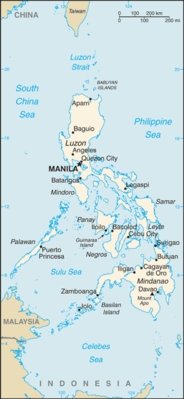
Geography
- Location
- Southeastern Asia, archipelago between the Philippine Sea and the South China Sea, east of Vietnam
- Area
- 300,000 sq km
- Climate
- tropical marine; northeast monsoon (November to April); southwest monsoon (May to October)
- Terrain
- mostly mountains with narrow to extensive coastal lowlands
- Natural resources
- timber, petroleum, nickel, cobalt, silver, gold, salt, copper
- Coastline
- 36,289 km
- Natural hazards
- astride typhoon belt, usually affected by several cyclonic storms each year; landslides; active volcanoes; destructive earthquakes; tsunamis volcanism: significant volcanic activity; Taal (311 m) has been deemed a Decade Volcano by the International Association of Volcanology and Chemistry of the Earth's Interior, worthy of study due to its explosive history and close proximity to human populations; Mayon (2,462 m), the country's most active volcano, erupted in 2009 and forced over 33,000 to be evacuated; other historically active volcanoes include Biliran, Babuyan Claro, Bulusan, Camiguin, Camiguin de Babuyanes, Didicas, Iraya, Jolo, Kanlaon, Makaturing, Musuan, Parker, Pinatubo, and Ragang; see note 2 under "Geography - note"
People & society
- Population
- 118,277,063 (2024 est.)
- Nationality
- Filipino(s)
- Ethnic groups
- Tagalog 26%, Bisaya/Binisaya 14.3%, Ilocano 8%, Cebuano 8%, Illonggo 7.9%, Bikol/Bicol 6.5%, Waray 3.8%, Kapampangan 3%, Maguindanao 1.9%, Pangasinan 1.9%, other local ethnicities 18.5%, foreign ethnicities 0.2% (2020 est.)
- Languages
- Tagalog 39.9%, Bisaya/Binisaya 16%, Hiligaynon/Ilonggo 7.3%, Ilocano 7.1%, Cebuano 6.5%, Bikol/Bicol 3.9%, Waray 2.6%, Kapampangan 2.4%, Maguindanao 1.4%, Pangasinan/Panggalato 1.3%, other languages/dialects 11.2%, unspecified 0.4% (2020 est.)
- Religions
- Roman Catholic 78.8%, Muslim 6.4%, Iglesia ni Cristo 2.6%, other Christian 3.9%, other 8.2%, none/unspecified <0.1 (2020 est.)
- Median age
- 27.1 years (2025 est.)
- Life expectancy at birth
- 70.8 years (2024 est.)
- Literacy
- 98.5% (2020 est.)
Economy
- Economic overview
- growing Southeast Asian economy; commercial rebound led by transportation, construction and financial services; electronics exports recovering from sector slowdown; significant remittances; interest rate rises following heightened inflation; uncertainties due to increased regional tensions with China
- Industries
- semiconductors and electronics assembly, business process outsourcing, food and beverage manufacturing, construction, electric/gas/water supply, chemical products, radio/television/communications equipment and apparatus, petroleum and fuel, textile and garments, non-metallic minerals, basic metal industries, transport equipment
- Agricultural products
- sugarcane, rice, coconuts, maize, bananas, vegetables, tropical fruits, plantains, pineapples, cassava (2023)
- Exports - partners
- China 19%, USA 13%, Hong Kong 12%, Japan 11%, Germany 5% (2023)
- Imports - partners
- China 25%, Indonesia 8%, Japan 8%, S. Korea 6%, USA 6% (2023)
Government
- Government type
- presidential republic
- Capital
- Manila
- Independence
- 4 July 1946 (from the US)
- Constitution
- several previous; latest ratified 2 February 1987, effective 11 February 1987
- Executive branch
- President Ferdinand "BongBong" MARCOS, Jr. (since 30 June 2022)
- Legislative branch
- Congress (Kongreso)
Full reference data
Every field, by section, CIA World Factbook. Open a topic to expand it.
Introduction
Travel Facts
Please visit the following links to find further information about your desired destination.
World Health Organization (WHO) - To learn what vaccines and health precautions to take while visiting your destination.
US State Dept Travel Information - Overall information about foreign travel for US citizens.
To obtain an international driving permit (IDP). Only two organizations in the US issue IDPs: American Automobile Association (AAA) and American Automobile Touring Alliance (AATA)
How to get help in an emergency? Contact the nearest US embassy or consulate, or call one of these numbers: from the US or Canada - 1-888-407-4747 or from Overseas - +1 202-501-4444
Page last updated: Monday, August 15, 2022