
Country exposure · AU

Australia
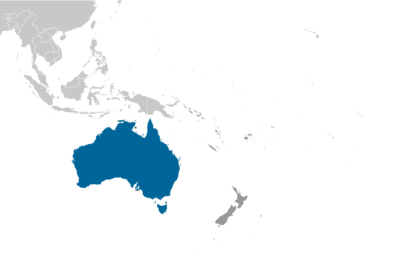
Australia Oceania · Canberra · federal parliamentary democracy under a constitutional monarchy; a Commonwealth realm
What Australia means for your money, the prices you pay, the tariffs in motion, and where U.S. policy could change both.
$29.0B
U.S. imports, 2025
+74%
change in one year
$33.7B
U.S. exports, 2025
27M
Population
$1.8T
GDP
In your house
What you buy that Australia makes
America bought $29.0B in goods from Australia in 2025, up 74% in a single year. Of every $100 of it, here's where the money went.
Finished metal shapes
Meat products
meat at the counter
Nonmonetary gold
U.s. goods returned, and reimports
Pharmaceutical preparations
medicines and pharmacy items
Tobacco, waxes, etc.
Numismatic coins
Copper
copper for wiring
Nuclear fuel materials
Medicinal equipment
medical devices and equipment
2026 so far (through July): $10.4B in imports. Source: U.S. Census Bureau, International Trade in Goods (customs basis).
The other direction
What America sells to Australia
$33.7B in 2025, a trade rupture cuts both ways, for American producers as well as American prices.
Civilian aircraft, engines, equipment, and parts
$2.0BPharmaceutical preparations
$1.9Bmedicines and pharmacy items
Telecommunications equipment
$1.8Bphones, routers, networking gear
Computers
$1.6Blaptops, desktops, monitors
Medicinal equipment
$1.5Bmedical devices and equipment
Minimum value shipments
$1.4BNonmonetary gold
$1.4BMaterials handling equipment
$1.3BIndustrial machines, other
$1.1BWhere you stand
U.S. tariff posture toward Australia
Australia sat at the 10% reciprocal baseline — notable because the U.S. runs a goods trade surplus with Australia, yet it received no better than the floor rate. Despite an intensive lobbying campaign by the Albanese government, Australia was denied a Section 232 exemption, so its steel and aluminum moved to 25% (March 2025) then 50% (June 2025). No comprehensive trade deal was reached, and Australia declined to retaliate. Executive Order 14389 (Ending Certain Tariff Actions, Feb 20, 2026) terminated the IEEPA reciprocal duties, and Proclamation 11012 replaced it with a 10% Section 122 temporary import surcharge effective February 24, 2026 — leaving the baseline at 10%, while Section 232 metals at 50% are unaffected.
Section 232 sectors
Steel
Steel, aluminum, autos, and similar national-security tariffs that name this country.
Policy in motion
Tariff status: a moving target
U.S. tariff policy toward Australia has changed 4 times since 2025. This page tracks it.
2026-02-24
IEEPA reciprocal tariffs terminated — replaced by 10% Section 122
In effectExecutive Order 14389 (Ending Certain Tariff Actions) terminated the IEEPA tariff duties effective February 24, 2026, replacing the reciprocal regime with a 10% Section 122 temporary import surcharge (Proclamation 11012) — leaving Australia's baseline unchanged at 10%. Section 232 metals at 50% are unaffected.
91 FR 9437 →2025-06-04
Section 232 steel and aluminum doubled to 50%
In effectProclamation 10947 raised the Section 232 steel and aluminum tariff to 50% for all countries except the UK. Australia received no carve-out, so its metals rate moved from 25% to 50%.
90 FR 24199 →2025-04-05
10% reciprocal baseline applies — no elevated rate
In effectExecutive Order 14257 imposed a 10% universal reciprocal duty. Although the U.S. runs a trade surplus with Australia, it was placed at the 10% baseline with no country-specific reduction.
90 FR 15041 →2025-03-12
Section 232 steel and aluminum tariffs applied to Australia at 25% — exemption denied
In effectPresident Trump ruled out an exemption for Australia, and proclamations terminated Australia's prior steel and aluminum arrangements, subjecting Australian metals and derivatives to the 25% Section 232 tariff despite the close alliance.
Federal Register · 2025-02833 →
Made for America
What Australia makes for America
Australia is a direct U.S. source of 12 essential goods Americans rely on, the items themselves, shipped finished off the line.
food
28% of U.S.Beef and ground beef
$3.6B to the U.S.
health
8% of U.S.Blood products
$461M to the U.S.
health
Cancer and specialty drugs
$223M to the U.S.
food
1% of U.S.Beer, wine, and spirits
$216M to the U.S.
food
6% of U.S.Sugar
$115M to the U.S.
materials
Auto parts and repairs
$114M to the U.S.
materials
Steel and iron products
$86M to the U.S.
food
Seafood and fish
$73M to the U.S.
materials
Plumbing pipes and fittings
$70M to the U.S.
digital
Fiber optic cables and networking
$59M to the U.S.
home
1% of U.S.Cosmetics & makeup
$43M to the U.S.
health
OTC medicines
$38M to the U.S.
Go deeper
The supply chain view
Australia sits upstream of 24 essential American goods through 12 tracked inputs.
mineral
57%Iron ore (direct shipping ore & pellets)
mineral
55%Metallurgical (coking) coal
agricultural
50%Thebaine & oripavine (opium alkaloid precursors)
agricultural
48%Vital Wheat Gluten
mineral
46%Lithium Carbonate
manufactured
28%Raw Cattle Hides (Green Hides)
Reference
The country itself
Australia Oceania · Geography, people, economy, and government, public-domain data from the CIA World Factbook.
Aboriginal Australians arrived on the continent at least 60,000 years ago and developed complex hunter-gatherer societies and oral histories. Dutch navigators led by Abel TASMAN were the first Europeans to land in Australia in 1606, and they mapped the western and northern coasts. They named the continent New Holland but made no attempts to permanently settle it. In 1770, Englishman James COOK sailed to the east coast of Australia, named it New South Wales, and claimed it for Great Britain. In 1788 and 1825 respectively, Great Britain established New South Wales and then Tasmania as penal colonies. Great Britain and Ireland sent more than 150,000 convicts to Australia before ending the practice in 1868. As Europeans began settling areas away from the coasts, they came into more direct contact with Aboriginal Australians. Europeans also cleared land for agriculture, impacting Aboriginal Australians’ ways of life. These issues, along with disease and a policy in the 1900s that forcefully removed Aboriginal children from their parents, reduced the Aboriginal Australian population from more than 700,000 pre-European contact to a low of 74,000 in 1933. Four additional colonies were established in Australia in the mid-1800s: Western Australia (1829), South Australia (1836), Victoria (1851), and Queensland (1859). Gold rushes beginning in the 1850s brought thousands of new immigrants to New South Wales and Victoria, helping to reorient Australia away from its penal colony roots. In the second half of the 1800s, the colonies were all gradually granted self-government, and in 1901, they federated and became the Commonwealth of Australia. Australia contributed more than 400,000 troops to Allied efforts during World War I, and Australian troops played a large role in the defeat of Japanese troops in the Pacific in World War II. Australia severed most constitutional links with the UK in 1942 but remained part of the British Commonwealth. Australia’s post-war economy boomed and by the 1970s, racial policies that prevented most non-Whites from immigrating to Australia were removed, greatly increasing Asian immigration to the country. In recent decades, Australia has become an internationally competitive, advanced market economy due in large part to economic reforms adopted in the 1980s and its proximity to East and Southeast Asia. In the early 2000s, Australian politics became unstable with frequent attempts to oust party leaders, including five changes of prime minister between 2010 and 2018. As a result, both major parties instituted rules to make it harder to remove a party leader.
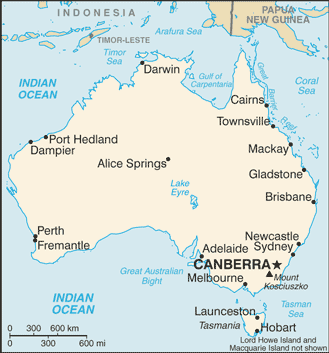
Geography
- Location
- Oceania, continent between the Indian Ocean and the South Pacific Ocean
- Area
- 7,741,220 sq km
- Climate
- generally arid to semiarid; temperate in south and east; tropical in north
- Terrain
- mostly low plateau with deserts; fertile plain in southeast
- Natural resources
- alumina, coal, iron ore, copper, lithium, tin, gold, silver, uranium, nickel, tungsten, rare earth elements, mineral sands, lead, zinc, diamonds, opals, natural gas, petroleum
- Coastline
- 25,760 km
- Natural hazards
- cyclones along the coast; severe droughts; forest fires volcanism: volcanic activity on Heard and McDonald Islands
People & society
- Population
- 27,490,921 (2025 est.)
- Nationality
- Australian(s)
- Ethnic groups
- English 33%, Australian 29.9%, Irish 9.5%, Scottish 8.6%, Chinese 5.5%, Italian 4.4%, German 4%, Indian 3.1%, Australian Aboriginal 2.9%, Greek 1.7%, unspecified 4.7% (2021 est.)
- Languages
- English 72%, Mandarin 2.7%, Arabic 1.4%, Vietnamese 1.3%, Cantonese 1.2%, other 15.7%, unspecified 5.7% (2021 est.)
- Religions
- Roman Catholic 20%, Protestant 18.1% (Anglican 9.8%, Uniting Church 2.6%, Presbyterian and Reformed 1.6%, Baptist 1.4%, Pentecostal 1%, other Protestant 1.7%), other Christian 3.5%, Muslim 3.2%, Hindu 2.7%, Buddhist 2.4%, Orthodox 2.3% (Eastern Orthodox 2.1%, Oriental Orthodox 0.2%), other 2.1%, none 38.4%, unspecified 7.3% (2021 est.)
- Median age
- 38.5 years (2025 est.)
- Life expectancy at birth
- 83.5 years (2024 est.)
Economy
- Economic overview
- high-income and globally integrated economy; strong mining, manufacturing, and service sectors driving slow but steady growth; net exporter, driven by commodities to East Asian trade partners; weak productivity and aging population straining labor force participation
- Industries
- mining, industrial and transportation equipment, food processing, chemicals, steel
- Agricultural products
- wheat, sugarcane, barley, rapeseed, milk, cotton, sorghum, beef, lentils, grapes (2023)
- Exports - partners
- China 37%, Japan 16%, S. Korea 6%, India 5%, Taiwan 5% (2023)
- Imports - partners
- China 26%, USA 11%, S. Korea 6%, Japan 6%, Thailand 5% (2023)
Government
- Government type
- federal parliamentary democracy under a constitutional monarchy; a Commonwealth realm
- Capital
- Canberra
- Independence
- 1 January 1901 (from the federation of UK colonies)
- Constitution
- approved in a series of referenda from 1898 through 1900 and became law 9 July 1900, effective 1 January 1901
- Executive branch
- King CHARLES III (since 8 September 2022); represented by Governor General Samantha (Sam) MOSTYN (since 1 July 2024)
- Legislative branch
- Parliament
Full reference data
Every field, by section, CIA World Factbook. Open a topic to expand it.
Introduction
Travel Facts
Please visit the following links to find further information about your desired destination.
CDC - To learn what vaccines and health precautions to take while visiting your destination.
US State Dept Travel Information - Overall information about foreign travel for US citizens.
To obtain an international driving permit (IDP). Only two organizations in the US issue IDPs: American Automobile Association (AAA) and American Automobile Touring Alliance (AATA)
How to get help in an emergency? Contact the nearest US embassy or consulate, or call one of these numbers: from the US or Canada - 1-888-407-4747 or from Overseas - +1 202-501-4444
Page last updated: Thursday, January 02, 2025