
Country exposure · SG
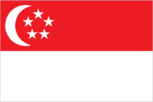
Singapore
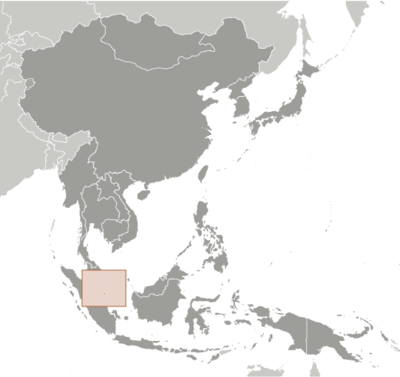
East N Southeast Asia · Singapore · parliamentary republic
What Singapore means for your money, the prices you pay, the tariffs in motion, and where U.S. policy could change both.
$38.2B
U.S. imports, 2025
-11.6%
change in one year
$41.6B
U.S. exports, 2025
6M
Population
$547.4B
GDP
In your house
What you buy that Singapore makes
America bought $38.2B in goods from Singapore in 2025. Of every $100 of it, here's where the money went.
Pharmaceutical preparations
medicines and pharmacy items
U.s. goods returned, and reimports
Medicinal equipment
medical devices and equipment
Other foods
Finished metal shapes
Semiconductors
semiconductors and chips
Industrial machines, other
Cell phones and other household goods, n.e.c.
cell phones and home electronics
Chemicals-other, n.e.c.
Computers
laptops, desktops, monitors
2026 so far (through July): $19.0B in imports. Source: U.S. Census Bureau, International Trade in Goods (customs basis).
The other direction
What America sells to Singapore
$41.6B in 2025, a trade rupture cuts both ways, for American producers as well as American prices.
Civilian aircraft, engines, equipment, and parts
$6.8BIndustrial machines, other
$3.4BNonmonetary gold
$3.0BComputers
$2.2Blaptops, desktops, monitors
Crude oil
$1.8BSemiconductors
$1.6Bsemiconductors and chips
Telecommunications equipment
$1.5Bphones, routers, networking gear
Minimum value shipments
$1.4BComputer accessories
$1.4Bkeyboards, drives, computer parts
Where you stand
U.S. tariff posture toward Singapore
No U.S. tariff action singles this country out. Its goods face the universal 10% temporary import surcharge under Section 122 of the Trade Act (which replaced the IEEPA reciprocal baseline in February 2026) plus the sectoral Section 232 duties — steel and aluminum at 50% — that apply to all countries. The Section 122 surcharge is statutorily temporary — scheduled to lapse on or about July 23, 2026 (a 150-day cap) unless extended or replaced.
Reciprocal tariff (universal baseline)
10%
The universal 10% floor, a Section 122 import surcharge since February 2026, previously the EO 14257 reciprocal baseline, applies to nearly all U.S. imports. This country has no higher assigned rate of its own.
Policy in motion
Tariff status: a moving target
No U.S. tariff action names Singapore. These are the universal measures, applied to every country without a country-specific arrangement, that set its treatment.
2026-04-06
Section 232 metals coverage expanded
In effectThe April 2026 proclamation strengthening Section 232 actions on aluminum, steel, and copper expanded derivative-product coverage for all countries, keeping the general metals rate at 50%.
91 FR 18201 →2026-02-24
IEEPA reciprocal tariffs terminated — replaced by 10% Section 122 surcharge
In effectExecutive Order 14389 (Ending Certain Tariff Actions) terminated the IEEPA tariff duties — including the EO 14257 reciprocal baseline — effective February 24, 2026. A flat 10% Section 122 temporary import surcharge (Proclamation 11012 of February 20, 2026) replaced them, leaving the universal rate unchanged at 10% on a different statutory basis. Section 122 caps such surcharges at 150 days, so this 10% surcharge is scheduled to lapse on or about July 23, 2026 absent further action (the administration has signaled it could raise the rate toward the 15% statutory maximum).
91 FR 9437 →2025-11-13
Agricultural products exempted from reciprocal tariffs
In effectExecutive Order 14360 of November 14, 2025 removed reciprocal duties from certain agricultural products listed in its annexes (coffee, cocoa, bananas, and other goods the U.S. does not produce in sufficient quantity), retroactive to November 13, 2025 — for all countries subject to the reciprocal tariff.
90 FR 54091 →2025-06-04
Section 232 steel and aluminum duties doubled to 50%
In effectThe June 3, 2025 proclamation raised Section 232 duties on steel and aluminum articles and derivatives from 25% to 50% for all countries, effective June 4, 2025.
90 FR 24199 →2025-04-05
Universal 10% reciprocal baseline takes effect
In effectExecutive Order 14257 (signed April 2, 2025) imposed a 10% ad valorem reciprocal duty on imports from all trading partners, effective April 5, 2025. Countries without a higher Annex I rate remain at this baseline.
Federal Register · 2025-06063 →2025-03-12
Section 232 steel and aluminum duties set at 25% for all countries
In effectProclamations of February 10, 2025 terminated all country exemptions and quota arrangements and applied 25% Section 232 duties to steel and aluminum imports from every country, effective March 12, 2025.
90 FR 9817 →
Made for America
What Singapore makes for America
Singapore is a direct U.S. source of 12 essential goods Americans rely on, the items themselves, shipped finished off the line.
health
7% of U.S.Cancer and specialty drugs
$5.7B to the U.S.
health
5% of U.S.OTC medicines
$3.7B to the U.S.
digital
Servers and cloud hardware
$709M to the U.S.
health
11% of U.S.Diagnostic tests and lab supplies
$624M to the U.S.
digital
Fiber optic cables and networking
$390M to the U.S.
digital
1% of U.S.Semiconductors and chips
$348M to the U.S.
materials
1% of U.S.Plumbing pipes and fittings
$276M to the U.S.
digital
2% of U.S.Specialty chips
$137M to the U.S.
health
1% of U.S.Surgical and sterile supplies
$131M to the U.S.
energy
1% of U.S.Home heating oil
$124M to the U.S.
materials
1% of U.S.Jewelry
$120M to the U.S.
energy
1% of U.S.Gasoline and diesel
$117M to the U.S.
Go deeper
The supply chain view
Singapore sits upstream of 24 essential American goods through 12 tracked inputs.
chemical
68%Vinyl Acetate Monomer (VAM)
manufactured
45%Offshore Pipe Handling Spreaders
chemical
25%DL-Methionine (Essential Amino Acid Supplement)
manufactured
25%Containerised Bulk Handling Spreaders (Mining Port Logistics)
manufactured
20%Container Spreader Headblocks & Frames
agricultural
20%Vegetable Oil Blend (Palm Olein, Soy, Coconut, Sunflower)
Reference
The country itself
East N Southeast Asia · Geography, people, economy, and government, public-domain data from the CIA World Factbook.
A Malay trading port known as Temasek existed on the island of Singapore by the 14th century. The settlement changed hands several times in the ensuing centuries and was eventually burned in the 17th century, falling into obscurity. In 1819, the British founded modern Singapore as a trading colony on the same site and granted it full internal self-government for all matters except defense and foreign affairs in 1959. Singapore joined the Malaysian Federation in 1963 but was ousted two years later and became independent. Singapore subsequently became one of the world's most prosperous countries, with strong international trading links and per capita GDP among the highest globally. The People’s Action Party has won every general election in Singapore since the end of the British colonial era, aided by its success in delivering consistent economic growth, as well as the city-state's fragmented opposition and electoral procedures that strongly favor the ruling party.
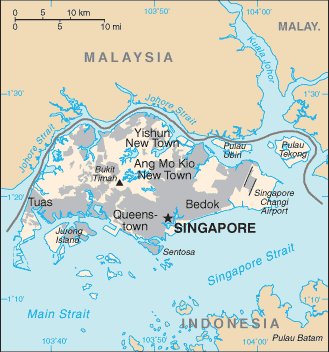
Geography
- Location
- Southeastern Asia, islands between Malaysia and Indonesia
- Area
- 719 sq km
- Climate
- tropical; hot, humid, rainy; two distinct monsoon seasons - northeastern monsoon (December to March) and southwestern monsoon (June to September); inter-monsoon - frequent afternoon and early evening thunderstorms
- Terrain
- lowlying, gently undulating central plateau
- Natural resources
- fish, deepwater ports
- Coastline
- 193 km
- Natural hazards
- flash floods
People & society
- Population
- 6,080,545 (2025 est.)
- Nationality
- Singaporean(s)
- Ethnic groups
- Chinese 74.2%, Malay 13.7%, Indian 8.9%, other 3.2% (2021 est.)
- Languages
- English (official) 48.3%, Mandarin (official) 29.9%, other Chinese dialects (includes Hokkien, Cantonese, Teochew, Hakka) 8.7%, Malay (official) 9.2%, Tamil (official) 2.5%, other 1.4% (2020 est.)
- Religions
- Buddhist 31.1%, Christian 18.9%, Muslim 15.6%, Taoist 8.8%, Hindu 5%, other 0.6%, none 20% (2020 est.)
- Median age
- 39.8 years (2025 est.)
- Life expectancy at birth
- 86.7 years (2024 est.)
- Literacy
- 97.7% (2021 est.)
Economy
- Economic overview
- high-income, service-based economy; global financial hub; business-friendly policies and open to investment and trade; inflation easing but persistent in services; public investments in education, healthcare, and infrastructure; strong human capital development challenged by aging population
- Industries
- electronics, chemicals, financial services, oil drilling equipment, petroleum refining, biomedical products, scientific instruments, telecommunication equipment, processed food and beverages, ship repair, offshore platform construction, entrepot trade
- Agricultural products
- chicken, eggs, vegetables, pork, duck, spinach, lettuce, pork offal, cabbages, pork fat (2023)
- Exports - partners
- Hong Kong 13%, China 11%, USA 10%, Malaysia 9%, S. Korea 6% (2023)
- Imports - partners
- China 15%, Malaysia 11%, Taiwan 11%, USA 10%, S. Korea 6% (2023)
Government
- Government type
- parliamentary republic
- Capital
- Singapore
- Independence
- 9 August 1965 (from Malaysian Federation)
- Constitution
- several previous; latest adopted 22 December 1965
- Executive branch
- President THARMAN Shanmugaratnam (since 14 September 2023)
- Legislative branch
- Parliament
Full reference data
Every field, by section, CIA World Factbook. Open a topic to expand it.
Introduction
Travel Facts
Please visit the following links to find further information about your desired destination.
World Health Organization (WHO) - To learn what vaccines and health precautions to take while visiting your destination.
US State Dept Travel Information - Overall information about foreign travel for US citizens.
To obtain an international driving permit (IDP). Only two organizations in the US issue IDPs: American Automobile Association (AAA) and American Automobile Touring Alliance (AATA)
How to get help in an emergency? Contact the nearest US embassy or consulate, or call one of these numbers: from the US or Canada - 1-888-407-4747 or from Overseas - +1 202-501-4444
Page last updated: Wednesday, June 26, 2024