
Country exposure · SV
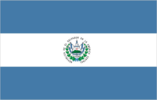
El Salvador
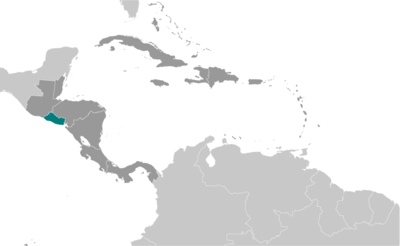
Central America N Caribbean · San Salvador · presidential republic
What El Salvador means for your money, the prices you pay, the tariffs in motion, and where U.S. policy could change both.
$2.3B
U.S. imports, 2025
-1.3%
change in one year
$4.6B
U.S. exports, 2025
6M
Population
$35.4B
GDP
In your house
What you buy that El Salvador makes
America bought $2.3B in goods from El Salvador in 2025. Of every $100 of it, here's where the money went.
Apparel, textiles, nonwool or cotton
synthetic and performance apparel
Apparel, household goods - cotton
cotton clothing and linens
U.s. goods returned, and reimports
Cane and beet sugar
cane and beet sugar
Other foods
Green coffee
green coffee for roasters
Other parts and accessories of vehicles
car parts and accessories
Electric apparatus
Bakery products
Furniture, household goods, etc.
furniture, mattresses, lamps
2026 so far (through July): $1.4B in imports. Source: U.S. Census Bureau, International Trade in Goods (customs basis).
The other direction
What America sells to El Salvador
$4.6B in 2025, a trade rupture cuts both ways, for American producers as well as American prices.
Petroleum products, other
$1.0BFuel oil
$503MNatural gas liquids
$194MPassenger cars, new and used
$174Mnew and used cars
Minimum value shipments
$159MCorn
$157MManmade cloth
$149MCivilian aircraft, engines, equipment, and parts
$147MCell phones and other household goods, n.e.c.
$123Mcell phones and home electronics
Where you stand
U.S. tariff posture toward El Salvador
No U.S. tariff action singles this country out. Its goods face the universal 10% temporary import surcharge under Section 122 of the Trade Act (which replaced the IEEPA reciprocal baseline in February 2026) plus the sectoral Section 232 duties — steel and aluminum at 50% — that apply to all countries. The Section 122 surcharge is statutorily temporary — scheduled to lapse on or about July 23, 2026 (a 150-day cap) unless extended or replaced.
Reciprocal tariff (universal baseline)
10%
The universal 10% floor, a Section 122 import surcharge since February 2026, previously the EO 14257 reciprocal baseline, applies to nearly all U.S. imports. This country has no higher assigned rate of its own.
Policy in motion
Tariff status: a moving target
No U.S. tariff action names El Salvador. These are the universal measures, applied to every country without a country-specific arrangement, that set its treatment.
2026-04-06
Section 232 metals coverage expanded
In effectThe April 2026 proclamation strengthening Section 232 actions on aluminum, steel, and copper expanded derivative-product coverage for all countries, keeping the general metals rate at 50%.
91 FR 18201 →2026-02-24
IEEPA reciprocal tariffs terminated — replaced by 10% Section 122 surcharge
In effectExecutive Order 14389 (Ending Certain Tariff Actions) terminated the IEEPA tariff duties — including the EO 14257 reciprocal baseline — effective February 24, 2026. A flat 10% Section 122 temporary import surcharge (Proclamation 11012 of February 20, 2026) replaced them, leaving the universal rate unchanged at 10% on a different statutory basis. Section 122 caps such surcharges at 150 days, so this 10% surcharge is scheduled to lapse on or about July 23, 2026 absent further action (the administration has signaled it could raise the rate toward the 15% statutory maximum).
91 FR 9437 →2025-11-13
Agricultural products exempted from reciprocal tariffs
In effectExecutive Order 14360 of November 14, 2025 removed reciprocal duties from certain agricultural products listed in its annexes (coffee, cocoa, bananas, and other goods the U.S. does not produce in sufficient quantity), retroactive to November 13, 2025 — for all countries subject to the reciprocal tariff.
90 FR 54091 →2025-06-04
Section 232 steel and aluminum duties doubled to 50%
In effectThe June 3, 2025 proclamation raised Section 232 duties on steel and aluminum articles and derivatives from 25% to 50% for all countries, effective June 4, 2025.
90 FR 24199 →2025-04-05
Universal 10% reciprocal baseline takes effect
In effectExecutive Order 14257 (signed April 2, 2025) imposed a 10% ad valorem reciprocal duty on imports from all trading partners, effective April 5, 2025. Countries without a higher Annex I rate remain at this baseline.
Federal Register · 2025-06063 →2025-03-12
Section 232 steel and aluminum duties set at 25% for all countries
In effectProclamations of February 10, 2025 terminated all country exemptions and quota arrangements and applied 25% Section 232 duties to steel and aluminum imports from every country, effective March 12, 2025.
90 FR 9817 →
Made for America
What El Salvador makes for America
El Salvador is a direct U.S. source of 12 essential goods Americans rely on, the items themselves, shipped finished off the line.
materials
2% of U.S.Clothing and apparel
$1.3B to the U.S.
food
6% of U.S.Sugar
$115M to the U.S.
food
1% of U.S.Coffee
$96M to the U.S.
materials
Auto parts and repairs
$82M to the U.S.
food
1% of U.S.Bread, grains, and flour
$49M to the U.S.
food
Soft drinks & juices
$29M to the U.S.
home
1% of U.S.Mattresses & bedding
$27M to the U.S.
home
Towels & home linens
$25M to the U.S.
materials
Copper and electrical wiring
$22M to the U.S.
food
Seafood and fish
$17M to the U.S.
health
OTC medicines
$16M to the U.S.
food
Snacks & confectionery
$15M to the U.S.
Go deeper
The supply chain view
El Salvador sits upstream of 6 essential American goods through 5 tracked inputs.
manufactured
14%Tantalum Capacitors
agricultural
5%Refined Sugar
chemical
2%Flexible Polyurethane Foam (Cushioning)
manufactured
1%Carpet BCF Face Fiber (Nylon/PET/PP)
manufactured
1%Decor Textiles (Throw Pillows, Curtains)
Reference
The country itself
Central America N Caribbean · Geography, people, economy, and government, public-domain data from the CIA World Factbook.
El Salvador achieved independence from Spain in 1821 and from the Central American Federation in 1839. A 12-year civil war, which cost about 75,000 lives, was brought to a close in 1992 when the government and leftist rebels signed a treaty that provided for military and political reforms. El Salvador is beset by one of the world's highest homicide rates and pervasive criminal gangs.
Geography
- Location
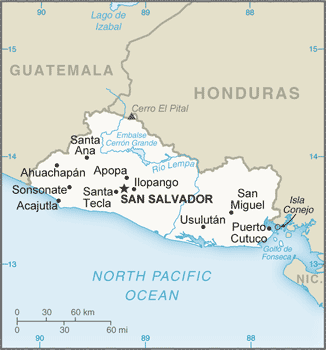
- Central America, bordering the North Pacific Ocean, between Guatemala and Honduras
- Area
- 21,041 sq km
- Climate
- tropical; rainy season (May to October); dry season (November to April); tropical on coast; temperate in uplands
- Terrain
- mostly mountains with narrow coastal belt and central plateau
- Natural resources
- hydropower, geothermal power, petroleum, arable land
- Coastline
- 307 km
- Natural hazards
- known as the Land of Volcanoes; frequent and sometimes destructive earthquakes and volcanic activity; extremely susceptible to hurricanes volcanism: significant volcanic activity; San Salvador (1,893 m), which last erupted in 1917, has the potential to cause major harm to the country's capital, which lies just below the volcano's slopes; San Miguel (2,130 m) is one of the most active volcanoes in the country; other historically active volcanoes include Conchaguita, Ilopango, Izalco, and Santa Ana
People & society
- Population
- 6,334,723 (2025 est.)
- Nationality
- Salvadoran(s)
- Ethnic groups
- Mestizo 86.3%, White 12.7%, Indigenous 0.2% (includes Lenca, Kakawira, Nahua-Pipil), Black 0.1%, other 0.6% (2007 est.)
- Languages
- Spanish (official), Nawat (among some indigenous)
- Religions
- Roman Catholic 43.9%, Protestant 39.6% (Evangelical - unspecified 38.2%, Evangelical - Methodist 1.3%, Evangelical - Baptist 0.1%), none 16.3%, unspecified 0.2% (2023 est.)
- Median age
- 31.2 years (2025 est.)
- Life expectancy at birth
- 75.9 years (2024 est.)
- Literacy
- 89.8% (2024 est.)
Economy
- Economic overview
- upper-middle-income, dollarized Central American economy; reliant on remittances from US; recent growth linked to infrastructure investment, consumption, and crime reduction; $1.3 billion IMF loan to address fiscal imbalances; Bitcoin adopted as legal tender; persistent poverty and large informal sector
- Industries
- food processing, beverages, petroleum, chemicals, fertilizer, textiles, furniture, light metals
- Agricultural products
- sugarcane, maize, milk, chicken, sorghum, beans, oranges, coconuts, eggs, mangoes/guavas (2023)
- Exports - partners
- USA 36%, Guatemala 17%, Honduras 15%, Nicaragua 8%, Costa Rica 5% (2023)
- Imports - partners
- USA 28%, China 15%, Guatemala 11%, Mexico 8%, Honduras 5% (2023)
Government
- Government type
- presidential republic
- Capital
- San Salvador
- Independence
- 15 September 1821 (from Spain)
- Constitution
- many previous; latest drafted 16 December 1983, enacted 23 December 1983
- Executive branch
- President Nayib Armando BUKELE Ortez (since 1 June 2019)
- Legislative branch
- Legislative Assembly (Asamblea legislativa)
Full reference data
Every field, by section, CIA World Factbook. Open a topic to expand it.
Introduction
Travel Facts
Please visit the following links to find further information about your desired destination.
World Health Organization (WHO) - To learn what vaccines and health precautions to take while visiting your destination.
US State Dept Travel Information - Overall information about foreign travel for US citizens.
To obtain an international driving permit (IDP). Only two organizations in the US issue IDPs: American Automobile Association (AAA) and American Automobile Touring Alliance (AATA)
How to get help in an emergency? Contact the nearest US embassy or consulate, or call one of these numbers: from the US or Canada - 1-888-407-4747 or from Overseas - +1 202-501-4444
Page last updated: Monday, July 25, 2022