
State of · DE
Delaware
Matt Meyer
Governor
DemocratState Government 101
How Delaware’s Government Works
Delaware is the corporate capital of America: more than a million companies, including a majority of the Fortune 500, are legally incorporated there, and its specialized Court of Chancery has become the nation’s most important business court. The first state to ratify the U.S. Constitution also stands out for being the only one whose legislature cannot put constitutional amendments to a public vote, the General Assembly amends the constitution by itself.
- Governor term
- 4 years
- Governor term limit
- 2 terms (lifetime)
- Legislature
- Delaware General Assembly
- State Senate
- 21 seats · 4-yr terms
- House of Representatives
- 41 seats · 2-yr terms
- Legislator term limit
- None
- Sessions
- Annual (January to June 30)
- Session length
- Adjourns by June 30 (constitutional)
- Legislature type
- Hybrid
- Legislator pay
- $51,692/yr (salary, no per diem) + expenses
- Veto override
- Three-fifths of each chamber
- Line-item veto
- Yes (appropriations)
The Executive Branch, Who Runs the State
Delaware has a plural executive of statewide elected officials: the Governor, the Lieutenant Governor, the Attorney General, the State Treasurer, the State Auditor, and the Insurance Commissioner. The Governor and Lieutenant Governor are elected separately rather than as a ticket, so the two can come from different parties, and the Lieutenant Governor presides over the State Senate. Delaware has no elected secretary of state, that office is appointed by the Governor and, fittingly for the corporate capital, oversees the Division of Corporations that registers the state’s vast roster of companies.
With several officers elected independently, the Governor leads the executive branch but shares authority with colleagues who answer to voters. The Governor appoints the heads of the executive departments not separately elected.
The Legislature, Who Writes the Laws
The Delaware General Assembly is bicameral and small: a 21-seat State Senate (four-year terms) and a 41-seat House of Representatives (two-year terms), with no term limits, fitting for the second-smallest state by area and one of the smallest by population. It is a hybrid legislature, sitting between full-time and part-time bodies, where members do substantial legislative work but most also hold outside jobs, with a salary of $51,692 a year (no session per diem) plus expenses.
The General Assembly convenes each January and, by the constitution, must adjourn by June 30, so its work is built around a roughly six-month annual calendar. A notable share of that work involves keeping Delaware’s General Corporation Law, the body of statute that governs how the nation’s companies are run, current and competitive, since corporate franchise fees and taxes are a major source of state revenue.
How a Bill Becomes Law
A bill is introduced, referred to committee, and, if it advances, voted on the floor of each chamber, with differences reconciled before final passage. The Governor can sign a bill, veto it, or let it become law, and holds a line-item veto over appropriations; a veto override takes three-fifths of each chamber.
Delaware is unique in how it changes its constitution. It is the only state where amendments do not go to the voters at all: the General Assembly can amend the state constitution on its own, by passing the change with a two-thirds vote in two consecutive sessions of the legislature, with an election in between. There is no statewide citizen initiative or referendum either, so in Delaware lawmaking, including fundamental constitutional change, runs entirely through elected representatives rather than the ballot box.
What the Governor Can (and Can’t) Do
The Governor appoints the heads of the non-elected agencies (including the powerful Secretary of State), proposes the budget, can call special sessions, holds emergency powers, and wields a line-item veto. On clemency, the Governor cannot act alone: a pardon or commutation requires a favorable recommendation from the Board of Pardons, chaired by the Lieutenant Governor, before the Governor may grant it.
The main internal checks are the independently elected Attorney General, Treasurer, Auditor, and Insurance Commissioner, and the three-fifths legislative override. Much of what makes Delaware nationally consequential, though, happens in its courts rather than the governor’s office.
The Courts
Delaware’s judiciary is the source of its outsized national influence. The Court of Chancery, a rare surviving court of equity, sitting without juries, hears corporate and business disputes and has become the most important business court in the country: because so many companies are incorporated in Delaware, its decisions effectively set the ground rules of American corporate law, and the Delaware Supreme Court above it is the final word on those questions. Delaware’s judges are appointed by the Governor and confirmed by the Senate, not elected, and the state uniquely requires partisan balance on its major courts, so neither party can dominate the bench. The Supreme Court sits at the top, with the Court of Chancery and the Superior Court below.
What makes Delaware’s government distinctive
- The corporate capital of America: a majority of the Fortune 500 and over a million companies are incorporated in Delaware, and corporate fees are a major source of state revenue.
- The Court of Chancery is the nation’s most important business court, its rulings effectively set the rules of American corporate law.
- The only state where the legislature amends the constitution by itself, with no public vote, by passing it twice in consecutive sessions.
- Major courts require partisan balance, so neither party can control the bench, and judges are appointed rather than elected.
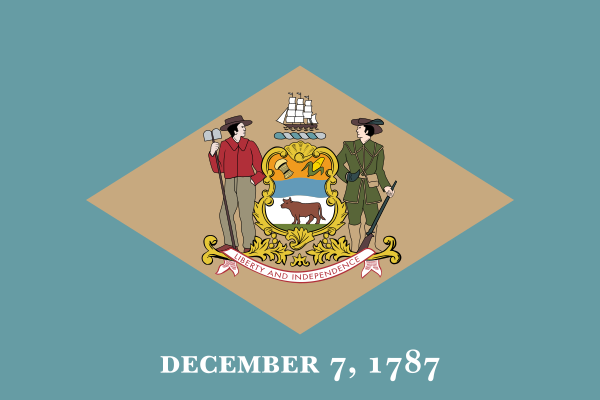
- The first state to ratify the U.S. Constitution (1787), "The First State."
See how Delaware is governed right now
Jump from the explainer into the live record for Delaware.
Executive branch
Orders, rulemaking & official actions
Recent activity
View all →- Press Release·May 13, 2026Open ↗
Medicare “Birthday Rule” & New Enrollment Protections Now in Effect
- Press Release·May 12, 2026Open ↗
Governor Meyer Announces Landmark Healthcare Legislation that Lowers Costs and Increases Access for Delawareans
- Press Release·May 12, 2026Open ↗
Delaware Receives Highest Bond Ratings
- Press Release·May 11, 2026Open ↗
AG Jennings takes storm-chasing home improvement company to court over failure to respond to subpoena
- Press Release·May 8, 2026Open ↗
Governor Meyer Swears In New CIO for Delaware
- Press Release·May 8, 2026Open ↗
Governor Meyer Announces New Public Service Commission Nominees
- Press Release·May 8, 2026Open ↗
Governor Meyer Swears In New Inspector General
- Press Release·May 7, 2026Open ↗
Governor Meyer Visits Milford Businesses, Signs Two Small Business Executive Orders
Legislative branch
Constitution, statutes & bills
1,135 bills tracked · 153rd General Assembly (2024–2026)
- SB 110signed
AN ACT TO AMEND TITLE 24 OF THE DELAWARE CODE RELATING TO THE EXAMINING BOARD OF PHYSICAL THERAPISTS AND ATHLETIC TRAINERS.
Nicole PooreDemocrat
Last action Apr 23, 2026
- HB 224signed
AN ACT TO AMEND TITLE 16 AND TITLE 24 OF THE DELAWARE CODE RELATING TO REGISTRATION OF DEATH.
Kendra JohnsonDemocrat
Last action Apr 23, 2026
- HB 277signed
AN ACT TO AMEND TITLE 21 OF THE DELAWARE CODE RELATING TO SAFETY DURING TRAFFIC STOPS.
DeShanna U NealDemocrat
Last action Apr 23, 2026
- HB 221signed
AN ACT TO AMEND TITLE 3 OF THE DELAWARE CODE RELATING TO PESTICIDES.
William J. CarsonDemocrat
Last action Apr 23, 2026
- HB 191signed
AN ACT TO AMEND TITLE 24 OF THE DELAWARE CODE RELATING TO MEDICAL PROFESSIONALS, TITLES, AND NONHUMAN ENTITIES.
Melissa Minor-BrownDemocrat
Last action Apr 23, 2026
- SCR 175passed
RECOGNIZING APRIL 29, 2026, AS "WORLD WISH DAY" IN DELAWARE.
Nicole PooreDemocrat
Last action Apr 23, 2026
- SCR 173passed
RECOGNIZING APRIL 28, 2026, AS WORKERS MEMORIAL DAY IN THE STATE OF DELAWARE.
John "Jack" WalshDemocrat
Last action Apr 23, 2026
- SB 16 -SA 1passed
AN ACT TO AMEND TITLE 5 OF THE DELAWARE CODE RELATING TO DELAWARE BANKS AND TRUST COMPANIES.
Last action Apr 23, 2026
Frequently asked questions
Why are so many companies incorporated in Delaware?
Delaware offers a well-developed body of corporate law (its General Corporation Law), a specialized business court with deep expertise, and predictable, business-friendly rules, so corporations across the country choose to incorporate there regardless of where they actually operate. More than a million entities, including a majority of the Fortune 500, are Delaware-incorporated, and the franchise fees and taxes they pay are a major source of state revenue.
What is the Delaware Court of Chancery?
It is a specialized court of equity, sitting without juries, that hears corporate and business disputes. Because so many U.S. companies are incorporated in Delaware, the Court of Chancery has become the most important business court in the country: its decisions on mergers, fiduciary duties, and shareholder rights effectively set the ground rules of American corporate law, with the Delaware Supreme Court as the final word.
Does Delaware let voters approve constitutional amendments?
No, and it is the only state that does not. In Delaware the General Assembly amends the state constitution entirely on its own, by passing the same change with a two-thirds vote in two consecutive legislative sessions with an election in between. Amendments never go to the voters, and Delaware has no citizen initiative either, so all lawmaking runs through elected representatives.
How are judges chosen in Delaware?
They are appointed by the governor and confirmed by the State Senate, not elected. Delaware is also unusual in requiring partisan balance on its major courts, neither party may hold more than a bare majority of the seats, which is meant to keep the influential bench, including the Court of Chancery, from being dominated by one party.
When does the Delaware legislature meet?
The General Assembly convenes each January and, under the constitution, must adjourn by June 30, so it works on a roughly six-month annual calendar. It is a small, hybrid legislature, between full-time and part-time bodies, and a notable share of its work involves keeping the state’s corporate law current.
Free app
Get alerted when anything here changes.
Download the free app to watch the Delaware hub. We’ll ping you when a new Superfund site is added, your representative votes on something that affects your wallet, FEMA redraws the flood map, or any of 50+ data sources move.
- Proactive alerts tuned to the datasets you choose to watch.
- Push notifications when a watched datapoint changes meaningfully.