
Country exposure · IE
Ireland
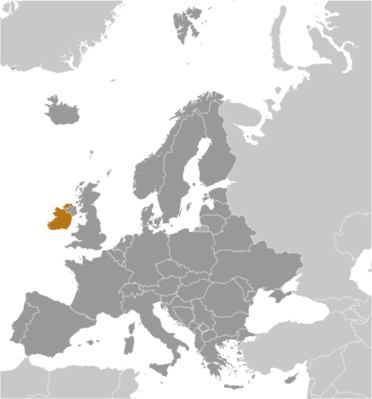
Europe · Dublin · parliamentary republic
What Ireland means for your money, the prices you pay, the tariffs in motion, and where U.S. policy could change both.
$133.6B
U.S. imports, 2025
+29.4%
change in one year
$19.3B
U.S. exports, 2025
5M
Population
$577.4B
GDP
In your house
What you buy that Ireland makes
America bought $133.6B in goods from Ireland in 2025, up 29.4% in a single year. Of every $100 of it, here's where the money went.
Pharmaceutical preparations
medicines and pharmacy items
U.s. goods returned, and reimports
Cell phones and other household goods, n.e.c.
cell phones and home electronics
Medicinal equipment
medical devices and equipment
Other foods
Semiconductors
semiconductors and chips
Industrial machines, other
Computers
laptops, desktops, monitors
Minimum value shipments
Alcoholic beverages, excluding wine
spirits and liquor
2026 so far (through July): $34.7B in imports. Source: U.S. Census Bureau, International Trade in Goods (customs basis).
The other direction
What America sells to Ireland
$19.3B in 2025, a trade rupture cuts both ways, for American producers as well as American prices.
Pharmaceutical preparations
$5.5Bmedicines and pharmacy items
Civilian aircraft, engines, equipment, and parts
$1.8BComputer accessories
$1.2Bkeyboards, drives, computer parts
Other industrial supplies
$1.1BSemiconductors
$1.1Bsemiconductors and chips
Crude oil
$925MMedicinal equipment
$794Mmedical devices and equipment
Computers
$713Mlaptops, desktops, monitors
Industrial machines, other
$704MWhere you stand
U.S. tariff posture toward Ireland
Since February 24, 2026 most EU goods face the universal 10% Section 122 temporary import surcharge, which replaced the framework's 15% all-inclusive IEEPA structure when EO 14389 terminated the reciprocal tariffs. The framework's Section 232 terms persist: EU autos at 15%, and the April 2026 metals expansion expressly preserved the EU's trade-agreement-partner treatment (steel and aluminum otherwise at 50%).
The United States negotiates tariffs with the European Union as a single market, every measure here applies to Ireland as an EU member.
Reciprocal tariff (assigned, terminated)
20%
The rate this country was assigned under the EO 14257 reciprocal Annex, no longer in force. The Supreme Court struck down the IEEPA tariffs and they were terminated February 24, 2026 (EO 14389), replaced by a universal ~10% Section 122 surcharge. See the timeline below for the current effective rate.
Section 232 sectors
Autos, Wood
Steel, aluminum, autos, and similar national-security tariffs that name this country.
Policy in motion
Tariff status: a moving target
U.S. tariff policy toward the European Union, and with it Ireland, has changed 11 times since 2025. This page tracks it.
2026-04-06
EU treatment preserved in expanded metals tariffs
In effectThe April 2026 proclamation expanding Section 232 coverage of aluminum, steel, and copper derivatives expressly does not alter or supersede the prior U.S.–EU agreement implementation, and lists the EU among 'Trade Agreement Partners' eligible for its exclusion process.
91 FR 18201 →2026-02-24
IEEPA reciprocal tariffs terminated — replaced by 10% Section 122
In effectExecutive Order 14389 (Ending Certain Tariff Actions) terminated the IEEPA tariff duties — including those under EO 14257, the basis of the EU's 15% all-inclusive structure — effective February 24, 2026. A flat 10% Section 122 temporary import surcharge (Proclamation 11012 of February 20, 2026) replaced them. The framework's Section 232 terms (the 15% EU autos cap, metals carve-outs) rest on separate authority and were expressly unaffected.
91 FR 9437 →2025-09-25
Framework implemented: preferential treatment for certain EU goods
In effectActing under the September 8, 2025 procedures order, Commerce and USTR modified the HTSUS to implement the framework — preferential (zero) reciprocal treatment for certain EU goods and a reduction of the Section 232 automobile and parts duty to 15% for EU-origin vehicles.
90 FR 46136 →2025-08-21
U.S.–EU Framework Agreement joint statement
AgreementThe United States and the European Union issued the Joint Statement on a Framework on an Agreement on Reciprocal, Fair, and Balanced Trade: the U.S. committed to the 15% all-inclusive ceiling, zero reciprocal duty on certain products, and a cut of the Section 232 automobile duty to 15%; the EU committed to eliminate tariffs on U.S. industrial goods and expand agricultural access, plus $750B in U.S. energy procurement through 2028.
Source ↗2025-08-07
15% all-inclusive structure replaces the 20% rate
In effectThe July 31, 2025 order ('Further Modifying the Reciprocal Tariff Rates') gave the EU a unique structure effective August 7, 2025: for goods with an MFN (Column 1) rate below 15%, the reciprocal duty tops the total up to exactly 15%; goods with an MFN rate of 15% or higher pay no additional reciprocal duty.
Federal Register · 2025-15010 →2025-07-09
Reciprocal-rate pause extended to August 1
In effectThe July 7, 2025 order extended the suspension of country-specific reciprocal rates through August 1, 2025, keeping the EU at the 10% baseline while framework talks continued.
90 FR 30823 →2025-06-04
Section 232 steel and aluminum duties doubled to 50%
In effectThe June 3, 2025 proclamation raised Section 232 duties on steel and aluminum articles and derivatives from 25% to 50% effective June 4, 2025, with no EU carve-out.
90 FR 24199 →2025-04-10
90-day pause suspends the 20% rate back to 10%
In effectThe April 9, 2025 modification order suspended country-specific reciprocal rates for 90 days for all partners except China, returning the EU to the 10% universal baseline effective April 10, 2025 while negotiations proceeded.
90 FR 15625 →2025-04-09
EU country-specific reciprocal rate of 20% takes effect
In effectAnnex I of Executive Order 14257 assigned the European Union a 20% country-specific reciprocal rate, effective April 9, 2025 — the rate still carried for the EU in the HTS Chapter 99 Subchapter III note.
Federal Register · 2025-06063 →2025-04-05
Universal 10% reciprocal baseline takes effect
In effectExecutive Order 14257 (signed April 2, 2025) imposed a 10% ad valorem reciprocal duty on imports from all trading partners, including the EU, effective April 5, 2025. The order singled out the EU's 5% average MFN rate and 10% passenger-vehicle tariff as examples of non-reciprocal treatment.
Federal Register · 2025-06063 →2025-03-12
Section 232 steel and aluminum arrangements terminated — 25% duties on EU metals
In effectProclamations of February 10, 2025 ended the EU's tariff-rate-quota arrangements for steel and aluminum and raised the aluminum duty from 10% to 25%, applying 25% Section 232 duties to EU steel and aluminum effective March 12, 2025.
90 FR 9817 →
Made for America
What Ireland makes for America
Ireland is a direct U.S. source of 12 essential goods Americans rely on, the items themselves, shipped finished off the line.
health
24% of U.S.Cancer and specialty drugs
$19.1B to the U.S.
health
15% of U.S.OTC medicines
$11.8B to the U.S.
health
33% of U.S.Vaccines
$3.1B to the U.S.
digital
6% of U.S.Semiconductors and chips
$2.1B to the U.S.
health
9% of U.S.Surgical and sterile supplies
$1.5B to the U.S.
food
3% of U.S.Beer, wine, and spirits
$554M to the U.S.
digital
Servers and cloud hardware
$398M to the U.S.
health
12% of U.S.Eyeglasses & contact lenses
$367M to the U.S.
health
6% of U.S.Diagnostic tests and lab supplies
$320M to the U.S.
logistics
4% of U.S.Port and crane equipment
$279M to the U.S.
food
43% of U.S.Butter and dairy fats
$203M to the U.S.
health
11% of U.S.Topical and dermatology Rx products
$166M to the U.S.
Go deeper
The supply chain view
Ireland sits upstream of 24 essential American goods through 12 tracked inputs.
chemical
86%Beverage Flavor Concentrate & Syrup
manufactured
40%Pen Needles (Subcutaneous Injection)
chemical
35%Atmospheric Air
manufactured
35%Refrigerated truck transport (fresh produce)
pharmaceutical
35%Cyclosporine A API
manufactured
30%Cryogenic cold boxes and heat exchangers
Reference
The country itself
Europe · Geography, people, economy, and government, public-domain data from the CIA World Factbook.
Celtic tribes arrived in Ireland between 600 and 150 B.C. Norse invasions that began in the late 8th century finally ended when King Brian BORU defeated the Danes in 1014. Norman invasions began in the 12th century and set off more than seven centuries of Anglo-Irish struggle marked by fierce rebellions and harsh repressions. The Irish famine of the mid-19th century caused an almost 25-percent decline in the island's population through starvation, disease, and emigration. The population of the island continued to fall until the 1960s, but over the last 50 years, Ireland's high birthrate has made it demographically one of the youngest populations in the EU. The modern Irish state traces its origins to the failed 1916 Easter Monday Uprising that galvanized nationalist sentiment. The ensuing guerrilla war led to independence from the UK in 1921 with the signing of the Anglo-Irish Treaty and the creation of the Irish Free State. The treaty was deeply controversial in Ireland, in part because it helped solidify the country's partition, with six of the 32 counties remaining in the UK as Northern Ireland. The split between pro-Treaty and anti-Treaty partisans led to the Irish Civil War (1922-23). The traditionally dominant political parties in Ireland, Fine Gael and Fianna Fail, are de facto descendants of the opposing sides of the treaty debate. Ireland declared itself a republic in 1949 and formally left the British Dominion. Beginning in the 1960s, deep sectarian divides between the Catholic and Protestant populations and systemic discrimination in Northern Ireland erupted into years of violence known as the Troubles. In 1998, the governments of Ireland and the UK, along with most political parties in Northern Ireland, reached the Belfast/Good Friday Agreement with the support of the US. This agreement helped end the Troubles and initiated a new phase of cooperation between the Irish and British Governments. Ireland was neutral in World War II and continues its policy of military neutrality. Ireland joined the European Community in 1973 and the euro-zone currency union in 1999. The economic boom years of the Celtic Tiger (1995-2007) saw rapid economic growth that came to an abrupt end in 2008 with the meltdown of the Irish banking system. As a small, open economy, Ireland has excelled at courting foreign direct investment, especially from US multi-nationals, which has helped the economy recover from the financial crisis and insulated it somewhat from the economic shocks of the COVID-19 pandemic.
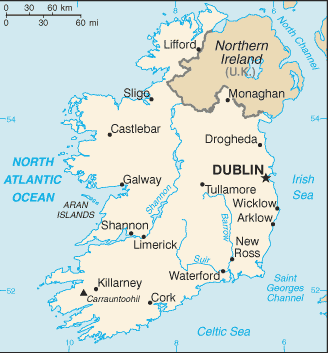
Geography
- Location
- Western Europe, occupying five-sixths of the island of Ireland in the North Atlantic Ocean, west of Great Britain
- Area
- 70,273 sq km
- Climate
- temperate maritime; modified by North Atlantic Current; mild winters, cool summers; consistently humid; overcast about half the time
- Terrain
- mostly flat to rolling interior plain surrounded by rugged hills and low mountains; sea cliffs on west coast
- Natural resources
- natural gas, peat, copper, lead, zinc, silver, barite, gypsum, limestone, dolomite
- Coastline
- 1,448 km
- Natural hazards
- rare extreme weather events
People & society
- Population
- 5,233,461 (2024 est.)
- Nationality
- Irishman(men), Irishwoman(women), Irish (collective plural)
- Ethnic groups
- Irish 76.6%, Irish travelers 0.6%, other White 9.9%, Asian 3.3%, Black 1.5%, other (includes Arab, Roma, and persons of mixed backgrounds) 2%, unspecified 2.6% (2022 est.)
- Languages
- English (official, the language generally used), Irish (Gaelic or Gaeilge) (official, spoken by approximately 37.7% of the population)
- Religions
- Roman Catholic 69.2% (includes lapsed), Protestant 3.7% (Church of Ireland/England/Anglican/Episcopalian 2.5%, other Protestant 1.2%), Orthodox 2%, other Christian 0.9%, Muslim 1.6%, other 1.4%, agnostic/atheist 0.1%, none 14.5%, unspecified 6.7% (2022 est.)
- Median age
- 40.5 years (2025 est.)
- Life expectancy at birth
- 82 years (2024 est.)
Economy
- Economic overview
- high-income, export-oriented EU economy; large multinational business sector contributes to growth and tax revenues but poses volatility risks; high living standards; strong labor market challenged by skill shortages and aging workforce
- Industries
- pharmaceuticals, chemicals, computer hardware and software, food products, beverages and brewing; medical devices
- Agricultural products
- milk, barley, beef, wheat, potatoes, pork, oats, chicken, rapeseed, beans (2023)
- Exports - partners
- USA 28%, Germany 11%, UK 8%, Belgium 8%, China 7% (2023)
- Imports - partners
- UK 20%, USA 17%, France 10%, China 7%, Germany 7% (2023)
Government
- Government type
- parliamentary republic
- Capital
- Dublin
- Independence
- 6 December 1921 (from the UK); 6 December 1922 (Irish Free State established); 18 April 1949 (Republic of Ireland Act enabled)
- Constitution
- previous 1922; latest drafted 14 June 1937, adopted by plebiscite 1 July 1937, effective 29 December 1937
- Executive branch
- President Catherine CONNOLLY (since 11 November 2025)
- Legislative branch
- Parliament (Oireachtas)
Full reference data
Every field, by section, CIA World Factbook. Open a topic to expand it.
Introduction
Travel Facts
Please visit the following links to find further information about your desired destination.
World Health Organization (WHO) - To learn what vaccines and health precautions to take while visiting your destination.
US State Dept Travel Information - Overall information about foreign travel for US citizens.
To obtain an international driving permit (IDP). Only two organizations in the US issue IDPs: American Automobile Association (AAA) and American Automobile Touring Alliance (AATA)
How to get help in an emergency? Contact the nearest US embassy or consulate, or call one of these numbers: from the US or Canada - 1-888-407-4747 or from Overseas - +1 202-501-4444
Page last updated: Tuesday, June 04, 2024