
Country exposure · IL
Israel
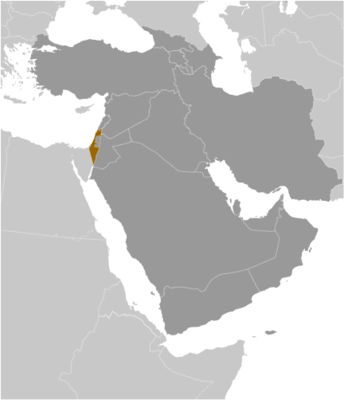
Middle East · Jerusalem · parliamentary democracy
What Israel means for your money, the prices you pay, the tariffs in motion, and where U.S. policy could change both.
$20.7B
U.S. imports, 2025
-6.6%
change in one year
$13.7B
U.S. exports, 2025
9M
Population
$540.4B
GDP
In your house
What you buy that Israel makes
America bought $20.7B in goods from Israel in 2025. Of every $100 of it, here's where the money went.
Semiconductors
semiconductors and chips
Pharmaceutical preparations
medicines and pharmacy items
Gem diamonds
Telecommunications equipment
phones, routers, networking gear
Medicinal equipment
medical devices and equipment
U.s. goods returned, and reimports
Electric apparatus
Measuring, testing, control instruments
Industrial supplies, other
Chemicals-fertilizers
2026 so far (through July): $12.3B in imports. Source: U.S. Census Bureau, International Trade in Goods (customs basis).
The other direction
What America sells to Israel
$13.7B in 2025, a trade rupture cuts both ways, for American producers as well as American prices.
Tanks, artillery, missiles, rockets, guns and ammunition
$1.9BGem diamonds
$1.2BSemiconductors
$718Msemiconductors and chips
Telecommunications equipment
$698Mphones, routers, networking gear
Civilian aircraft, engines, equipment, and parts
$665MParts for military-type goods
$539MPharmaceutical preparations
$537Mmedicines and pharmacy items
Electric apparatus
$414MMinimum value shipments
$398MWhere you stand
U.S. tariff posture toward Israel
Israel moved faster than any partner to satisfy U.S. demands — unilaterally eliminating all its remaining tariffs on American goods before April 2025 — yet was still assigned a 17% reciprocal rate, later reduced to 15% (effective August 7, 2025). A December 2025 agreement implemented permanent modifications to the 2004 U.S.-Israel agricultural products agreement (Proclamation 10999), but no comprehensive reciprocal deal followed. Executive Order 14389 (Ending Certain Tariff Actions, Feb 20, 2026) terminated the IEEPA reciprocal duties, and Proclamation 11012 replaced it with a 10% Section 122 temporary import surcharge effective February 24, 2026. Israel has no Section 232 steel/aluminum exposure.
Reciprocal tariff (assigned, terminated)
17%
The rate this country was assigned under the EO 14257 reciprocal Annex, no longer in force. The Supreme Court struck down the IEEPA tariffs and they were terminated February 24, 2026 (EO 14389), replaced by a universal ~10% Section 122 surcharge. See the timeline below for the current effective rate.
Policy in motion
Tariff status: a moving target
U.S. tariff policy toward Israel has changed 5 times since 2025. This page tracks it.
2026-02-24
IEEPA reciprocal tariffs terminated — replaced by 10% Section 122
In effectExecutive Order 14389 (Ending Certain Tariff Actions) terminated the IEEPA tariff duties effective February 24, 2026, replacing Israel's 15% reciprocal rate with a 10% Section 122 temporary import surcharge under Proclamation 11012 (capped at 150 days).
91 FR 9437 →2025-12-29
U.S.-Israel agricultural products agreement implemented
AgreementProclamation 10999 implemented permanent modifications to the 2004 U.S.-Israel Agreement on Trade in Agricultural Products, a sector-specific measure separate from the reciprocal tariff and short of a comprehensive bilateral trade deal.
91 FR 889 →2025-08-07
Reciprocal rate reduced to 15%
In effectExecutive Order 14326 set the post-pause Annex I reciprocal rates; Israel's rate was set at 15% effective for goods entered on or after August 7, 2025, down from the 17% originally assigned following its unilateral tariff concessions.
90 FR 37963 →2025-04-10
Elevated reciprocal rates paused to 10% for 90 days
In effectExecutive Order 14266 suspended the higher country-specific reciprocal rates — including Israel's 17% — back to the 10% baseline for 90 days to allow negotiations.
90 FR 15625 →2025-04-05
Reciprocal tariff regime begins — Israel assigned 17%
In effectExecutive Order 14257 imposed a 10% universal reciprocal duty effective April 5 and a higher country-specific rate of 17% for Israel scheduled to take effect April 9 under Annex I — imposed despite Israel having pre-emptively eliminated its remaining tariffs on U.S. goods.
90 FR 15041 →
Made for America
What Israel makes for America
Israel is a direct U.S. source of 12 essential goods Americans rely on, the items themselves, shipped finished off the line.
digital
13% of U.S.Semiconductors and chips
$4.7B to the U.S.
health
3% of U.S.OTC medicines
$2.5B to the U.S.
materials
9% of U.S.Jewelry
$1.9B to the U.S.
digital
1% of U.S.Fiber optic cables and networking
$1.2B to the U.S.
health
2% of U.S.Surgical and sterile supplies
$377M to the U.S.
agriculture
6% of U.S.Potash and phosphate fertilizers
$268M to the U.S.
materials
1% of U.S.Plumbing pipes and fittings
$187M to the U.S.
health
Cancer and specialty drugs
$121M to the U.S.
energy
1% of U.S.Gasoline and diesel
$118M to the U.S.
home
2% of U.S.Personal care and hygiene
$94M to the U.S.
agriculture
7% of U.S.Pesticides and herbicides
$89M to the U.S.
digital
1% of U.S.Cameras & photo equipment
$83M to the U.S.
Go deeper
The supply chain view
Israel sits upstream of 24 essential American goods through 12 tracked inputs.
manufactured
48%Disc and media filtration units
manufactured
45%Pressure-compensating drip emitters
chemical
43%Elemental Bromine (Industrial)
manufactured
40%Disc & media filtration systems
chemical
33%Food-Grade Carbon Dioxide (CO2)
chemical
32%TBBPA (Tetrabromobisphenol A) Flame Retardant
Reference
The country itself
Middle East · Geography, people, economy, and government, public-domain data from the CIA World Factbook.
Israel has become a regional economic and military powerhouse, leveraging its prosperous high-tech sector, large defense industry, and concerns about Iran to foster partnerships around the world. The State of Israel was established in 1948. The UN General Assembly proposed in 1947 partitioning the British Mandate for Palestine into an Arab and Jewish state. The Jews accepted the proposal, but the local Arabs and the Arab states rejected the UN plan and launched a war. The Arabs were subsequently defeated in the 1947-1949 war that followed the UN proposal and the British withdrawal. Israel joined the UN in 1949 and saw rapid population growth, primarily due to Jewish refugee migration from Europe and the Middle East. Israel and its Arab neighbors fought wars in 1956, 1967, and 1973, and Israel signed peace treaties with Egypt in 1979 and Jordan in 1994. Israel took control of the West Bank, the eastern part of Jerusalem, the Gaza Strip, the Sinai Peninsula, and the Golan Heights in the course of the 1967 war. It ceded the Sinai back to Egypt in the 1979-1982 period but has continued to administer the other territories through military authorities. Israel and Palestinian officials signed interim agreements in the 1990s that created a period of Palestinian self-rule in parts of the West Bank and Gaza. Israel withdrew from Gaza in 2005. The most recent formal efforts between Israel and the Palestinian Authority to negotiate final status issues occurred in 2013 and 2014, and the US continues its efforts to advance peace. Israel signed the US-brokered normalization agreements (the Abraham Accords) with Bahrain, the UAE, and Morocco in 2020 and reached an agreement with Sudan in 2021. Immigration to Israel continues, with more than 44,000 estimated new immigrants, mostly Jewish, in the first 11 months of 2023. Former Prime Minister Benjamin NETANYAHU returned to office in 2022, continuing his dominance of Israel's political landscape at the head of Israel's most rightwing and religious government. NETANYAHU previously served as premier from 1996 to 1999 and from 2009 to 2021, becoming Israel's longest serving prime minister. On 7 October 2023, HAMAS militants launched a combined unguided rocket and ground terrorist attack from Gaza into southern Israel. The same day Israel’s Air Force launched air strikes inside Gaza and initiated a sustained air campaign against HAMAS targets across the Gaza Strip. The following day, NETANYAHU formally declared war on HAMAS, and on 28 October, the Israel Defense Forces launched a large-scale ground assault inside Gaza. The Israeli economy has undergone a dramatic transformation in the last 30 years, led by cutting-edge high-tech sectors. Offshore gas discoveries in the Mediterranean place Israel at the center of a potential regional natural gas market. In 2022, a US-brokered agreement between Israel and Lebanon established their maritime boundary, allowing Israel to begin production on additional gas fields in the Mediterranean. However, Israel's economic development has been uneven. Structural issues such as low labor-force participation among religious and minority populations, low workforce productivity, high costs for housing and consumer staples, and high income inequality concern both economists and the general population. The current war with Hamas disrupted Israel’s solid economic fundamentals, but it is not likely to have long-term structural implications for the economy.
Geography
- Location
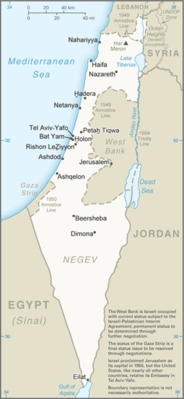
- Middle East, bordering the Mediterranean Sea, between Egypt and Lebanon
- Area
- 21,937 sq km
- Climate
- temperate; hot and dry in southern and eastern desert areas
- Terrain
- Negev desert in the south; low coastal plain; central mountains; Jordan Rift Valley
- Natural resources
- timber, potash, copper ore, natural gas, phosphate rock, magnesium bromide, clays, sand
- Coastline
- 273 km
- Natural hazards
- sandstorms may occur during spring and summer; droughts; periodic earthquakes
People & society
- Population
- 9,402,617 (2024 est.)
- Nationality
- Israeli(s)
- Ethnic groups
- Jewish 73.5% (of which Israel-born 79.7%, Europe/America/Oceania-born 14.3%, Africa-born 3.9%, Asia-born 2.1%), Arab 21.1%, other 5.4% (2022 est.)
- Languages
- Hebrew (official), Arabic (special status under Israeli law), English (most commonly used foreign language)
- Religions
- Jewish 73.5%, Muslim 18.1%, Christian 1.9%, Druze 1.6%, other 4.9% (2022 est.)
- Median age
- 30.2 years (2025 est.)
- Life expectancy at birth
- 83.1 years (2024 est.)
Economy
- Economic overview
- high-income, technology- and industrial-based economy; economic contraction and fiscal deficits resulting from war in Gaza; labor force stabilizing following military reservist mobilization; high-tech industry remains resilient while construction and tourism among hardest-hit sectors
- Industries
- high-technology products (including aviation, communications, computer-aided design and manufactures, medical electronics, fiber optics), wood and paper products, potash and phosphates, food, beverages, and tobacco, caustic soda, cement, pharmaceuticals, construction, metal products, chemical products, plastics, cut diamonds, textiles, footwear
- Agricultural products
- milk, chicken, potatoes, tomatoes, tangerines/mandarins, bananas, eggs, avocados, beef, carrots/turnips (2023)
- Exports - partners
- USA 29%, China 10%, Ireland 6%, Germany 4%, Hong Kong 4% (2023)
- Imports - partners
- China 17%, USA 12%, Germany 7%, Turkey 6%, Italy 4% (2023)
Government
- Government type
- parliamentary democracy
- Capital
- Jerusalem
- Independence
- 14 May 1948 (following League of Nations mandate under British administration)
- Constitution
- no formal constitution; some functions of a constitution are filled by the Declaration of Establishment (1948), the Basic Laws, and the Law of Return (as amended)
- Executive branch
- President Isaac HERZOG (since 7 July 2021)
- Legislative branch
- Parliament (Knesset)
Full reference data
Every field, by section, CIA World Factbook. Open a topic to expand it.
Introduction
Travel Facts
Please visit the following links to find further information about your desired destination.
World Health Organization (WHO) - To learn what vaccines and health precautions to take while visiting your destination.
US State Dept Travel Information - Overall information about foreign travel for US citizens.
To obtain an international driving permit (IDP). Only two organizations in the US issue IDPs: American Automobile Association (AAA) and American Automobile Touring Alliance (AATA)
How to get help in an emergency? Contact the nearest US embassy or consulate, or call one of these numbers: from the US or Canada - 1-888-407-4747 or from Overseas - +1 202-501-4444
Page last updated: Thursday, January 04, 2024