
Country exposure · TH

Thailand
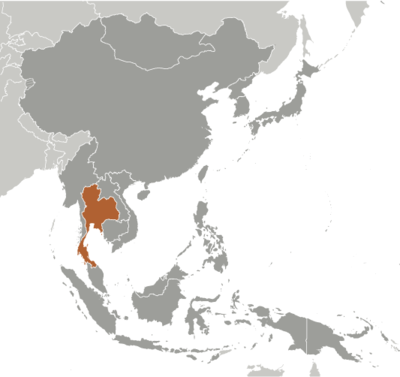
East N Southeast Asia · Bangkok · constitutional monarchy
What Thailand means for your money, the prices you pay, the tariffs in motion, and where U.S. policy could change both.
$91.3B
U.S. imports, 2025
+45%
change in one year
$19.6B
U.S. exports, 2025
70M
Population
$526.4B
GDP
In your house
What you buy that Thailand makes
America bought $91.3B in goods from Thailand in 2025, up 45% in a single year. Of every $100 of it, here's where the money went.
Telecommunications equipment
phones, routers, networking gear
Computers
laptops, desktops, monitors
Computer accessories
keyboards, drives, computer parts
Automotive tires and tubes
tires
Household appliances
household appliances
Electric apparatus
Semiconductors
semiconductors and chips
Other parts and accessories of vehicles
car parts and accessories
Generators, accessories
Industrial machines, other
2026 so far (through July): $80.9B in imports. Source: U.S. Census Bureau, International Trade in Goods (customs basis).
The other direction
What America sells to Thailand
$19.6B in 2025, a trade rupture cuts both ways, for American producers as well as American prices.
Crude oil
$3.5BSemiconductors
$1.3Bsemiconductors and chips
Aluminum and alumina
$1.0BSteelmaking materials
$829MCivilian aircraft, engines, equipment, and parts
$808MOther parts and accessories of vehicles
$731Mcar parts and accessories
Copper
$612MComputers
$577Mlaptops, desktops, monitors
Telecommunications equipment
$573Mphones, routers, networking gear
Where you stand
U.S. tariff posture toward Thailand
Thailand negotiated its reciprocal tariff down from 36% to 19% under the October 26, 2025 U.S.-Thailand framework agreement (the rate applied from August 7, 2025), in exchange for opening roughly 99% of its market to U.S. industrial and agricultural goods. Because the reciprocal tariff was an IEEPA measure, Executive Order 14389 (Ending Certain Tariff Actions, Feb 20, 2026) terminated it effective February 24, 2026, replacing it with a 10% Section 122 temporary import surcharge under Proclamation 11012 (capped at 150 days). Thailand has no Section 232 steel/aluminum exposure. The framework's preferential elements — including zero-rate treatment for certain goods — await the finalized Agreement on Reciprocal Trade.
Reciprocal tariff (assigned, terminated)
36%
The rate this country was assigned under the EO 14257 reciprocal Annex, no longer in force. The Supreme Court struck down the IEEPA tariffs and they were terminated February 24, 2026 (EO 14389), replaced by a universal ~10% Section 122 surcharge. See the timeline below for the current effective rate.
Policy in motion
Tariff status: a moving target
U.S. tariff policy toward Thailand has changed 6 times since 2025. This page tracks it.
2026-02-24
Reciprocal tariffs terminated after Supreme Court ruling
EndedExecutive Order 14389 (Ending Certain Tariff Actions, Feb 20, 2026) terminated the IEEPA tariff duties — including the reciprocal regime under which Thailand's 19% rate was set — effective February 24, 2026.
91 FR 9437 →2026-02-24
Replaced by a 10% Section 122 global tariff
In effectTo replace the terminated IEEPA reciprocal tariffs, the administration imposed a flat 10% tariff under Section 122 of the Trade Act of 1974, limited to 150 days absent Congressional action — superseding Thailand's 19% reciprocal rate pending a finalized bilateral agreement.
Source ↗2025-10-26
U.S.-Thailand framework agreement reached
AgreementThe U.S. and Thailand agreed to a Framework for an Agreement on Reciprocal Trade, locking the reciprocal rate at 19% (with certain goods from EO 14346 Annex III eligible for 0%) in exchange for Thailand eliminating tariff barriers on about 99% of goods and accepting U.S. auto and FDA standards.
Source ↗2025-08-07
19% reciprocal rate takes effect for Thailand
In effectExecutive Order 14326 set the post-pause Annex I reciprocal rates; Thailand's rate was set at 19% effective for goods entered on or after August 7, 2025, roughly half the 36% originally assigned and in line with regional peers like Vietnam.
90 FR 37963 →2025-04-10
Elevated reciprocal rates paused to 10% for 90 days
In effectExecutive Order 14266 suspended the higher country-specific reciprocal rates — including Thailand's 36% — back to the 10% baseline for 90 days to allow negotiations.
90 FR 15625 →2025-04-05
Reciprocal tariff regime begins — Thailand assigned 36%
In effectExecutive Order 14257 imposed a 10% universal reciprocal duty effective April 5 and a higher country-specific rate of 36% for Thailand scheduled to take effect April 9 under Annex I — one of the steepest rates assigned to any partner.
90 FR 15041 →
Made for America
What Thailand makes for America
Thailand is a direct U.S. source of 12 essential goods Americans rely on, the items themselves, shipped finished off the line.
digital
21% of U.S.Fiber optic cables and networking
$18.2B to the U.S.
digital
4% of U.S.Servers and cloud hardware
$8.0B to the U.S.
digital
46% of U.S.Memory and storage chips
$7.5B to the U.S.
digital
10% of U.S.Computers and laptops
$5.1B to the U.S.
materials
19% of U.S.Tires
$3.7B to the U.S.
materials
2% of U.S.Auto parts and repairs
$1.9B to the U.S.
digital
13% of U.S.Printers & peripherals
$1.4B to the U.S.
digital
16% of U.S.Cameras & photo equipment
$1.4B to the U.S.
materials
7% of U.S.Jewelry
$1.4B to the U.S.
materials
9% of U.S.HVAC systems and equipment
$1.4B to the U.S.
food
4% of U.S.Seafood and fish
$1.1B to the U.S.
materials
1% of U.S.Clothing and apparel
$1.1B to the U.S.
Go deeper
The supply chain view
Thailand sits upstream of 24 essential American goods through 12 tracked inputs.
manufactured
54%Lead-Free SAC Solder (Tin-Silver-Copper)
mineral
47%Antimony Metal (Bullet Core Hardener)
manufactured
40%Bonded NdFeB Magnetic Powder (Magnequench-Type, for Small Motors)
agricultural
36%Natural Rubber (Compounded, Tire & Track Grade)
chemical
33%Vanillin (Synthetic)
agricultural
32%Natural rubber (NR) — Hevea brasiliensis latex
Reference
The country itself
East N Southeast Asia · Geography, people, economy, and government, public-domain data from the CIA World Factbook.
Two unified Thai kingdoms emerged in the mid-13th century. The Sukhothai Kingdom, located in the south-central plains, gained its independence from the Khmer Empire to the east. By the late 13th century, Sukhothai’s territory extended into present-day Burma and Laos. Sukhothai lasted until the mid-15th century. The Thai Lan Na Kingdom was established in the north with its capital at Chang Mai; the Burmese conquered Lan Na in the 16th century. The Ayutthaya Kingdom (14th-18th centuries) succeeded the Sukhothai and would become known as the Siamese Kingdom. During the Ayutthaya period, the Thai/Siamese peoples consolidated their hold on what is present-day central and north-central Thailand. Following a military defeat at the hands of the Burmese in 1767, the Siamese Kingdom rose to new heights under the military ruler TAKSIN, who defeated the Burmese occupiers and expanded the kingdom’s territory into modern-day northern Thailand (formerly the Lan Na Kingdom), Cambodia, Laos, and the Malay Peninsula. In the mid-1800s, Western pressure led to Siam signing trade treaties that reduced the country’s sovereignty and independence. In the 1890s and 1900s, the British and French forced the kingdom to cede Cambodian, Laotian, and Malay territories that had been under Siamese control. Following a bloodless revolution in 1932 that led to the establishment of a constitutional monarchy, Thailand's political history was marked by a series of mostly bloodless coups with power concentrated among military and bureaucratic elites. Periods of civilian rule were unstable. The Cold War era saw a communist insurgency and the rise of strongman leaders. Thailand became a US treaty ally in 1954 after sending troops to Korea and later fighting alongside the US in Vietnam. In the 21st century, Thailand has experienced additional turmoil, including a military coup in 2006 that ousted then Prime Minister THAKSIN Chinnawat and large-scale street protests led by competing political factions in 2008-2010. In 2011, THAKSIN's youngest sister, YINGLAK Chinnawat, led the Puea Thai Party to an electoral win and assumed control of the government. In 2014, after months of major anti-government protests in Bangkok, the Constitutional Court removed YINGLAK from office, and the Army, led by Gen. PRAYUT Chan-ocha, then staged a coup against the caretaker government. The military-affiliated National Council for Peace and Order (NCPO) ruled the country under PRAYUT for more than four years, drafting a new constitution that allowed the military to appoint the entire 250-member Senate and required a joint meeting of the House and Senate to select the prime minister -- which effectively gave the military a veto on the selection. King PHUMIPHON Adunyadet passed away in 2016 after 70 years on the throne; his only son, WACHIRALONGKON (aka King RAMA X), formally ascended the throne in 2019. The same year, a long-delayed election allowed PRAYUT to continue his premiership, although the results were disputed and widely viewed as skewed in favor of the party aligned with the military. The country again experienced major anti-government protests in 2020. The reformist Move Forward Party won the most seats in the 2023 election but was unable to form a government, and Srettha THRAVISIN from the Pheu Thai Party replaced PRAYUT as prime minister after forming a coalition of moderate and conservative parties.
Geography
- Location
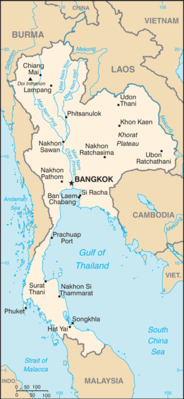
- Southeastern Asia, bordering the Andaman Sea and the Gulf of Thailand, southeast of Burma
- Area
- 513,120 sq km
- Climate
- tropical; rainy, warm, cloudy southwest monsoon (mid-May to September); dry, cool northeast monsoon (November to mid-March); southern isthmus always hot and humid
- Terrain
- central plain; Khorat Plateau in the east; mountains elsewhere
- Natural resources
- tin, rubber, natural gas, tungsten, tantalum, timber, lead, fish, gypsum, lignite, fluorite, arable land
- Coastline
- 3,219 km
- Natural hazards
- land subsidence in Bangkok area resulting from the depletion of the water table; droughts
People & society
- Population
- 70,025,248 (2025 est.)
- Nationality
- Thai (singular and plural)
- Ethnic groups
- Thai 97.5%, Burmese 1.3%, other 1.1%, unspecified <0.1% (2015 est.)
- Languages
- Thai (official) only 90.7%, Thai and other languages 6.4%, only other languages 2.9% (includes Malay, Burmese); English is a secondary language among the elite (2010 est.)
- Religions
- Buddhist 92.5%, Muslim 5.4%, Christian 1.2%, other 0.9% (includes animist, Confucian, Hindu, Jewish, Sikh, and Taoist) (2021 est.)
- Median age
- 41.9 years (2025 est.)
- Life expectancy at birth
- 78.2 years (2024 est.)
- Literacy
- 91.1% (2022 est.)
Economy
- Economic overview
- upper middle-income Southeast Asian economy; substantial infrastructure; major electronics, food, and automobile parts exporter; globally used currency; extremely low unemployment; ongoing Thailand 4.0 economic development
- Industries
- tourism, textiles and garments, agricultural processing, beverages, tobacco, cement, light manufacturing such as jewelry and electric appliances, computers and parts, integrated circuits, furniture, plastics, automobiles and automotive parts, agricultural machinery, air conditioning and refrigeration, ceramics, aluminum, chemical, environmental management, glass, granite and marble, leather, machinery and metal work, petrochemical, petroleum refining, pharmaceuticals, printing, pulp and paper, rubber, sugar, rice, fishing, cassava, world's second-largest tungsten producer and third-largest tin producer
- Agricultural products
- sugarcane, rice, cassava, oil palm fruit, maize, rubber, tropical fruits, chicken, mangoes/guavas, fruits (2023)
- Exports - partners
- USA 18%, China 13%, Japan 7%, Australia 4%, Singapore 4% (2023)
- Imports - partners
- China 26%, Japan 11%, USA 7%, UAE 6%, Taiwan 5% (2023)
Government
- Government type
- constitutional monarchy
- Capital
- Bangkok
- Independence
- 1238 (traditional founding date; never colonized)
- Constitution
- many previous; latest drafted and presented 29 March 2016, approved by referendum 7 August 2016, signed into law by the king on 6 April 2017
- Executive branch
- King WACHIRALONGKON; also spelled Vajiralongkorn (since 1 December 2016)
- Legislative branch
- National Assembly (Rathhasapha)
Full reference data
Every field, by section, CIA World Factbook. Open a topic to expand it.
Introduction
Travel Facts
Please visit the following links to find further information about your desired destination.
World Health Organization (WHO) - To learn what vaccines and health precautions to take while visiting your destination.
US State Dept Travel Information - Overall information about foreign travel for US citizens.
To obtain an international driving permit (IDP). Only two organizations in the US issue IDPs: American Automobile Association (AAA) and American Automobile Touring Alliance (AATA)
How to get help in an emergency? Contact the nearest US embassy or consulate, or call one of these numbers: from the US or Canada - 1-888-407-4747 or from Overseas - +1 202-501-4444
Page last updated: Thursday, December 01, 2022