
Country exposure · CL
Chile
South America · Santiago; note - Valparaiso is the seat of the national legislature · presidential republic
What Chile means for your money, the prices you pay, the tariffs in motion, and where U.S. policy could change both.
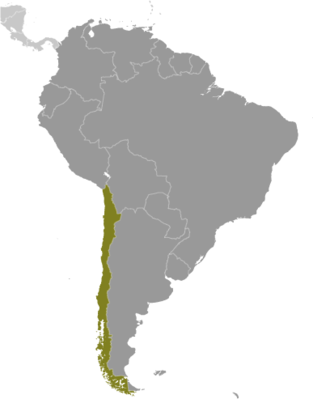
$19.0B
U.S. imports, 2025
+15.6%
change in one year
$19.1B
U.S. exports, 2025
19M
Population
$330.3B
GDP
In your house
What you buy that Chile makes
America bought $19.0B in goods from Chile in 2025, up 15.6% in a single year. Of every $100 of it, here's where the money went.
Copper
copper for wiring
Fish and shellfish
fish, shrimp, shellfish
Fruits, frozen juices
fruit and frozen juices
Shingles, wallboard
U.s. goods returned, and reimports
Chemicals-inorganic
Automotive tires and tubes
tires
Nonmonetary gold
Meat products
meat at the counter
Plywood and veneers
2026 so far (through July): $12.8B in imports. Source: U.S. Census Bureau, International Trade in Goods (customs basis).
The other direction
What America sells to Chile
$19.1B in 2025, a trade rupture cuts both ways, for American producers as well as American prices.
Fuel oil
$4.6BCivilian aircraft, engines, equipment, and parts
$1.4BPetroleum products, other
$1.1BExcavating machinery
$788MMaterials handling equipment
$685MMinimum value shipments
$673MIndustrial engines
$615MIndustrial machines, other
$605MPharmaceutical preparations
$458Mmedicines and pharmacy items
Where you stand
U.S. tariff posture toward Chile
No U.S. tariff action singles this country out. Its goods face the universal 10% temporary import surcharge under Section 122 of the Trade Act (which replaced the IEEPA reciprocal baseline in February 2026) plus the sectoral Section 232 duties — steel and aluminum at 50% — that apply to all countries. The Section 122 surcharge is statutorily temporary — scheduled to lapse on or about July 23, 2026 (a 150-day cap) unless extended or replaced.
Reciprocal tariff (universal baseline)
10%
The universal 10% floor, a Section 122 import surcharge since February 2026, previously the EO 14257 reciprocal baseline, applies to nearly all U.S. imports. This country has no higher assigned rate of its own.
Policy in motion
Tariff status: a moving target
No U.S. tariff action names Chile. These are the universal measures, applied to every country without a country-specific arrangement, that set its treatment.
2026-04-06
Section 232 metals coverage expanded
In effectThe April 2026 proclamation strengthening Section 232 actions on aluminum, steel, and copper expanded derivative-product coverage for all countries, keeping the general metals rate at 50%.
91 FR 18201 →2026-02-24
IEEPA reciprocal tariffs terminated — replaced by 10% Section 122 surcharge
In effectExecutive Order 14389 (Ending Certain Tariff Actions) terminated the IEEPA tariff duties — including the EO 14257 reciprocal baseline — effective February 24, 2026. A flat 10% Section 122 temporary import surcharge (Proclamation 11012 of February 20, 2026) replaced them, leaving the universal rate unchanged at 10% on a different statutory basis. Section 122 caps such surcharges at 150 days, so this 10% surcharge is scheduled to lapse on or about July 23, 2026 absent further action (the administration has signaled it could raise the rate toward the 15% statutory maximum).
91 FR 9437 →2025-11-13
Agricultural products exempted from reciprocal tariffs
In effectExecutive Order 14360 of November 14, 2025 removed reciprocal duties from certain agricultural products listed in its annexes (coffee, cocoa, bananas, and other goods the U.S. does not produce in sufficient quantity), retroactive to November 13, 2025 — for all countries subject to the reciprocal tariff.
90 FR 54091 →2025-06-04
Section 232 steel and aluminum duties doubled to 50%
In effectThe June 3, 2025 proclamation raised Section 232 duties on steel and aluminum articles and derivatives from 25% to 50% for all countries, effective June 4, 2025.
90 FR 24199 →2025-04-05
Universal 10% reciprocal baseline takes effect
In effectExecutive Order 14257 (signed April 2, 2025) imposed a 10% ad valorem reciprocal duty on imports from all trading partners, effective April 5, 2025. Countries without a higher Annex I rate remain at this baseline.
Federal Register · 2025-06063 →2025-03-12
Section 232 steel and aluminum duties set at 25% for all countries
In effectProclamations of February 10, 2025 terminated all country exemptions and quota arrangements and applied 25% Section 232 duties to steel and aluminum imports from every country, effective March 12, 2025.
90 FR 9817 →
Made for America
What Chile makes for America
Chile is a direct U.S. source of 12 essential goods Americans rely on, the items themselves, shipped finished off the line.
food
11% of U.S.Seafood and fish
$2.9B to the U.S.
grocery
6% of U.S.Fresh produce staples
$1.8B to the U.S.
materials
5% of U.S.Lumber and wood products
$921M to the U.S.
materials
2% of U.S.Tires
$372M to the U.S.
food
6% of U.S.Frozen foods
$326M to the U.S.
food
28% of U.S.Chicken and turkey
$244M to the U.S.
food
3% of U.S.Canned and shelf-stable foods
$192M to the U.S.
food
1% of U.S.Beer, wine, and spirits
$159M to the U.S.
food
1% of U.S.Soft drinks & juices
$82M to the U.S.
agriculture
4% of U.S.Animal feed
$73M to the U.S.
agriculture
12% of U.S.Crop seeds
$72M to the U.S.
materials
Auto parts and repairs
$59M to the U.S.
Go deeper
The supply chain view
Chile sits upstream of 24 essential American goods through 12 tracked inputs.
pharmaceutical
90%AS01B Adjuvant System (GSK proprietary)
mineral
64%Molybdenum (Catalyst Metal)
mineral
30%Lithium Carbonate
mineral
30%Lithium carbonate / lithium hydroxide
chemical
28%Molten Salt Heat Transfer Fluid (NaNO2/NaNO3 for CSP Solar)
mineral
28%Process Water (Mining)
Reference
The country itself
South America · Geography, people, economy, and government, public-domain data from the CIA World Factbook.
Indigenous groups inhabited central and southern Chile for several thousand years, living in mixed pastoralist and settled communities. The Inca then ruled the north of the country for nearly a century prior to the arrival of the Spanish in the 16th century. In 1541, the Spanish established the Captaincy General of Chile, which lasted until Chile declared its independence in 1810. The subsequent struggle with the Spanish became tied to other South American independence conflicts, with a decisive victory not being achieved until 1818. In the War of the Pacific (1879-83), Chile defeated Peru and Bolivia to win its current northernmost regions. By the 1880s, the Chilean central government cemented its control over the central and southern regions inhabited by Mapuche Indigenous peoples. Between 1891 and 1973, a series of elected governments succeeded each other until the Marxist government of Salvador ALLENDE was overthrown in 1973 in a military coup led by General Augusto PINOCHET, who ruled until a democratically elected president was inaugurated in 1990. Economic reforms that were maintained consistently since the 1980s contributed to steady growth, reduced poverty rates by over half, and helped secure the country's commitment to democratic and representative government. Chile has increasingly assumed regional and international leadership roles befitting its status as a stable, democratic nation.
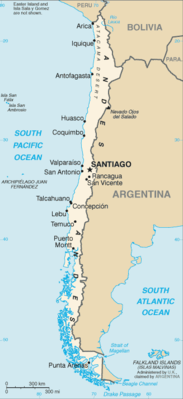
Geography
- Location
- Southern South America, bordering the South Pacific Ocean, between Argentina and Peru
- Area
- 756,102 sq km
- Climate
- temperate; desert in north; Mediterranean in central region; cool and damp in south
- Terrain
- low coastal mountains, fertile central valley, rugged Andes in east
- Natural resources
- copper, timber, iron ore, nitrates, precious metals, molybdenum, hydropower
- Coastline
- 6,435 km
- Natural hazards
- severe earthquakes; active volcanism; tsunamis volcanism: significant volcanic activity due to more than three-dozen active volcanoes along the Andes Mountains; Lascar (5,592 m), which last erupted in 2007, is the most active volcano in the northern Chilean Andes; Llaima (3,125 m) in central Chile, which last erupted in 2009, is another of the country's most active; Chaiten's 2008 eruption forced major evacuations; other notable historically active volcanoes include Cerro Hudson, Calbuco, Copahue, Guallatiri, Llullaillaco, Nevados de Chillan, Puyehue, San Pedro, and Villarrica; see note 2 under "Geography - note"
People & society
- Population
- 19,091,343 (2025 est.)
- Nationality
- Chilean(s)
- Ethnic groups
- White and non-Indigenous 88.9%, Mapuche 9.1%, Aymara 0.7%, other Indigenous groups 1% (includes Rapa Nui, Likan Antai, Quechua, Colla, Diaguita, Kawesqar, Yagan or Yamana), unspecified 0.3% (2012 est.)
- Languages
- Spanish 99.5% (official), English 10.2%, Indigenous 1% (includes Mapudungun, Aymara, Quechua, Rapa Nui), other 2.3%, unspecified 0.2% (2012 est.)
- Religions
- Catholic 57%, none 25.7%, Evangelical or Protestant 16.2%, other Christians and traditions related to Christ 1.3%; less than 1%: Buddhist, Catholic Orthodox, Church of Jesus Christ of Latter-Day Saints, Islam, Judaism, other religions, no religion (2024)
- Median age
- 38.9 years (2025 est.)
- Life expectancy at birth
- 80.3 years (2024 est.)
- Literacy
- 96.4% (2017 est.)
Economy
- Economic overview
- export-driven economy; leading copper producer; though hit by COVID-19, fairly quick rebound from increased liquidity and rapid vaccine rollouts; decreasing poverty but still lingering inequality; public debt rising but still manageable; recent political violence has had negative economic consequences
- Industries
- copper, lithium, other minerals, foodstuffs, fish processing, iron and steel, wood and wood products, transport equipment, cement, textiles
- Agricultural products
- grapes, milk, apples, wheat, tomatoes, potatoes, chicken, maize, sugar beets, pork (2023)
- Exports - partners
- China 39%, USA 16%, Japan 7%, S. Korea 6%, Brazil 4% (2023)
- Imports - partners
- China 23%, USA 20%, Brazil 10%, Argentina 7%, Germany 5% (2023)
Government
- Government type
- presidential republic
- Capital
- Santiago; note - Valparaiso is the seat of the national legislature
- Independence
- 18 September 1810 (from Spain)
- Constitution
- many previous; latest adopted 11 September 1980, effective 11 March 1981; in September 2022 and again in December 2023, referendums presented for a new constitution were both defeated, and the September 1980 constitution remains in force
- Executive branch
- President Gabriel BORIC (since 11 March 2022)
- Legislative branch
- National Congress (Congreso Nacional)
Full reference data
Every field, by section, CIA World Factbook. Open a topic to expand it.
Introduction
Travel Facts
Please visit the following links to find further information about your desired destination.
World Health Organization (WHO) - To learn what vaccines and health precautions to take while visiting your destination.
US State Dept Travel Information - Overall information about foreign travel for US citizens.
To obtain an international driving permit (IDP). Only two organizations in the US issue IDPs: American Automobile Association (AAA) and American Automobile Touring Alliance (AATA)
How to get help in an emergency? Contact the nearest US embassy or consulate, or call one of these numbers: from the US or Canada - 1-888-407-4747 or from Overseas - +1 202-501-4444
Page last updated: Monday, May 08, 2023