
Country exposure · OM

Oman
Middle East · Muscat · absolute monarchy
What Oman means for your money, the prices you pay, the tariffs in motion, and where U.S. policy could change both.
$1.1B
U.S. imports, 2025
-15.1%
change in one year
$2.2B
U.S. exports, 2025
4M
Population
$106.9B
GDP
In your house
What you buy that Oman makes
America bought $1.1B in goods from Oman in 2025, down 15.1% in a single year. Of every $100 of it, here's where the money went.
Industrial supplies, other
Bauxite and aluminum
aluminum for cans and autos
Jewelry
jewelry
U.s. goods returned, and reimports
Iron and steel, advanced
Finished metal shapes
Iron and steel products, n.e.c.
Plastic materials
plastics for packaging and goods
Petroleum products, other
gasoline and petroleum products
Steelmaking materials
2026 so far (through July): $839M in imports. Source: U.S. Census Bureau, International Trade in Goods (customs basis).
The other direction
What America sells to Oman
$2.2B in 2025, a trade rupture cuts both ways, for American producers as well as American prices.
Civilian aircraft, engines, equipment, and parts
$631MPassenger cars, new and used
$583Mnew and used cars
Jewelry, etc.
$86Mjewelry
Petroleum products, other
$82MMinimum value shipments
$62MIndustrial engines
$59MPlastic materials
$47Mplastics for packaging and goods
Measuring, testing, control instruments
$36MElectric apparatus
$36MWhere you stand
U.S. tariff posture toward Oman
No U.S. tariff action singles this country out. Its goods face the universal 10% temporary import surcharge under Section 122 of the Trade Act (which replaced the IEEPA reciprocal baseline in February 2026) plus the sectoral Section 232 duties — steel and aluminum at 50% — that apply to all countries. The Section 122 surcharge is statutorily temporary — scheduled to lapse on or about July 23, 2026 (a 150-day cap) unless extended or replaced.
Reciprocal tariff (universal baseline)
10%
The universal 10% floor, a Section 122 import surcharge since February 2026, previously the EO 14257 reciprocal baseline, applies to nearly all U.S. imports. This country has no higher assigned rate of its own.
Policy in motion
Tariff status: a moving target
No U.S. tariff action names Oman. These are the universal measures, applied to every country without a country-specific arrangement, that set its treatment.
2026-04-06
Section 232 metals coverage expanded
In effectThe April 2026 proclamation strengthening Section 232 actions on aluminum, steel, and copper expanded derivative-product coverage for all countries, keeping the general metals rate at 50%.
91 FR 18201 →2026-02-24
IEEPA reciprocal tariffs terminated — replaced by 10% Section 122 surcharge
In effectExecutive Order 14389 (Ending Certain Tariff Actions) terminated the IEEPA tariff duties — including the EO 14257 reciprocal baseline — effective February 24, 2026. A flat 10% Section 122 temporary import surcharge (Proclamation 11012 of February 20, 2026) replaced them, leaving the universal rate unchanged at 10% on a different statutory basis. Section 122 caps such surcharges at 150 days, so this 10% surcharge is scheduled to lapse on or about July 23, 2026 absent further action (the administration has signaled it could raise the rate toward the 15% statutory maximum).
91 FR 9437 →2025-11-13
Agricultural products exempted from reciprocal tariffs
In effectExecutive Order 14360 of November 14, 2025 removed reciprocal duties from certain agricultural products listed in its annexes (coffee, cocoa, bananas, and other goods the U.S. does not produce in sufficient quantity), retroactive to November 13, 2025 — for all countries subject to the reciprocal tariff.
90 FR 54091 →2025-06-04
Section 232 steel and aluminum duties doubled to 50%
In effectThe June 3, 2025 proclamation raised Section 232 duties on steel and aluminum articles and derivatives from 25% to 50% for all countries, effective June 4, 2025.
90 FR 24199 →2025-04-05
Universal 10% reciprocal baseline takes effect
In effectExecutive Order 14257 (signed April 2, 2025) imposed a 10% ad valorem reciprocal duty on imports from all trading partners, effective April 5, 2025. Countries without a higher Annex I rate remain at this baseline.
Federal Register · 2025-06063 →2025-03-12
Section 232 steel and aluminum duties set at 25% for all countries
In effectProclamations of February 10, 2025 terminated all country exemptions and quota arrangements and applied 25% Section 232 duties to steel and aluminum imports from every country, effective March 12, 2025.
90 FR 9817 →
Made for America
What Oman makes for America
Oman is a direct U.S. source of 12 essential goods Americans rely on, the items themselves, shipped finished off the line.
materials
2% of U.S.Aluminum and aluminum products
$252M to the U.S.
materials
1% of U.S.Jewelry
$131M to the U.S.
materials
Hardware & fasteners
$55M to the U.S.
materials
Steel and iron products
$38M to the U.S.
agriculture
Ammonia and nitrogen fertilizers
$19M to the U.S.
home
1% of U.S.Trash bags and plastic wrap
$16M to the U.S.
home
1% of U.S.Office & school supplies
$12M to the U.S.
materials
Electric grid transformers
$9M to the U.S.
food
Seafood and fish
$9M to the U.S.
materials
Auto parts and repairs
$7M to the U.S.
food
Bread, grains, and flour
$7M to the U.S.
materials
Plumbing pipes and fittings
$6M to the U.S.
Go deeper
The supply chain view
Oman sits upstream of 14 essential American goods through 12 tracked inputs.
mineral
8%Gypsum (Natural & Synthetic FGD)
manufactured
5%Cookware Aluminum Sheet/Circle
chemical
3%Aromatic Formulation Solvents (Xylene / Naphtha)
manufactured
3%BOPP Multilayer Packaging Film
mineral
3%Iron ore (direct shipping ore & pellets)
chemical
2%Superabsorbent Polymer (SAP) for Diapers
Reference
The country itself
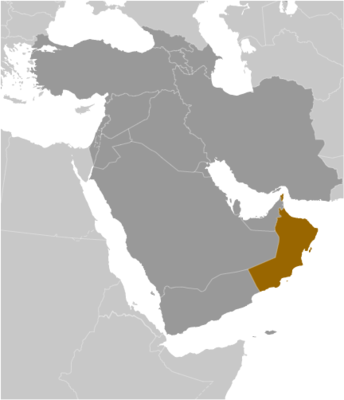
Middle East · Geography, people, economy, and government, public-domain data from the CIA World Factbook.
The inhabitants of the area of present-day Oman have long prospered from Indian Ocean trade. In the late 18th century, the nascent sultanate in Muscat signed the first in a series of friendship treaties with Britain. Over time, Oman's dependence on British political and military advisors increased, although the sultanate never became a British colony. In 1970, QABOOS bin Said Al Said overthrew his father and ruled as sultan for the next five decades. His extensive modernization program opened the country to the outside world. He prioritized strategic ties to the UK and US, and his moderate, independent foreign policy allowed Oman to maintain good relations with its neighbors and avoid external entanglements. In 2011, the popular uprisings that swept the Middle East and North Africa inspired demonstrations in Oman that called for more jobs and economic benefits and an end to corruption. In response, QABOOS implemented economic and political reforms such as granting Oman’s legislative body more power and authorizing direct elections for its lower house. Additionally, the sultan increased unemployment benefits and issued a royal directive mandating a national public- and private-sector job creation plan. As part of the government's efforts to decentralize authority and allow greater citizen participation in local governance, Oman successfully conducted its first municipal council elections in 2012. QABOOS, Oman's longest reigning monarch, died in 2020. His cousin, HAYTHAM bin Tariq Al Said, former Minister of Heritage and Culture, was sworn in as Oman's new sultan the same day.
Geography
- Location
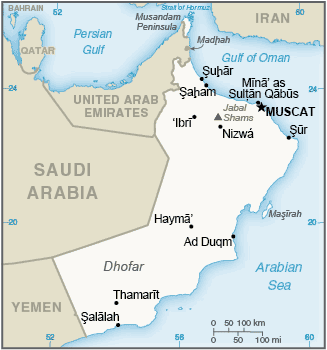
- Middle East, bordering the Arabian Sea, Gulf of Oman, and Persian Gulf, between Yemen and the UAE
- Area
- 309,500 sq km
- Climate
- dry desert; hot, humid along coast; hot, dry interior; strong southwest summer monsoon (May to September) in far south
- Terrain
- central desert plain, rugged mountains in north and south
- Natural resources
- petroleum, copper, asbestos, some marble, limestone, chromium, gypsum, natural gas
- Coastline
- 2,092 km
- Natural hazards
- summer winds often raise large sandstorms and dust storms in interior; periodic droughts
People & society
- Population
- 3,969,824 (2025 est.)
- Nationality
- Omani(s)
- Ethnic groups
- Arab, Baluchi, South Asian (Indian, Pakistani, Sri Lankan, Bangladeshi), African
- Languages
- Arabic (official), English, Baluchi, Swahili, Urdu, Indian dialects
- Religions
- Muslim 85.9%, Christian 6.4%, Hindu 5.7%, other and unaffiliated 2% (2020 est.)
- Median age
- 27.5 years (2025 est.)
- Life expectancy at birth
- 77.4 years (2024 est.)
- Literacy
- 97.3% (2022 est.)
Economy
- Economic overview
- high-income, oil-based economy; large welfare system; growing government debt; citizenship-based labor force growth policy; US free trade agreement; diversifying portfolio; high female labor force participation
- Industries
- crude oil production and refining, natural and liquefied natural gas production; construction, cement, copper, steel, chemicals, optic fiber
- Agricultural products
- vegetables, dates, milk, tomatoes, sorghum, chillies/peppers, goat milk, cucumbers/gherkins, cantaloupes/melons, cabbages (2023)
- Exports - partners
- China 43%, India 6%, Saudi Arabia 5%, UAE 5%, South Africa 4% (2023)
- Imports - partners
- UAE 25%, Saudi Arabia 12%, India 8%, China 7%, Qatar 5% (2023)
Government
- Government type
- absolute monarchy
- Capital
- Muscat
- Independence
- 1650 (expulsion of the Portuguese)
- Constitution
- promulgated by royal decree 6 November 1996 (the Basic Law of the Sultanate of Oman serves as the constitution); amended by royal decree in 2011
- Executive branch
- Sultan and Prime Minister HAITHAM bin Tarik Al Said (since 11 January 2020)
- Legislative branch
- Majles
Full reference data
Every field, by section, CIA World Factbook. Open a topic to expand it.
Introduction
Travel Facts
Please visit the following links to find further information about your desired destination.
CDC - To learn what vaccines and health precautions to take while visiting your destination.
US State Dept Travel Information - Overall information about foreign travel for US citizens.
To obtain an international driving permit (IDP). Only two organizations in the US issue IDPs: American Automobile Association (AAA) and American Automobile Touring Alliance (AATA)
How to get help in an emergency? Contact the nearest US embassy or consulate, or call one of these numbers: from the US or Canada - 1-888-407-4747 or from Overseas - +1 202-501-4444
Page last updated: Tuesday, November 05, 2024