
Country exposure · ZA
South Africa
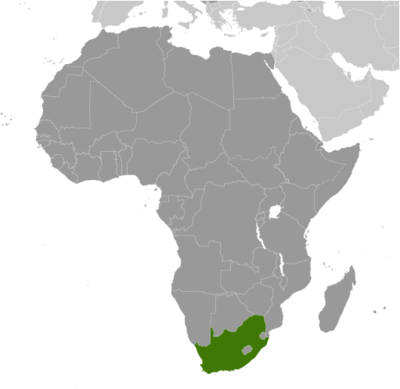
Africa · Pretoria (administrative capital); Cape Town (legislative capital); Bloemfontein (judicial capital) · parliamentary republic
What South Africa means for your money, the prices you pay, the tariffs in motion, and where U.S. policy could change both.
$16.5B
U.S. imports, 2025
+12.1%
change in one year
$6.3B
U.S. exports, 2025
61M
Population
$400.3B
GDP
In your house
What you buy that South Africa makes
America bought $16.5B in goods from South Africa in 2025. Of every $100 of it, here's where the money went.
Other precious metals
Finished metal shapes
Nonmonetary gold
Passenger cars, new and used
new and used cars
Bauxite and aluminum
aluminum for cans and autos
Steelmaking materials
Gem diamonds
Fruits, frozen juices
fruit and frozen juices
Chemicals-organic
Nonferrous metals, other
2026 so far (through July): $6.6B in imports. Source: U.S. Census Bureau, International Trade in Goods (customs basis).
The other direction
What America sells to South Africa
$6.3B in 2025, a trade rupture cuts both ways, for American producers as well as American prices.
Other parts and accessories of vehicles
$559Mcar parts and accessories
Crude oil
$539MCivilian aircraft, engines, equipment, and parts
$431MMinimum value shipments
$277MComputers
$270Mlaptops, desktops, monitors
Natural gas liquids
$256MIndustrial machines, other
$222MPlastic materials
$174Mplastics for packaging and goods
Chemicals-other
$173MWhere you stand
U.S. tariff posture toward South Africa
South Africa never reached a deal — its May 2025 framework offer was rejected — so it bore the full 30% reciprocal tariff from August 7, 2025, hitting citrus, table grapes, wine, and automotive exports and largely superseding its AGOA duty-free access. Relief came not from negotiation but from Executive Order 14389 (Ending Certain Tariff Actions, Feb 20, 2026), which terminated the IEEPA reciprocal duties; Proclamation 11012 replaced it with a 10% Section 122 temporary import surcharge effective February 24, 2026. AGOA was extended in February 2026 (backdated to September 2025) but expires at year-end. South Africa has no Section 232 steel/aluminum exposure.
Reciprocal tariff (assigned, terminated)
30%
The rate this country was assigned under the EO 14257 reciprocal Annex, no longer in force. The Supreme Court struck down the IEEPA tariffs and they were terminated February 24, 2026 (EO 14389), replaced by a universal ~10% Section 122 surcharge. See the timeline below for the current effective rate.
Policy in motion
Tariff status: a moving target
U.S. tariff policy toward South Africa has changed 4 times since 2025. This page tracks it.
2026-02-24
IEEPA reciprocal tariffs terminated — replaced by 10% Section 122
In effectExecutive Order 14389 (Ending Certain Tariff Actions) terminated the IEEPA tariff duties effective February 24, 2026, cutting South Africa's 30% rate and replacing it with a 10% Section 122 temporary import surcharge under Proclamation 11012 (capped at 150 days).
91 FR 9437 →2025-08-07
Full 30% reciprocal rate takes effect — no deal reached
In effectExecutive Order 14326 set the post-pause Annex I reciprocal rates. South Africa's framework offer submitted May 20, 2025 was unsuccessful, so it bore the full 30% rate from August 7, 2025, hitting citrus, wine, grapes, and autos and overriding much of its AGOA duty-free access.
90 FR 37963 →2025-04-10
Elevated reciprocal rates paused to 10% for 90 days
In effectExecutive Order 14266 suspended the higher country-specific reciprocal rates — including South Africa's 30% — back to the 10% baseline for 90 days to allow negotiations.
90 FR 15625 →2025-04-05
Reciprocal tariff regime begins — South Africa assigned 30%
In effectExecutive Order 14257 imposed a 10% universal reciprocal duty effective April 5 and a higher country-specific rate of 30% for South Africa scheduled to take effect April 9 under Annex I.
90 FR 15041 →
Made for America
What South Africa makes for America
South Africa is a direct U.S. source of 12 essential goods Americans rely on, the items themselves, shipped finished off the line.
materials
Vehicles and light trucks
$712M to the U.S.
materials
3% of U.S.Jewelry
$554M to the U.S.
grocery
1% of U.S.Fresh produce staples
$181M to the U.S.
materials
1% of U.S.Aluminum and aluminum products
$111M to the U.S.
materials
Steel and iron products
$97M to the U.S.
materials
Auto parts and repairs
$72M to the U.S.
food
1% of U.S.Soft drinks & juices
$67M to the U.S.
food
1% of U.S.Canned and shelf-stable foods
$51M to the U.S.
food
1% of U.S.Snacks & confectionery
$48M to the U.S.
food
Seafood and fish
$44M to the U.S.
food
1% of U.S.Frozen foods
$36M to the U.S.
food
Beer, wine, and spirits
$33M to the U.S.
Go deeper
The supply chain view
South Africa sits upstream of 24 essential American goods through 12 tracked inputs.
mineral
72%Platinum Group Metals (PGMs) — Catalytic Converters
mineral
70%PGM Sulfide Ore — Bushveld Complex (South Africa)
energy
65%Grid Electricity for PGM Smelting (South Africa / Russia)
mineral
61%Platinum group metal (pharmaceutical grade)
mineral
20%Manganese ore
mineral
19%Titanium mineral concentrates (ilmenite/rutile)
Reference
The country itself
Africa · Geography, people, economy, and government, public-domain data from the CIA World Factbook.
Some of the earliest human remains in the fossil record were found in South Africa. By about A.D. 500, Bantu-speaking groups began settling into what is now northeastern South Africa, displacing Khoisan-speaking groups to the southwest. Dutch traders landed at the southern tip of present-day South Africa in 1652 and established a stopover point on the spice route between the Netherlands and the Far East, founding the city of Cape Town. After the British seized the Cape of Good Hope area in 1806, many settlers of Dutch descent -- known then as "Boers," or farmers, but later called Afrikaners -- trekked north to found their own republics, Transvaal and Orange Free State. In the 1820s, several decades of wars began as the Zulus expanded their territory, moving out of what is today southeastern South Africa and clashing with other indigenous peoples and the growing European settlements. The discovery of diamonds (1867) and gold (1886) spurred mass immigration, predominantly from Europe. The Zulu kingdom's territory was incorporated into the British Empire after the Anglo-Zulu War in 1879, and the Afrikaner republics were incorporated after their defeat in the Second South African War (1899-1902). Beginning in 1910, the British and the Afrikaners ruled together under the Union of South Africa, which left the British Commonwealth to become a fully self-governing republic in 1961 after a Whites-only referendum. In 1948, the National Party was voted into power and instituted a policy of apartheid -– billed as "separate development" of the races -- which favored the White minority and suppressed the Black majority and other non-White groups. The African National Congress (ANC) led the resistance to apartheid, and many top ANC leaders such as Nelson MANDELA spent decades in South Africa's prisons. Internal protests and insurgency, as well as boycotts from some Western nations and institutions, led to the regime's eventual willingness to unban the ANC and negotiate a peaceful transition to majority rule. The first multi-racial elections in 1994 ushered in majority rule under an ANC-led government. South Africa has since struggled to address apartheid-era imbalances in wealth, housing, education, and health care under successive administrations. President Cyril RAMAPHOSA, who was reelected as the ANC leader in 2022, has made some progress in reigning in corruption.
Geography
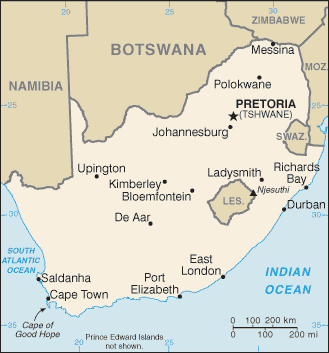
- Location
- Southern Africa, at the southern tip of the continent of Africa
- Area
- 1,219,090 sq km
- Climate
- mostly semiarid; subtropical along east coast; sunny days, cool nights
- Terrain
- vast interior plateau rimmed by rugged hills and narrow coastal plain
- Natural resources
- gold, chromium, antimony, coal, iron ore, manganese, nickel, phosphates, tin, rare earth elements, uranium, gem diamonds, platinum, copper, vanadium, salt, natural gas
- Coastline
- 2,798 km
- Natural hazards
- prolonged droughts volcanism: the volcano that formed Marion Island in the Prince Edward Islands is South Africa's only active volcano
People & society
- Population
- 61,089,926 (2025 est.)
- Nationality
- South African(s)
- Ethnic groups
- Black African 80.9%, Colored 8.8%, White 7.8%, Indian/Asian 2.6% (2021 est.)
- Languages
- isiZulu or Zulu (official) 25.3%, isiXhosa or Xhosa (official) 14.8%, Afrikaans (official) 12.2%, Sepedi or Pedi (official) 10.1%, Setswana or Tswana (official) 9.1%, English (official) 8.1%, Sesotho or Sotho (official) 7.9%, Xitsonga or Tsonga (official) 3.6%, siSwati or Swati (official) 2.8%, Tshivenda or Venda (official) 2.5%, isiNdebele or Ndebele (official) 1.6%, other (includes South African sign language (official) and Khoi or Khoisan or Khoe languages) 2% (2018 est.)
- Religions
- Christian 86%, ancestral, tribal, animist, or other traditional African religions 5.4%, Muslim 1.9%, other 1.5%, nothing in particular 5.2% (2015 est.)
- Median age
- 30.7 years (2025 est.)
- Life expectancy at birth
- 71.9 years (2024 est.)
- Literacy
- 91.2% (2024 est.)
Economy
- Economic overview
- upper-middle-income, largest southern African economy; Government of National Unity facing slow growth, fiscal gaps, and structural challenges; high income inequality, unemployment, and poverty; reforms to address electricity generation, transport, and logistics; leading producer and exporter of critical minerals
- Industries
- mining (world's largest producer of platinum, gold, chromium), automobile assembly, metalworking, machinery, textiles, iron and steel, chemicals, fertilizer, foodstuffs, commercial ship repair
- Agricultural products
- sugarcane, maize, milk, soybeans, potatoes, wheat, grapes, chicken, oranges, apples (2023)
- Exports - partners
- China 19%, USA 8%, Germany 7%, India 7%, UK 6% (2023)
- Imports - partners
- China 21%, India 7%, USA 7%, Germany 6%, UAE 4% (2023)
Government
- Government type
- parliamentary republic
- Capital
- Pretoria (administrative capital); Cape Town (legislative capital); Bloemfontein (judicial capital)
- Independence
- 31 May 1910 (Union of South Africa formed from four British colonies: Cape Colony, Natal, Transvaal, and Orange Free State); 22 August 1934 (Status of the Union Act); 31 May 1961 (republic declared); 27 April 1994 (majority rule)
- Constitution
- several previous; latest drafted 8 May 1996, approved by the Constitutional Court 4 December 1996, effective 4 February 1997
- Executive branch
- President Matamela Cyril RAMAPHOSA (since 19 June 2024)
- Legislative branch
- Parliament
Full reference data
Every field, by section, CIA World Factbook. Open a topic to expand it.
Introduction
Travel Facts
Please visit the following links to find further information about your desired destination.
World Health Organization (WHO) - To learn what vaccines and health precautions to take while visiting your destination.
US State Dept Travel Information - Overall information about foreign travel for US citizens.
To obtain an international driving permit (IDP). Only two organizations in the US issue IDPs: American Automobile Association (AAA) and American Automobile Touring Alliance (AATA)
How to get help in an emergency? Contact the nearest US embassy or consulate, or call one of these numbers: from the US or Canada - 1-888-407-4747 or from Overseas - +1 202-501-4444
Page last updated: Wednesday, July 20, 2022