
Country exposure · TR

Turkey
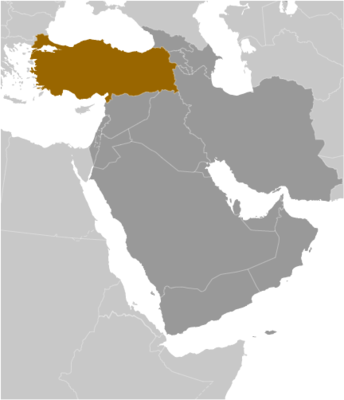
Middle East · Ankara · presidential republic
What Turkey means for your money, the prices you pay, the tariffs in motion, and where U.S. policy could change both.
$16.4B
U.S. imports, 2025
-1.7%
change in one year
$20.4B
U.S. exports, 2025
85M
Population
$1.3T
GDP
In your house
What you buy that Turkey makes
America bought $16.4B in goods from Turkey in 2025. Of every $100 of it, here's where the money went.
Stone, sand, cement, etc.
cement, stone, sand
Other parts and accessories of vehicles
car parts and accessories
Rugs
rugs
Apparel, household goods - cotton
cotton clothing and linens
Finished metal shapes
Fruits, frozen juices
fruit and frozen juices
Electric apparatus
Bakery products
Industrial machines, other
Engines-civilian aircraft
2026 so far (through July): $10.0B in imports. Source: U.S. Census Bureau, International Trade in Goods (customs basis).
The other direction
What America sells to Turkey
$20.4B in 2025, a trade rupture cuts both ways, for American producers as well as American prices.
Civilian aircraft, engines, equipment, and parts
$3.4BGas-natural
$3.3BSteelmaking materials
$1.3BPharmaceutical preparations
$1.2Bmedicines and pharmacy items
Plastic materials
$895Mplastics for packaging and goods
Chemicals-organic
$884MCotton, raw
$663MNuts
$585MOther parts and accessories of vehicles
$549Mcar parts and accessories
Where you stand
U.S. tariff posture toward Turkey
No U.S. tariff action singles this country out. Its goods face the universal 10% temporary import surcharge under Section 122 of the Trade Act (which replaced the IEEPA reciprocal baseline in February 2026) plus the sectoral Section 232 duties — steel and aluminum at 50% — that apply to all countries. The Section 122 surcharge is statutorily temporary — scheduled to lapse on or about July 23, 2026 (a 150-day cap) unless extended or replaced.
Reciprocal tariff (universal baseline)
10%
The universal 10% floor, a Section 122 import surcharge since February 2026, previously the EO 14257 reciprocal baseline, applies to nearly all U.S. imports. This country has no higher assigned rate of its own.
Policy in motion
Tariff status: a moving target
No U.S. tariff action names Turkey. These are the universal measures, applied to every country without a country-specific arrangement, that set its treatment.
2026-04-06
Section 232 metals coverage expanded
In effectThe April 2026 proclamation strengthening Section 232 actions on aluminum, steel, and copper expanded derivative-product coverage for all countries, keeping the general metals rate at 50%.
91 FR 18201 →2026-02-24
IEEPA reciprocal tariffs terminated — replaced by 10% Section 122 surcharge
In effectExecutive Order 14389 (Ending Certain Tariff Actions) terminated the IEEPA tariff duties — including the EO 14257 reciprocal baseline — effective February 24, 2026. A flat 10% Section 122 temporary import surcharge (Proclamation 11012 of February 20, 2026) replaced them, leaving the universal rate unchanged at 10% on a different statutory basis. Section 122 caps such surcharges at 150 days, so this 10% surcharge is scheduled to lapse on or about July 23, 2026 absent further action (the administration has signaled it could raise the rate toward the 15% statutory maximum).
91 FR 9437 →2025-11-13
Agricultural products exempted from reciprocal tariffs
In effectExecutive Order 14360 of November 14, 2025 removed reciprocal duties from certain agricultural products listed in its annexes (coffee, cocoa, bananas, and other goods the U.S. does not produce in sufficient quantity), retroactive to November 13, 2025 — for all countries subject to the reciprocal tariff.
90 FR 54091 →2025-06-04
Section 232 steel and aluminum duties doubled to 50%
In effectThe June 3, 2025 proclamation raised Section 232 duties on steel and aluminum articles and derivatives from 25% to 50% for all countries, effective June 4, 2025.
90 FR 24199 →2025-04-05
Universal 10% reciprocal baseline takes effect
In effectExecutive Order 14257 (signed April 2, 2025) imposed a 10% ad valorem reciprocal duty on imports from all trading partners, effective April 5, 2025. Countries without a higher Annex I rate remain at this baseline.
Federal Register · 2025-06063 →2025-03-12
Section 232 steel and aluminum duties set at 25% for all countries
In effectProclamations of February 10, 2025 terminated all country exemptions and quota arrangements and applied 25% Section 232 duties to steel and aluminum imports from every country, effective March 12, 2025.
90 FR 9817 →
Made for America
What Turkey makes for America
Turkey is a direct U.S. source of 12 essential goods Americans rely on, the items themselves, shipped finished off the line.
materials
1% of U.S.Clothing and apparel
$943M to the U.S.
materials
1% of U.S.Auto parts and repairs
$836M to the U.S.
home
23% of U.S.Rugs & carpets
$734M to the U.S.
materials
2% of U.S.Steel and iron products
$650M to the U.S.
materials
14% of U.S.Cement and concrete
$549M to the U.S.
materials
2% of U.S.Jewelry
$450M to the U.S.
energy
2% of U.S.Gasoline and diesel
$390M to the U.S.
food
5% of U.S.Soft drinks & juices
$377M to the U.S.
food
3% of U.S.Snacks & confectionery
$296M to the U.S.
materials
1% of U.S.Plumbing pipes and fittings
$279M to the U.S.
materials
2% of U.S.Aluminum and aluminum products
$235M to the U.S.
materials
2% of U.S.Home appliances
$227M to the U.S.
Go deeper
The supply chain view
Turkey sits upstream of 24 essential American goods through 12 tracked inputs.
mineral
73%Boron Trioxide (B₂O₃)
mineral
48%Iron (Fe) and Ferroboron (FeB)
manufactured
30%Cement and cement mortar for pipe lining
mineral
28%Ceramic Tableware Clay Body (Kaolin/Ball Clay/Feldspar)
manufactured
14%Outdoor Performance Fabric (Solution-Dyed Acrylic)
mineral
14%Bauxite Ore (Primary Aluminum Feedstock)
Reference
The country itself
Middle East · Geography, people, economy, and government, public-domain data from the CIA World Factbook.
Modern Turkey was founded in 1923 from the remnants of the Ottoman Empire by reformer and national hero Mustafa KEMAL, known as Ataturk or "Father of the Turks." One-party rule ended in 1950, and periods of instability and military coups have since fractured the multiparty democracy, in 1960, 1971, 1980, 1997, and 2016. Turkey joined the UN in 1945 and NATO in 1952. In 1963, Turkey became an associate member of the European Community; it began accession talks with the EU in 2005. Turkey intervened militarily on Cyprus in 1974 to prevent a Greek takeover of the island and has since acted as patron state to the "Turkish Republic of Northern Cyprus," which only Turkey recognizes. The Kurdistan Workers' Party (PKK), a US-designated terrorist organization, began a separatist insurgency in Turkey in 1984, and the struggle has long dominated the attention of Turkish security forces. In 2013, the Turkish Government and the PKK conducted negotiations aimed at ending the violence, but intense fighting resumed in 2015. The Turkish Government conducted a referendum in 2017 in which voters approved constitutional amendments changing Turkey from a parliamentary to a presidential system.
Geography
- Location
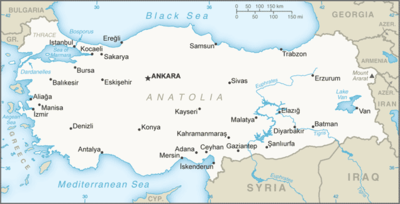
- Southeastern Europe and Southwestern Asia (that portion of Turkey west of the Bosporus is geographically part of Europe), bordering the Black Sea, between Bulgaria and Georgia, and bordering the Aegean Sea and the Mediterranean Sea, between Greece and Syria
- Area
- 783,562 sq km
- Climate
- temperate; hot, dry summers with mild, wet winters; harsher in interior
- Terrain
- high central plateau (Anatolia); narrow coastal plain; several mountain ranges
- Natural resources
- coal, iron ore, copper, chromium, antimony, mercury, gold, barite, borate, celestite (strontium), emery, feldspar, limestone, magnesite, marble, perlite, pumice, pyrites (sulfur), clay, arable land, hydropower
- Coastline
- 7,200 km
- Natural hazards
- severe earthquakes, especially in northern Turkey, along an arc extending from the Sea of Marmara to Lake Van; landslides; flooding volcanism: limited volcanic activity; the three historically active volcanoes (Ararat, Nemrut Dagi, and Tendurek Dagi) have not erupted since the 19th century or earlier
People & society
- Population
- 84,625,585 (2025 est.)
- Nationality
- Turk(s)
- Ethnic groups
- Turkish 70-75%, Kurdish 19%, other minorities 6-11% (2016 est.)
- Languages
- Turkish (official), Kurdish, other minority languages
- Religions
- Muslim 99.8% (mostly Sunni), other 0.2% (mostly Christians and Jews)
- Median age
- 34.4 years (2025 est.)
- Life expectancy at birth
- 76.7 years (2024 est.)
- Literacy
- 97.3% (2021 est.)
Economy
- Economic overview
- upper-middle-income, diversified Middle Eastern economy; industrializing economy that maintains large agricultural base; key energy, tourism, and construction sectors; high inflation, interest rates, and foreign debt pose risk to financial stability
- Industries
- textiles, food processing, automobiles, electronics, mining (coal, chromate, copper, boron), steel, petroleum, construction, lumber, paper
- Agricultural products
- sugar beets, wheat, milk, tomatoes, barley, maize, potatoes, apples, grapes, watermelons (2023)
- Exports - partners
- Germany 9%, USA 6%, UK 6%, UAE 5%, Iraq 5% (2023)
- Imports - partners
- China 13%, Russia 9%, Germany 9%, Switzerland 6%, USA 5% (2023)
Government
- Government type
- presidential republic
- Capital
- Ankara
- Independence
- 29 October 1923 (republic proclaimed, succeeding the Ottoman Empire)
- Constitution
- several previous; latest ratified 9 November 1982
- Executive branch
- President Recep Tayyip ERDOGAN (since 28 August 2014)
- Legislative branch
- Grand National Assembly of Türkiye (Türkiye Büyük Millet Meclisi (T.B.M.M))
Full reference data
Every field, by section, CIA World Factbook. Open a topic to expand it.
Introduction
Travel Facts
Please visit the following links to find further information about your desired destination.
World Health Organization (WHO) - To learn what vaccines and health precautions to take while visiting your destination.
US State Dept Travel Information - Overall information about foreign travel for US citizens.
To obtain an international driving permit (IDP). Only two organizations in the US issue IDPs: American Automobile Association (AAA) and American Automobile Touring Alliance (AATA)
How to get help in an emergency? Contact the nearest US embassy or consulate, or call one of these numbers: from the US or Canada - 1-888-407-4747 or from Overseas - +1 202-501-4444
Page last updated: Tuesday, October 03, 2023