
Country exposure · EG
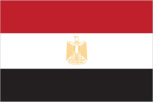
Egypt
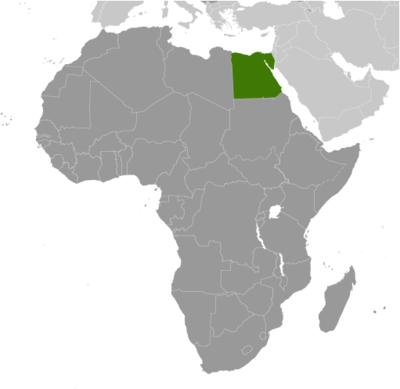
Africa · Cairo · presidential republic
What Egypt means for your money, the prices you pay, the tariffs in motion, and where U.S. policy could change both.
$2.8B
U.S. imports, 2025
+12%
change in one year
$9.4B
U.S. exports, 2025
113M
Population
$389.1B
GDP
In your house
What you buy that Egypt makes
America bought $2.8B in goods from Egypt in 2025. Of every $100 of it, here's where the money went.
Apparel, textiles, nonwool or cotton
synthetic and performance apparel
Apparel, household goods - cotton
cotton clothing and linens
Vegetables
vegetables
Iron and steel mill products
steel for cars and construction
Fruits, frozen juices
fruit and frozen juices
Chemicals-fertilizers
Rugs
rugs
Stone, sand, cement, etc.
cement, stone, sand
Nonagricultural foods, etc.
Apparel, household goods - wool
wool sweaters and coats
2026 so far (through July): $2.0B in imports. Source: U.S. Census Bureau, International Trade in Goods (customs basis).
The other direction
What America sells to Egypt
$9.4B in 2025, a trade rupture cuts both ways, for American producers as well as American prices.
Gas-natural
$3.3BSoybeans
$1.8Bmeat at the counter
Natural gas liquids
$859MFuel oil
$319MPharmaceutical preparations
$312Mmedicines and pharmacy items
Civilian aircraft, engines, equipment, and parts
$272MCoal and fuels, other
$255MOther parts and accessories of vehicles
$206Mcar parts and accessories
Corn
$171MWhere you stand
U.S. tariff posture toward Egypt
No U.S. tariff action singles this country out. Its goods face the universal 10% temporary import surcharge under Section 122 of the Trade Act (which replaced the IEEPA reciprocal baseline in February 2026) plus the sectoral Section 232 duties — steel and aluminum at 50% — that apply to all countries. The Section 122 surcharge is statutorily temporary — scheduled to lapse on or about July 23, 2026 (a 150-day cap) unless extended or replaced.
Reciprocal tariff (universal baseline)
10%
The universal 10% floor, a Section 122 import surcharge since February 2026, previously the EO 14257 reciprocal baseline, applies to nearly all U.S. imports. This country has no higher assigned rate of its own.
Policy in motion
Tariff status: a moving target
No U.S. tariff action names Egypt. These are the universal measures, applied to every country without a country-specific arrangement, that set its treatment.
2026-04-06
Section 232 metals coverage expanded
In effectThe April 2026 proclamation strengthening Section 232 actions on aluminum, steel, and copper expanded derivative-product coverage for all countries, keeping the general metals rate at 50%.
91 FR 18201 →2026-02-24
IEEPA reciprocal tariffs terminated — replaced by 10% Section 122 surcharge
In effectExecutive Order 14389 (Ending Certain Tariff Actions) terminated the IEEPA tariff duties — including the EO 14257 reciprocal baseline — effective February 24, 2026. A flat 10% Section 122 temporary import surcharge (Proclamation 11012 of February 20, 2026) replaced them, leaving the universal rate unchanged at 10% on a different statutory basis. Section 122 caps such surcharges at 150 days, so this 10% surcharge is scheduled to lapse on or about July 23, 2026 absent further action (the administration has signaled it could raise the rate toward the 15% statutory maximum).
91 FR 9437 →2025-11-13
Agricultural products exempted from reciprocal tariffs
In effectExecutive Order 14360 of November 14, 2025 removed reciprocal duties from certain agricultural products listed in its annexes (coffee, cocoa, bananas, and other goods the U.S. does not produce in sufficient quantity), retroactive to November 13, 2025 — for all countries subject to the reciprocal tariff.
90 FR 54091 →2025-06-04
Section 232 steel and aluminum duties doubled to 50%
In effectThe June 3, 2025 proclamation raised Section 232 duties on steel and aluminum articles and derivatives from 25% to 50% for all countries, effective June 4, 2025.
90 FR 24199 →2025-04-05
Universal 10% reciprocal baseline takes effect
In effectExecutive Order 14257 (signed April 2, 2025) imposed a 10% ad valorem reciprocal duty on imports from all trading partners, effective April 5, 2025. Countries without a higher Annex I rate remain at this baseline.
Federal Register · 2025-06063 →2025-03-12
Section 232 steel and aluminum duties set at 25% for all countries
In effectProclamations of February 10, 2025 terminated all country exemptions and quota arrangements and applied 25% Section 232 duties to steel and aluminum imports from every country, effective March 12, 2025.
90 FR 9817 →
Made for America
What Egypt makes for America
Egypt is a direct U.S. source of 12 essential goods Americans rely on, the items themselves, shipped finished off the line.
materials
2% of U.S.Clothing and apparel
$1.3B to the U.S.
materials
1% of U.S.Steel and iron products
$185M to the U.S.
home
4% of U.S.Rugs & carpets
$117M to the U.S.
agriculture
2% of U.S.Potash and phosphate fertilizers
$101M to the U.S.
food
2% of U.S.Frozen foods
$93M to the U.S.
food
1% of U.S.Canned and shelf-stable foods
$82M to the U.S.
materials
2% of U.S.Cement and concrete
$72M to the U.S.
food
Seafood and fish
$36M to the U.S.
agriculture
1% of U.S.Ammonia and nitrogen fertilizers
$33M to the U.S.
food
Soft drinks & juices
$29M to the U.S.
food
1% of U.S.Spices & seasonings
$25M to the U.S.
materials
Copper and electrical wiring
$20M to the U.S.
Go deeper
The supply chain view
Egypt sits upstream of 24 essential American goods through 12 tracked inputs.
manufactured
11%Steel Wire Rod (Feedstock for Wire Drawing)
manufactured
10%Bone char and granular activated carbon (GAC)
chemical
9%Cheese Salt (Food-Grade Sodium Chloride)
mineral
9%Industrial Salt / Brine (Chlor-Alkali Grade)
manufactured
7%Sporting Composites (Carbon/Glass Fiber)
manufactured
7%Cold-Heading-Quality (CHQ) Steel Wire Rod
Reference
The country itself
Africa · Geography, people, economy, and government, public-domain data from the CIA World Factbook.
The regularity and richness of the annual Nile River flood, coupled with semi-isolation provided by deserts to the east and west, allowed for the development of one of the world's great civilizations in Egypt. A unified kingdom arose circa 3200 B.C., and a series of dynasties ruled in Egypt for the next three millennia. The last native dynasty fell to the Persians in 341 B.C., who in turn were replaced by the Greeks, Romans, and Byzantines. Arab conquerors introduced Islam and the Arabic language in the 7th century and ruled for the next six centuries. The Mamluks, a local military caste, took control around 1250 and continued to govern after the Ottoman Turks conquered Egypt in 1517. Completion of the Suez Canal in 1869 elevated Egypt as an important world transportation hub. Ostensibly to protect its investments, Britain seized control of Egypt's government in 1882, but the country's nominal allegiance to the Ottoman Empire continued until 1914. Egypt gained partial independence from the UK in 1922 and full sovereignty in 1952. British forces evacuated the Suez Canal Zone in 1956. The completion of the Aswan High Dam in 1971 and the resultant Lake Nasser have reaffirmed the time-honored place of the Nile River in the agriculture and ecology of Egypt. A rapidly growing population (the largest in the Arab world), limited arable land, and dependence on the Nile all continue to overtax resources and stress society. The government has struggled to meet the demands of Egypt's fast-growing population as it implements large-scale infrastructure projects, energy cooperation, and foreign direct investment appeals. Inspired by the 2010 Tunisian revolution, Egyptian opposition groups led demonstrations and labor strikes countrywide, culminating in President Hosni MUBARAK's ouster in 2011. Egypt's military assumed national leadership until a new legislature was in place in early 2012; later that same year, Muslim Brotherhood candidate Mohamed MORSI won the presidential election. Following protests throughout the spring of 2013 against MORSI's government and the Muslim Brotherhood, the Egyptian Armed Forces intervened and removed MORSI from power in July 2013 and replaced him with interim president Adly MANSOUR. Simultaneously, the government began enacting laws to limit freedoms of assembly and expression. In 2014, voters approved a new constitution by referendum and then elected former defense minister Abdel Fattah EL-SISI president. EL-SISI was reelected to a second four-year term in 2018 and a third term in December 2023.
Geography
- Location
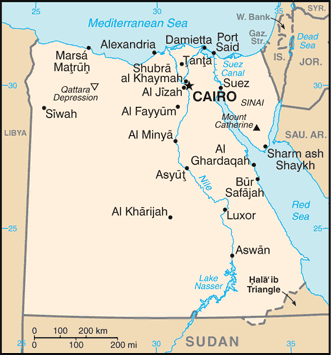
- Northern Africa, bordering the Mediterranean Sea, between Libya and the Gaza Strip, and the Red Sea north of Sudan, and includes the Asian Sinai Peninsula
- Area
- 1,001,450 sq km
- Climate
- desert; hot, dry summers with moderate winters
- Terrain
- vast desert plateau interrupted by Nile valley and delta
- Natural resources
- petroleum, natural gas, iron ore, phosphates, manganese, limestone, gypsum, talc, asbestos, lead, rare earth elements, zinc
- Coastline
- 2,450 km
- Natural hazards
- periodic droughts; frequent earthquakes; flash floods; landslides; hot, driving windstorms called khamsin occur in spring; dust storms; sandstorms
People & society
- Population
- 112,870,457 (2025 est.)
- Nationality
- Egyptian(s)
- Ethnic groups
- Egyptian 99.7%, other 0.3% (2006 est.)
- Languages
- Arabic (official); English and French widely understood by educated classes
- Religions
- Muslim (predominantly Sunni) 90%, Christian (majority Coptic Orthodox, other Christians include Armenian Apostolic, Catholic, Maronite, Orthodox, and Anglican) 10%
- Median age
- 24.6 years (2025 est.)
- Life expectancy at birth
- 75 years (2024 est.)
- Literacy
- 79.5% (2022 est.)
Economy
- Economic overview
- Africa’s second-largest economy; 2030 Vision to diversify markets and energy infrastructure; improving fiscal, external, and current accounts; underperforming private sector; poor labor force participation; expanded credit access
- Industries
- textiles, food processing, tourism, chemicals, pharmaceuticals, hydrocarbons, construction, cement, metals, light manufactures
- Agricultural products
- sugarcane, sugar beets, wheat, maize, potatoes, tomatoes, rice, milk, onions, oranges (2023)
- Exports - partners
- Saudi Arabia 10%, Turkey 9%, Italy 6%, USA 5%, UAE 5% (2023)
- Imports - partners
- China 16%, Saudi Arabia 6%, Russia 6%, USA 6%, Germany 5% (2023)
Government
- Government type
- presidential republic
- Capital
- Cairo
- Independence
- 28 February 1922 (from UK protectorate status; the military-led revolution that began on 23 July 1952 led to a republic being declared on 18 June 1953 and all British troops withdrawn on 18 June 1956)
- Constitution
- several previous; latest approved by a constitutional committee in December 2013, approved by referendum held on 14-15 January 2014, ratified by interim president on 19 January 2014
- Executive branch
- President Abdel Fattah EL-SISI (since 8 June 2014)
- Legislative branch
- bicameral
Full reference data
Every field, by section, CIA World Factbook. Open a topic to expand it.
Introduction
Travel Facts
Please visit the following links to find further information about your desired destination.
World Health Organization (WHO) - To learn what vaccines and health precautions to take while visiting your destination.
US State Dept Travel Information - Overall information about foreign travel for US citizens.
To obtain an international driving permit (IDP). Only two organizations in the US issue IDPs: American Automobile Association (AAA) and American Automobile Touring Alliance (AATA)
How to get help in an emergency? Contact the nearest US embassy or consulate, or call one of these numbers: from the US or Canada - 1-888-407-4747 or from Overseas - +1 202-501-4444
Page last updated: Tuesday, June 04, 2024