
Country exposure · JP
Japan
East N Southeast Asia · Tokyo · parliamentary constitutional monarchy
What Japan means for your money, the prices you pay, the tariffs in motion, and where U.S. policy could change both.
$145.8B
U.S. imports, 2025
-0.9%
change in one year
$81.4B
U.S. exports, 2025
123M
Population
$4.0T
GDP
In your house
What you buy that Japan makes
America bought $145.8B in goods from Japan in 2025. Of every $100 of it, here's where the money went.
Passenger cars, new and used
new and used cars
Other parts and accessories of vehicles
car parts and accessories
Industrial machines, other
Electric apparatus
Pharmaceutical preparations
medicines and pharmacy items
Excavating machinery
Generators, accessories
Engines and engine parts
Medicinal equipment
medical devices and equipment
Computer accessories
keyboards, drives, computer parts
2026 so far (through July): $84.5B in imports. Source: U.S. Census Bureau, International Trade in Goods (customs basis).
The other direction
What America sells to Japan
$81.4B in 2025, a trade rupture cuts both ways, for American producers as well as American prices.
Pharmaceutical preparations
$7.2Bmedicines and pharmacy items
Natural gas liquids
$6.3BCivilian aircraft, engines, equipment, and parts
$4.9BCorn
$3.5BMedicinal equipment
$3.5Bmedical devices and equipment
Industrial machines, other
$3.2BMeat, poultry, etc.
$3.1BCrude oil
$2.5BChemicals-other
$2.3BWhere you stand
U.S. tariff posture toward Japan
Japan's posture is governed by the July 22, 2025 framework agreement, implemented by Executive Order 14345: a 15% reciprocal rate (down from the 24% originally assigned), autos and auto parts cut to 15% from 27.5%, and a $550 billion Japanese investment pledge — but steel and aluminum left at the full 50% Section 232 rate with no metals carve-out. Because the reciprocal element was IEEPA-based, Executive Order 14389 (Ending Certain Tariff Actions) terminated it effective February 24, 2026, replacing Japan's 15% reciprocal with a 10% Section 122 temporary import surcharge (Proclamation 11012). The Section 232 auto tariff (15%) and steel/aluminum duties (50%) rest on separate authority and survive.
Reciprocal tariff (assigned, terminated)
24%
The rate this country was assigned under the EO 14257 reciprocal Annex, no longer in force. The Supreme Court struck down the IEEPA tariffs and they were terminated February 24, 2026 (EO 14389), replaced by a universal ~10% Section 122 surcharge. See the timeline below for the current effective rate.
Section 232 sectors
Autos, Steel, Wood
Steel, aluminum, autos, and similar national-security tariffs that name this country.
Policy in motion
Tariff status: a moving target
U.S. tariff policy toward Japan has changed 8 times since 2025. This page tracks it.
2026-02-24
IEEPA reciprocal tariffs terminated — replaced by 10% Section 122
In effectExecutive Order 14389 (Ending Certain Tariff Actions) terminated the IEEPA tariff duties effective February 24, 2026, replacing Japan's 15% reciprocal rate with a 10% Section 122 temporary import surcharge (Proclamation 11012). Japan's Section 232 auto tariff (15%) and steel/aluminum duties (50%) rest on separate authority and remain in force.
91 FR 9437 →2025-09-16
EO 14345 implements the agreement — autos cut to 15%
In effectExecutive Order 14345 implemented the tariff elements of the U.S.-Japan agreement: autos and auto parts were lowered to a combined 15% (from 27.5%), and a reciprocal stacking rule tops imports up to 15% where the MFN rate is lower. HTS changes took effect September 16, 2025.
Federal Register · 2025-17389 →2025-08-07
15% reciprocal rate takes effect for Japan
In effectExecutive Order 14326 set the post-pause Annex I reciprocal rates; Japan's rate was set at 15% effective for goods entered on or after August 7, 2025, replacing the suspended 24%/10% structure.
90 FR 37963 →2025-07-22
U.S.-Japan framework agreement announced
AgreementThe U.S. and Japan announced a framework trade agreement setting a 15% reciprocal tariff on most Japanese goods and cutting the auto and auto-parts tariff to 15%, paired with a Japanese pledge to invest $550 billion in the United States.
Source ↗2025-06-04
Section 232 steel and aluminum doubled to 50%
In effectA program-wide proclamation raised the Section 232 steel and aluminum tariff to 50% for all countries except the UK. Japan received no carve-out, so its metals rate moved from 25% to 50%.
Federal Register · 2025-10524 →2025-04-10
Elevated reciprocal rates paused to 10% for 90 days
In effectExecutive Order 14266 suspended the higher country-specific reciprocal rates — including Japan's 24% — back to the 10% baseline for 90 days to allow negotiations, while raising the rate on China.
90 FR 15625 →2025-04-05
Reciprocal tariff regime begins — Japan assigned 24%
In effectExecutive Order 14257 imposed a 10% universal reciprocal duty effective April 5 and a higher country-specific rate of 24% for Japan scheduled to take effect April 9 under Annex I.
90 FR 15041 →2025-03-12
Section 232 steel and aluminum tariffs reimposed on Japan at 25%
In effectProclamations terminated Japan's prior alternative steel arrangement (Proclamation 10356) and subjected Japanese steel, aluminum, and their derivatives to the 25% Section 232 tariff applied to most countries.
Federal Register · 2025-02833 →
Made for America
What Japan makes for America
Japan is a direct U.S. source of 12 essential goods Americans rely on, the items themselves, shipped finished off the line.
materials
17% of U.S.Vehicles and light trucks
$36.3B to the U.S.
materials
6% of U.S.Auto parts and repairs
$7.7B to the U.S.
health
6% of U.S.Cancer and specialty drugs
$4.6B to the U.S.
digital
13% of U.S.Lithium-ion batteries
$2.5B to the U.S.
health
3% of U.S.OTC medicines
$2.1B to the U.S.
materials
8% of U.S.Tires
$1.6B to the U.S.
logistics
21% of U.S.Port and crane equipment
$1.6B to the U.S.
materials
5% of U.S.Steel and iron products
$1.2B to the U.S.
materials
5% of U.S.Plumbing pipes and fittings
$990M to the U.S.
digital
3% of U.S.Semiconductors and chips
$984M to the U.S.
health
5% of U.S.Surgical and sterile supplies
$908M to the U.S.
materials
37% of U.S.Motorcycles & scooters
$862M to the U.S.
Go deeper
The supply chain view
Japan sits upstream of 24 essential American goods through 12 tracked inputs.
manufactured
100%PMMA Hollow Fiber Dialyzer Membrane (Adsorptive)
manufactured
97%EUV Photomask Blanks
chemical
95%PBO / Zylon Fiber (Poly-p-phenylene benzobisoxazole)
manufactured
95%Cellulose Triacetate (CTA) Hollow Fiber Membrane
chemical
88%EUV/ArF Semiconductor Photoresists
chemical
86%Specialty Semiconductor Process Chemicals
Reference
The country itself
East N Southeast Asia · Geography, people, economy, and government, public-domain data from the CIA World Factbook.
In 1603, after decades of civil warfare, the Tokugawa shogunate (a military-led, dynastic government) ushered in a long period of relative political stability and isolation from foreign influence. For more than two centuries, this policy enabled Japan to enjoy a flowering of its indigenous culture. Japan opened its ports after signing the Treaty of Kanagawa with the US in 1854 and began to intensively modernize and industrialize. During the late 19th and early 20th centuries, Japan became a regional power that was able to defeat the forces of both China and Russia. It occupied Korea, Formosa (Taiwan), and southern Sakhalin Island. In 1931-32, Japan occupied Manchuria, and in 1937, it launched a full-scale invasion of China. Japan attacked US forces at Pearl Harbor, Hawaii, in 1941, triggering America's entry into World War II, and Japan soon occupied much of East and Southeast Asia. After its defeat in World War II, the country recovered to become an economic power and a US ally. While the emperor retains his throne as a symbol of national unity, elected politicians hold the decision-making power. After three decades of unprecedented growth, Japan's economy experienced a major slowdown starting in the 1990s, but the country remains an economic power. In 2011, Japan's strongest-ever earthquake and an accompanying tsunami devastated the northeast part of Honshu, killed thousands, and damaged several nuclear power plants. ABE Shinzo was reelected as prime minister in 2012, and he embarked on ambitious economic and security reforms to improve Japan's economy and bolster the country's international standing. In 2019, ABE became Japan's longest-serving post-war prime minister; he resigned in 2020 and was succeeded by SUGA Yoshihide. KISHIDA Fumio became prime minister in 2021.
Geography
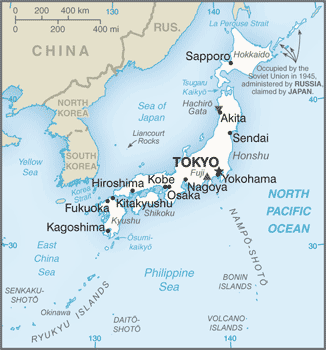
- Location
- Eastern Asia, island chain between the North Pacific Ocean and the Sea of Japan, east of the Korean Peninsula
- Area
- 377,915 sq km
- Climate
- varies from tropical in south to cool temperate in north
- Terrain
- mostly rugged and mountainous
- Natural resources
- negligible mineral resources, fish
- Coastline
- 29,751 km
- Natural hazards
- many dormant and some active volcanoes; about 1,500 seismic occurrences (mostly tremors but occasional severe earthquakes) every year; tsunamis; typhoons volcanism: both Unzen (1,500 m) and Sakura-jima (1,117 m), which lies near the densely populated city of Kagoshima, have been deemed Decade Volcanoes by the International Association of Volcanology and Chemistry of the Earth's Interior, worthy of study due to their explosive history and close proximity to human populations; other notable historically active volcanoes include Asama (Honshu Island's most active volcano), Aso, Bandai, Fuji, Iwo-Jima, Kikai, Kirishima, Komaga-take, Oshima, Suwanosejima, Tokachi, Yake-dake, and Usu; see note 2 under "Geography - note"
People & society
- Population
- 123,201,945 (2024 est.)
- Nationality
- Japanese (singular and plural)
- Ethnic groups
- Japanese 97.5%, Chinese 0.6%, Vietnam 0.4%, South Korean 0.3%, other 1.2% (includes Filipino, Brazilian, Nepalese, Indonesian, American, and Taiwanese) (2022 est.)
- Languages
- Japanese
- Religions
- Shintoism 48.6%, Buddhism 46.4%, Christianity 1.1%, other 4% (2021 est.)
- Median age
- 50.2 years (2025 est.)
- Life expectancy at birth
- 85.2 years (2024 est.)
Economy
- Economic overview
- second-largest East Asian economy; trade-oriented and highly diversified; high public debt levels; following years of near-zero interest rates, gradual increases to address inflation and depreciation of yen; strong rebound in tourism; aging population poses challenges to labor force participation
- Industries
- motor vehicles, electronic equipment, machine tools, steel and nonferrous metals, ships, chemicals, textiles, processed foods
- Agricultural products
- rice, milk, sugar beets, vegetables, eggs, chicken, potatoes, onions, cabbages, pork (2023)
- Exports - partners
- USA 19%, China 18%, Taiwan 6%, S. Korea 6%, Hong Kong 4% (2023)
- Imports - partners
- China 22%, USA 11%, Australia 8%, UAE 5%, Saudi Arabia 5% (2023)
Government
- Government type
- parliamentary constitutional monarchy
- Capital
- Tokyo
- Independence
- 3 May 1947 (current constitution adopted as amendment to Meiji Constitution); notable earlier dates: 11 February 660 B.C. (mythological date of Emperor JIMMU founding the nation); 29 November 1890 (Meiji Constitution provides for constitutional monarchy)
- Constitution
- previous 1890; latest approved 6 October 1946, adopted 3 November 1946, effective 3 May 1947
- Executive branch
- Emperor NARUHITO (since 1 May 2019)
- Legislative branch
- National Diet (Kokkai)
Full reference data
Every field, by section, CIA World Factbook. Open a topic to expand it.
Introduction
Travel Facts
Please visit the following links to find further information about your desired destination.
World Health Organization (WHO) - To learn what vaccines and health precautions to take while visiting your destination.
US State Dept Travel Information - Overall information about foreign travel for US citizens.
To obtain an international driving permit (IDP). Only two organizations in the US issue IDPs: American Automobile Association (AAA) and American Automobile Touring Alliance (AATA)
How to get help in an emergency? Contact the nearest US embassy or consulate, or call one of these numbers: from the US or Canada - 1-888-407-4747 or from Overseas - +1 202-501-4444
Page last updated: Wednesday, October 19, 2022