
Country exposure · KR
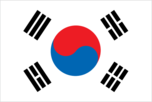
South Korea (Republic of Korea)
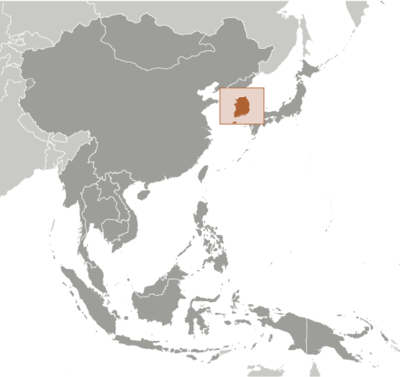
East N Southeast Asia · Seoul · presidential republic
What South Korea (Republic of Korea) means for your money, the prices you pay, the tariffs in motion, and where U.S. policy could change both.
$125.5B
U.S. imports, 2025
-4.5%
change in one year
$69.1B
U.S. exports, 2025
51M
Population
$1.7T
GDP
In your house
What you buy that South Korea (Republic of Korea) makes
America bought $125.5B in goods from South Korea (Republic of Korea) in 2025. Of every $100 of it, here's where the money went.
Passenger cars, new and used
new and used cars
Computer accessories
keyboards, drives, computer parts
Other parts and accessories of vehicles
car parts and accessories
Electric apparatus
Semiconductors
semiconductors and chips
Pharmaceutical preparations
medicines and pharmacy items
Petroleum products, other
gasoline and petroleum products
Industrial machines, other
Generators, accessories
Household appliances
household appliances
2026 so far (through July): $94.9B in imports. Source: U.S. Census Bureau, International Trade in Goods (customs basis).
The other direction
What America sells to South Korea (Republic of Korea)
$69.1B in 2025, a trade rupture cuts both ways, for American producers as well as American prices.
Crude oil
$12.4BIndustrial machines, other
$5.5BCivilian aircraft, engines, equipment, and parts
$3.8BMeat, poultry, etc.
$3.0BNatural gas liquids
$2.5BSemiconductors
$2.1Bsemiconductors and chips
Passenger cars, new and used
$2.1Bnew and used cars
Measuring, testing, control instruments
$1.9BCorn
$1.9BWhere you stand
U.S. tariff posture toward South Korea (Republic of Korea)
South Korea's posture is set by the Korea Strategic Trade and Investment deal (reaffirmed October 29, 2025): a 15% reciprocal rate on most goods (down from 25%), Section 232 autos and timber/wood cut from 25% to 15%, and a $350 billion investment commitment — but steel and aluminum left at the full 50% Section 232 rate. Because the reciprocal element was IEEPA-based, Executive Order 14389 (Ending Certain Tariff Actions) terminated it effective February 24, 2026, replacing Korea's 15% reciprocal with a 10% Section 122 temporary import surcharge (Proclamation 11012). The Section 232 auto/wood (15%) and steel/aluminum (50%) duties rest on separate authority and survive.
Reciprocal tariff (assigned, terminated)
25%
The rate this country was assigned under the EO 14257 reciprocal Annex, no longer in force. The Supreme Court struck down the IEEPA tariffs and they were terminated February 24, 2026 (EO 14389), replaced by a universal ~10% Section 122 surcharge. See the timeline below for the current effective rate.
Section 232 sectors
Autos, Wood
Steel, aluminum, autos, and similar national-security tariffs that name this country.
Policy in motion
Tariff status: a moving target
U.S. tariff policy toward South Korea (Republic of Korea) has changed 8 times since 2025. This page tracks it.
2026-02-24
IEEPA reciprocal tariffs terminated — replaced by 10% Section 122
In effectExecutive Order 14389 (Ending Certain Tariff Actions) terminated the IEEPA tariff duties effective February 24, 2026, replacing Korea's 15% reciprocal rate with a 10% Section 122 temporary import surcharge (Proclamation 11012). Korea's Section 232 auto and timber tariffs (15%) and steel/aluminum duties (50%) rest on separate authority and remain in force.
91 FR 9437 →2025-11-14
15% reciprocal rate takes effect for Korea
In effectThe country-specific reciprocal tariff on Korean goods was set at the higher of the KORUS FTA/MFN rate or 15%, retroactively effective November 14, 2025 — replacing the 25% assigned in April.
Federal Register · 2025-21940 →2025-11-01
Section 232 autos, parts, and timber/wood cut to 15%
In effectImplementing the deal under the EO 14346 framework procedures, Section 232 tariffs on Korean automobiles, auto parts, timber, lumber, and wood derivatives were reduced from 25% to 15%, retroactively effective November 1, 2025.
Federal Register · 2025-21940 →2025-10-29
Korea Strategic Trade and Investment deal reaffirmed
AgreementDuring President Trump's visit to Seoul, the U.S. and Korea reaffirmed a trade framework setting a 15% reciprocal tariff (the higher of KORUS/MFN or 15%) and cutting Section 232 auto and wood tariffs to 15%, paired with a $350 billion Korean investment commitment. A joint fact sheet followed on November 13.
Source ↗2025-06-04
Section 232 steel and aluminum doubled to 50%
In effectA program-wide proclamation raised the Section 232 steel and aluminum tariff to 50% for all countries except the UK. Korea received no carve-out, so its metals rate moved from 25% to 50%.
Federal Register · 2025-10524 →2025-04-10
Elevated reciprocal rates paused to 10% for 90 days
In effectExecutive Order 14266 suspended the higher country-specific reciprocal rates — including Korea's 25% — back to the 10% baseline for 90 days to allow negotiations, while raising the rate on China.
90 FR 15625 →2025-04-05
Reciprocal tariff regime begins — Korea assigned 25%
In effectExecutive Order 14257 imposed a 10% universal reciprocal duty effective April 5 and a higher country-specific rate of 25% for South Korea scheduled to take effect April 9 under Annex I.
90 FR 15041 →2025-03-12
Section 232 steel and aluminum tariffs reimposed — Korea quota terminated
In effectA proclamation terminated South Korea's longstanding steel quota arrangement (Proclamation 9740) and subjected Korean steel, aluminum, and their derivatives to the 25% Section 232 tariff applied to most countries.
Federal Register · 2025-02833 →
Made for America
What South Korea (Republic of Korea) makes for America
South Korea (Republic of Korea) is a direct U.S. source of 12 essential goods Americans rely on, the items themselves, shipped finished off the line.
materials
15% of U.S.Vehicles and light trucks
$30.8B to the U.S.
materials
7% of U.S.Auto parts and repairs
$8.4B to the U.S.
materials
9% of U.S.Steel and iron products
$2.5B to the U.S.
energy
70% of U.S.Jet fuel
$2.5B to the U.S.
digital
12% of U.S.Lithium-ion batteries
$2.3B to the U.S.
health
3% of U.S.Cancer and specialty drugs
$2.1B to the U.S.
home
25% of U.S.Cosmetics & makeup
$1.8B to the U.S.
materials
18% of U.S.Electric grid transformers
$1.7B to the U.S.
materials
15% of U.S.Home appliances
$1.7B to the U.S.
materials
6% of U.S.Copper and electrical wiring
$1.2B to the U.S.
energy
6% of U.S.Gasoline and diesel
$1.2B to the U.S.
materials
10% of U.S.Aluminum and aluminum products
$1.1B to the U.S.
Go deeper
The supply chain view
South Korea (Republic of Korea) sits upstream of 24 essential American goods through 12 tracked inputs.
manufactured
80%High-Bandwidth Memory (HBM3/HBM3E)
manufactured
79%HBM (High Bandwidth Memory) Stack
manufactured
75%GDDR Graphics Memory
manufactured
72%DDR5 DRAM Server Memory
manufactured
70%DRAM Memory Modules (LPDDR5/DDR5)
manufactured
70%OLED / AMOLED Display Panel
Reference
The country itself
East N Southeast Asia · Geography, people, economy, and government, public-domain data from the CIA World Factbook.
The first recorded kingdom (Choson) on the Korean Peninsula dates from approximately 2300 B.C. Over the subsequent centuries, three main kingdoms -- Kogoryo, Baekche, and Silla -- were established on the Peninsula. By the 5th century A.D., Kogoryo emerged as the most powerful, with control over much of the Peninsula and part of Manchuria (modern-day northeast China). However, Silla allied with the Chinese to create the first unified Korean state in 688. Following the collapse of Silla in the 9th century, Korea was unified under the Koryo (Goryeo; 918-1392) and the Chosen (Joseon; 1392-1910) dynasties. Korea became the object of intense imperialistic rivalry among the Chinese (its traditional benefactor), Japanese, and Russian empires in the latter half of the 19th and early 20th centuries. After the Sino-Japanese War (1894-95) and the Russo-Japanese War (1904-1905), Korea was occupied by Imperial Japan. In 1910, Japan formally annexed the entire Peninsula. Korea regained its independence after Japan's surrender to the US and its allies in 1945. A US-supported democratic government (Republic of Korea, ROK) was set up in the southern half of the Korean Peninsula, while a communist-style government backed by the Soviet Union was installed in the north (North Korea; aka Democratic People's Republic of Korea, DPRK). During the Korean War (1950-53), US troops and UN forces fought alongside ROK soldiers to defend South Korea from a North Korean invasion supported by communist China and the Soviet Union. After the 1953 armistice, the two Koreas were separated by a demilitarized zone. Syngman RHEE led the country as its first president from 1948 to 1960. PARK Chung-hee took over leadership of the country in a 1961 coup. During his controversial rule (1961-79), South Korea achieved rapid economic growth, with per capita income rising to roughly 17 times the level of North Korea by 1979. PARK was assassinated in 1979, and subsequent years were marked by political turmoil and continued military rule as the country's pro-democracy movement grew. South Korea held its first free presidential election under a revised democratic constitution in 1987, with former South Korean Army general ROH Tae-woo winning a close race. In 1993, KIM Young-sam became the first civilian president of South Korea's new democratic era. President KIM Dae-jung (1998-2003) won the Nobel Peace Prize in 2000 for his contributions to South Korean democracy and his "Sunshine Policy" of engagement with North Korea. President PARK Geun-hye, daughter of former South Korean President PARK Chung-hee, took office in 2013 as South Korea's first female leader. In 2016, the National Assembly passed an impeachment motion against PARK over her alleged involvement in a corruption and influence-peddling scandal, triggering an early presidential election in 2017 won by MOON Jae-in. In 2022, longtime prosecutor and political newcomer YOON Suk Yeol won the presidency by the slimmest margin in South Korean history. Discord and tensions with North Korea, punctuated by North Korean military provocations, missile launches, and nuclear tests, have permeated inter-Korean relations for years. Relations remained strained, despite a period of respite in 2018-2019 ushered in by North Korea's participation in the 2018 Winter Olympic and Paralympic Games in South Korea and high-level diplomatic meetings, including historic US-North Korea summits. In 2024, Pyongyang announced it was ending all economic cooperation with South Korea, a move that followed earlier proclamations that it was scrapping a 2018 military pact to de-escalate tensions along their militarized border, abandoning the country’s decades-long pursuit of peaceful unification with South Korea, and designating the South as North Korea’s “principal enemy.”
Geography
- Location
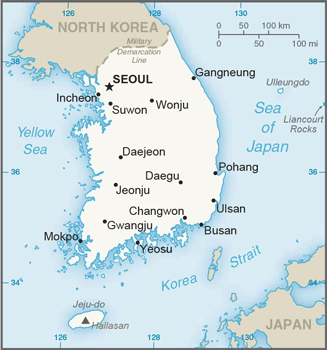
- Eastern Asia, southern half of the Korean Peninsula bordering the Sea of Japan and the Yellow Sea
- Area
- 99,720 sq km
- Climate
- temperate, with rainfall heavier in summer than winter; cold winters
- Terrain
- mostly hills and mountains; wide coastal plains in west and south
- Natural resources
- coal, tungsten, graphite, molybdenum, lead, hydropower potential
- Coastline
- 2,413 km
- Natural hazards
- occasional typhoons bring high winds and floods; low-level seismic activity common in southwest volcanism: Halla (1,950 m) is considered historically active; it has not erupted in many centuries
People & society
- Population
- 51,486,343 (2025 est.)
- Nationality
- Korean(s)
- Ethnic groups
- Korean
- Languages
- Korean, English
- Religions
- Protestant 17%, Buddhist 16%, Catholic 6%, none 60% (2021 est.)
- Median age
- 47 years (2025 est.)
- Life expectancy at birth
- 83.4 years (2024 est.)
- Literacy
- NA
Economy
- Economic overview
- high-income, export- and technology-oriented East Asian economy; manufacturing led by semiconductor and automotive industries; slow growth amid declining construction investment, export risks, and recent political instability; aging workforce; increased restraint in fiscal policy while maintaining industry support initiatives
- Industries
- electronics, telecommunications, automobile production, chemicals, shipbuilding, steel
- Agricultural products
- rice, vegetables, cabbages, milk, onions, pork, chicken, eggs, tangerines/mandarins, potatoes (2023)
- Exports - partners
- China 25%, USA 18%, Hong Kong 4%, Japan 4%, Taiwan 4% (2023)
- Imports - partners
- China 31%, USA 13%, Japan 9%, Germany 5%, Australia 4% (2023)
Government
- Government type
- presidential republic
- Capital
- Seoul
- Independence
- 15 August 1945 (from Japan)
- Constitution
- several previous; latest passed by National Assembly 12 October 1987, approved in referendum 28 October 1987, effective 25 February 1988
- Executive branch
- President LEE Jae-myung (since 4 June 2025)
- Legislative branch
- National Assembly (Kuk Hoe)
Full reference data
Every field, by section, CIA World Factbook. Open a topic to expand it.
Introduction
Travel Facts
Please visit the following links to find further information about your desired destination.
World Health Organization (WHO) - To learn what vaccines and health precautions to take while visiting your destination.
US State Dept Travel Information - Overall information about foreign travel for US citizens.
To obtain an international driving permit (IDP). Only two organizations in the US issue IDPs: American Automobile Association (AAA) and American Automobile Touring Alliance (AATA)
How to get help in an emergency? Contact the nearest US embassy or consulate, or call one of these numbers: from the US or Canada - 1-888-407-4747 or from Overseas - +1 202-501-4444
Page last updated: Wednesday, May 03, 2023